

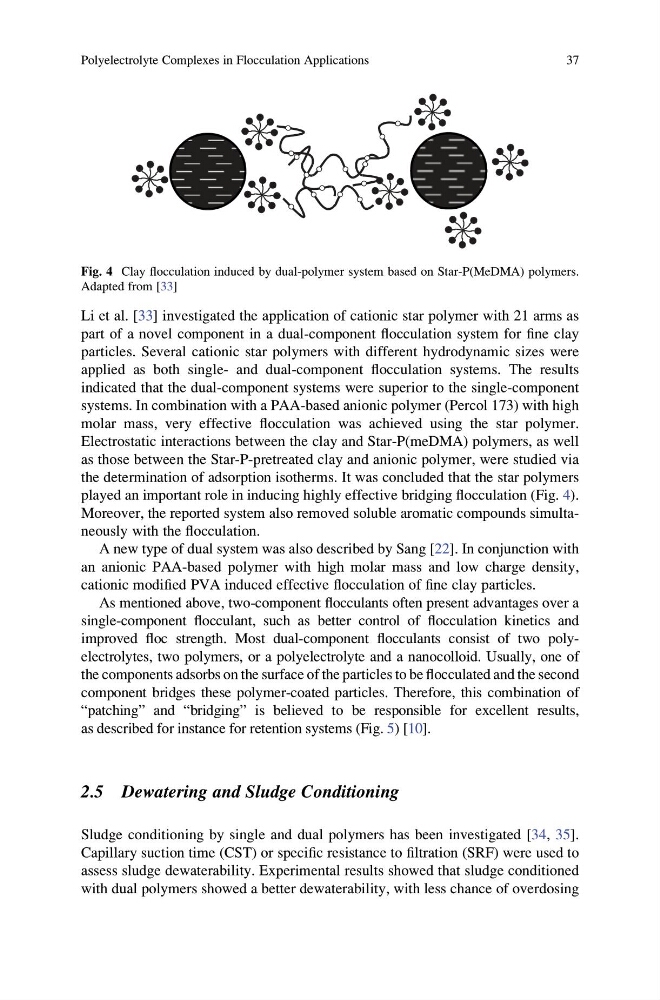
Li et al. [33] investigated the application of cationic star polymer with 21 arms as
part of a novel component in a dual-component flocculation system for fine clay
particles. Several cationic star polymers with different hydrodynamic sizes were
applied as both single- and dual-component flocculation systems. The results
indicated that the dual-component systems were superior to the single-component
systems. In combination with a PAA-based anionic polymer (Percol 173) with high
molar mass, very effective flocculation was achieved using the star polymer.
Electrostatic interactions between the clay and Star-P(meDMA) polymers, as well
as those between the Star-P-pretreated clay and anionic polymer, were studied via
the determination of adsorption isotherms. It was concluded that the star polymers
played an important role in inducing highly effective bridging flocculation (Fig. 4).
Moreover, the reported system also removed soluble aromatic compounds simultaneously with the flocculation.
A new type of dual system was also described by Sang [22]. In conjunction with
an anionic PAA-based polymer with high molar mass and low charge density,
cationic modified PVA induced effective flocculation of fine clay particles.
As mentioned above, two-component flocculants often present advantages over a
single-component flocculant, such as better control of flocculation kinetics and
improved floc strength. Most dual-component flocculants consist of two polyelectrolytes, two polymers, or a polyelectrolyte and a nanocolloid. Usually, one of
the components adsorbs on the surface of the particles to be flocculated and the second
component bridges these polymer-coated particles. Therefore, this combination of
“patching” and “bridging” is believed to be responsible for excellent results,
as described for instance for retention systems (Fig. 5) [10].
2.5 Dewatering and Sludge Conditioning
Sludge conditioning by single and dual polymers has been investigated [34, 35].
Capillary suction time (CST) or specific resistance to filtration (SRF) were used to
assess sludge dewaterability. Experimental results showed that sludge conditioned
with dual polymers showed a better dewaterability, with less chance of overdosing
Fig. 4 Clay flocculation induced by dual-polymer system based on Star-P(MeDMA) polymers.
Adapted from [33]
Polyelectrolyte Complexes in Flocculation Applications
37
part of a novel component in a dual-component flocculation system for fine clay
particles. Several cationic star polymers with different hydrodynamic sizes were
applied as both single- and dual-component flocculation systems. The results
indicated that the dual-component systems were superior to the single-component
systems. In combination with a PAA-based anionic polymer (Percol 173) with high
molar mass, very effective flocculation was achieved using the star polymer.
Electrostatic interactions between the clay and Star-P(meDMA) polymers, as well
as those between the Star-P-pretreated clay and anionic polymer, were studied via
the determination of adsorption isotherms. It was concluded that the star polymers
played an important role in inducing highly effective bridging flocculation (Fig. 4).
Moreover, the reported system also removed soluble aromatic compounds simultaneously with the flocculation.
A new type of dual system was also described by Sang [22]. In conjunction with
an anionic PAA-based polymer with high molar mass and low charge density,
cationic modified PVA induced effective flocculation of fine clay particles.
As mentioned above, two-component flocculants often present advantages over a
single-component flocculant, such as better control of flocculation kinetics and
improved floc strength. Most dual-component flocculants consist of two polyelectrolytes, two polymers, or a polyelectrolyte and a nanocolloid. Usually, one of
the components adsorbs on the surface of the particles to be flocculated and the second
component bridges these polymer-coated particles. Therefore, this combination of
“patching” and “bridging” is believed to be responsible for excellent results,
as described for instance for retention systems (Fig. 5) [10].
2.5 Dewatering and Sludge Conditioning
Sludge conditioning by single and dual polymers has been investigated [34, 35].
Capillary suction time (CST) or specific resistance to filtration (SRF) were used to
assess sludge dewaterability. Experimental results showed that sludge conditioned
with dual polymers showed a better dewaterability, with less chance of overdosing
Fig. 4 Clay flocculation induced by dual-polymer system based on Star-P(MeDMA) polymers.
Adapted from [33]
Polyelectrolyte Complexes in Flocculation Applications
37