

hindered settling function of positively charged alumina suspensions, as measured by a
filtration technique.
The removal of various heavy metal ions such as Cu
2+
, Co
2+
, Zn
2+
, Ni
2+
, and Pb
2+
from aqueous solutions was conducted [29]. Heavy metal binding with a phosphonomethylated derivative of PEI (PPEI) was initially allowed to occur and then, upon
equilibration, PEI was added to initiate precipitation of the PEC together with the
heavy metal ion. The PPEI–PEI system was found effective for heavy metal scavenging purposes, even in the presence of high concentrations of non-transition metal
ions like Na
+
. The PPEI–PEI PEC was found to be more effective than traditional
precipitation methods; however, the result was not obtained by the application of premixed complexes, but by a step-by-step addition of PPEI and PEI (similar to other
dual systems described here).
Gohlke described the separation of heavy metal ions with a PEC comprising a
polycation and a polyphosphone compound [30].
Another field of an advanced separation is the flocculation and efficient dewatering
of ultrfine coal (>150 μm) with a polymer blend (unmodified and sonicated flocculant)
as dual system [31]. The authors proved that ultrasonic conditioning may be an
effective alternative for a dual system in which two different flocculants are used.
2.4 Dual Systems Using “New Polymers”
In contrast to studies where most advantageous results were obtained by an optimization of the polymer amount and properties (molar mass, charge density) [20, 21],
other groups have been trying to improve the results by the application of “new”
polyelectrolytes. Water-soluble starch derivatives with a high degree of substitution
up to 1 (containing quaternary ammonium groups) were used in combination with a
high molar mass PAA for the flocculation of harbor sediment suspensions [32].
0,0
0,5
1,0
1,5
2,0
0,0
0,5
1,0
1,5
2,0
2,5
3,0
3,5
50 mg/l HA-Mono (PDADMAC)
25 mg/l HA-Mono (PDADMAC)
50 mg/l HA-Dual
25 mg/l HA-Dual
Absorption (500 nm)
Total amount of polycation+polyanion (mg/g)
1
2
3
4
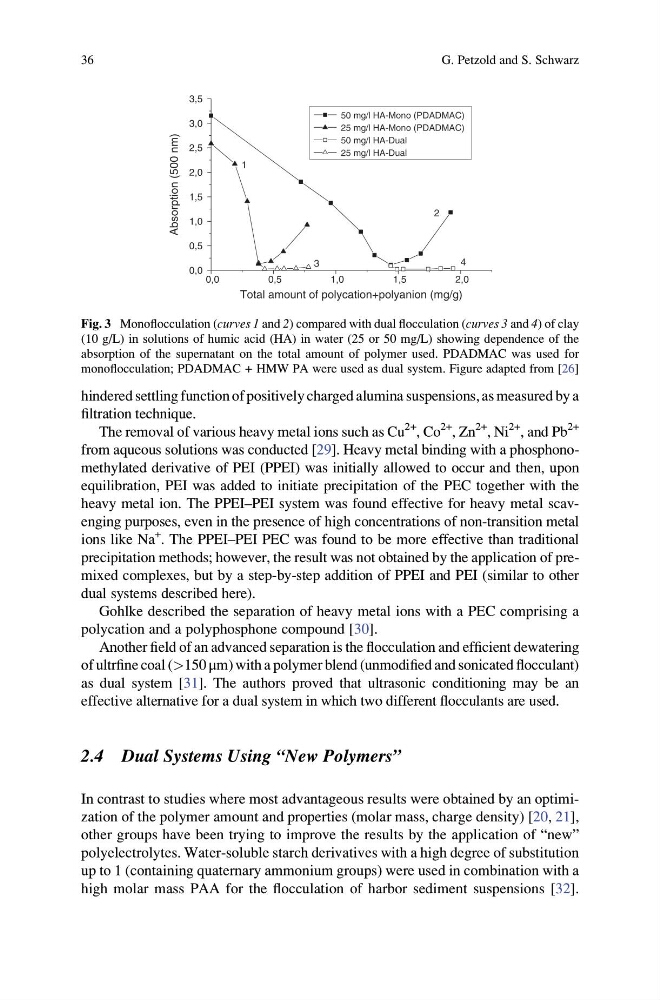
Fig. 3 Monoflocculation (curves 1 and 2) compared with dual flocculation (curves 3 and 4) of clay
(10 g/L) in solutions of humic acid (HA) in water (25 or 50 mg/L) showing dependence of the
absorption of the supernatant on the total amount of polymer used. PDADMAC was used for
monoflocculation; PDADMAC + HMW PA were used as dual system. Figure adapted from [26]
36
G. Petzold and S. Schwarz
filtration technique.
The removal of various heavy metal ions such as Cu
2+
, Co
2+
, Zn
2+
, Ni
2+
, and Pb
2+
from aqueous solutions was conducted [29]. Heavy metal binding with a phosphonomethylated derivative of PEI (PPEI) was initially allowed to occur and then, upon
equilibration, PEI was added to initiate precipitation of the PEC together with the
heavy metal ion. The PPEI–PEI system was found effective for heavy metal scavenging purposes, even in the presence of high concentrations of non-transition metal
ions like Na
+
. The PPEI–PEI PEC was found to be more effective than traditional
precipitation methods; however, the result was not obtained by the application of premixed complexes, but by a step-by-step addition of PPEI and PEI (similar to other
dual systems described here).
Gohlke described the separation of heavy metal ions with a PEC comprising a
polycation and a polyphosphone compound [30].
Another field of an advanced separation is the flocculation and efficient dewatering
of ultrfine coal (>150 μm) with a polymer blend (unmodified and sonicated flocculant)
as dual system [31]. The authors proved that ultrasonic conditioning may be an
effective alternative for a dual system in which two different flocculants are used.
2.4 Dual Systems Using “New Polymers”
In contrast to studies where most advantageous results were obtained by an optimization of the polymer amount and properties (molar mass, charge density) [20, 21],
other groups have been trying to improve the results by the application of “new”
polyelectrolytes. Water-soluble starch derivatives with a high degree of substitution
up to 1 (containing quaternary ammonium groups) were used in combination with a
high molar mass PAA for the flocculation of harbor sediment suspensions [32].
0,0
0,5
1,0
1,5
2,0
0,0
0,5
1,0
1,5
2,0
2,5
3,0
3,5
50 mg/l HA-Mono (PDADMAC)
25 mg/l HA-Mono (PDADMAC)
50 mg/l HA-Dual
25 mg/l HA-Dual
Absorption (500 nm)
Total amount of polycation+polyanion (mg/g)
1
2
3
4
Fig. 3 Monoflocculation (curves 1 and 2) compared with dual flocculation (curves 3 and 4) of clay
(10 g/L) in solutions of humic acid (HA) in water (25 or 50 mg/L) showing dependence of the
absorption of the supernatant on the total amount of polymer used. PDADMAC was used for
monoflocculation; PDADMAC + HMW PA were used as dual system. Figure adapted from [26]
36
G. Petzold and S. Schwarz