

of the system to be flocculated, the optimum PC concentration is higher compared
with clay in water. PCs with high charge density are efficient at removing humic acid
owing to complex formation and precipitation. It was shown that the complexes
formed by the highly charged PDADMAC and the weak PA humic acid are also able
to collect fine particles. Most effective removal of humic acid was obtained by a
combination of the highly charged PC and small amounts of a high molar mass PA
(dual system). In this case, a broad flocculation window (Fig. 3) was obtained
because of the bridging mechanism, as well as larger flocs than obtained with
monoflocculation [26].
2.3 Removal of Minerals or Heavy Metals
Dual systems were also used for the flocculation of mineral suspensions [27, 28] or for
the precipitation of heavy metals such as Cu
2+
, Co
2+
, Zn
2+
, Ni
2+
, and Pb
2+ [29, 30].
Glover [27] investigated the effect of a dual system on the compressive yield stress and
0
1
2
3
4
5
6
250
300
350
400
450
500
550
600
650
Drainage Volume
VSR
[ml]
Amount of PDADMAC [mg/g]
low TC
high TC
0
1
2
3
4
5
6
-40
-30
-20
-10
0
10
20
30
40
50
60
70
Net charge [µmol/l]
Amount of PDADMAC [mg/g]
low TC
high TC
a
b
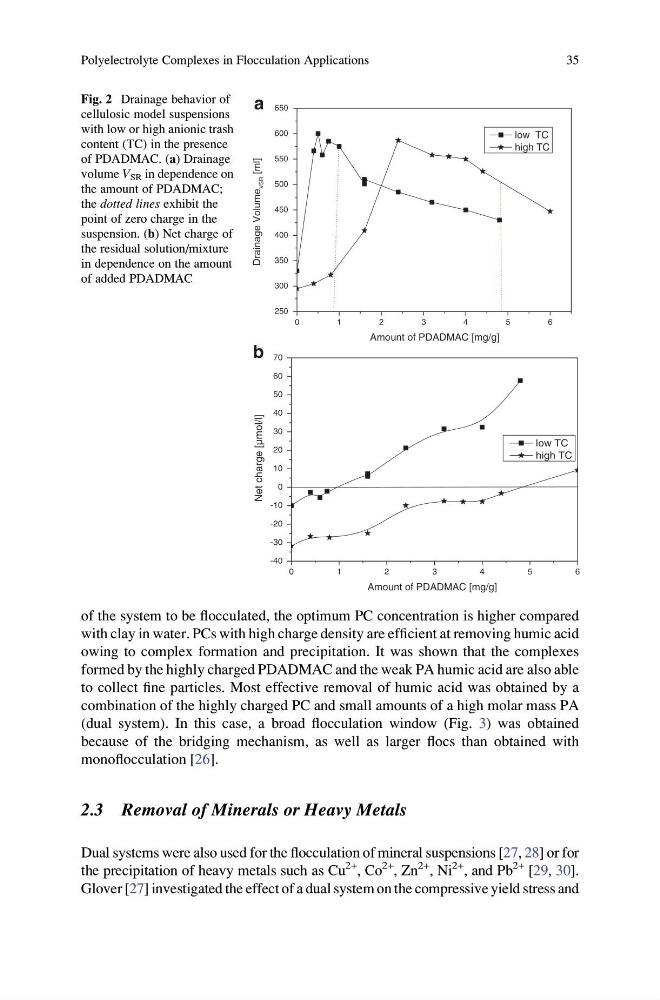
Fig. 2 Drainage behavior of
cellulosic model suspensions
with low or high anionic trash
content (TC) in the presence
of PDADMAC. (a) Drainage
volume V SR in dependence on
the amount of PDADMAC;
the dotted lines exhibit the
point of zero charge in the
suspension. (b) Net charge of
the residual solution/mixture
in dependence on the amount
of added PDADMAC
Polyelectrolyte Complexes in Flocculation Applications
35
with clay in water. PCs with high charge density are efficient at removing humic acid
owing to complex formation and precipitation. It was shown that the complexes
formed by the highly charged PDADMAC and the weak PA humic acid are also able
to collect fine particles. Most effective removal of humic acid was obtained by a
combination of the highly charged PC and small amounts of a high molar mass PA
(dual system). In this case, a broad flocculation window (Fig. 3) was obtained
because of the bridging mechanism, as well as larger flocs than obtained with
monoflocculation [26].
2.3 Removal of Minerals or Heavy Metals
Dual systems were also used for the flocculation of mineral suspensions [27, 28] or for
the precipitation of heavy metals such as Cu
2+
, Co
2+
, Zn
2+
, Ni
2+
, and Pb
2+ [29, 30].
Glover [27] investigated the effect of a dual system on the compressive yield stress and
0
1
2
3
4
5
6
250
300
350
400
450
500
550
600
650
Drainage Volume
VSR
[ml]
Amount of PDADMAC [mg/g]
low TC
high TC
0
1
2
3
4
5
6
-40
-30
-20
-10
0
10
20
30
40
50
60
70
Net charge [µmol/l]
Amount of PDADMAC [mg/g]
low TC
high TC
a
b
Fig. 2 Drainage behavior of
cellulosic model suspensions
with low or high anionic trash
content (TC) in the presence
of PDADMAC. (a) Drainage
volume V SR in dependence on
the amount of PDADMAC;
the dotted lines exhibit the
point of zero charge in the
suspension. (b) Net charge of
the residual solution/mixture
in dependence on the amount
of added PDADMAC
Polyelectrolyte Complexes in Flocculation Applications
35