

pattern has also been shown to be important. Ordered arrays of micron-sized PDMS
pillars were shown to have significantly higher adhesion than disordered arrays [65].
In both experimental studies and a developed model, the high sensitivity to geometrical effects was pointed out. In model studies using PAH/PAA complexes [59] it was
also found that the complexes formed a random array of contact points at the solid
liquid interface that could be efficient for the creation of efficient joints between two
treated surfaces (Fig. 16).
Later studies of real gecko feet have shown that the true contact area and the
minimized compliance in the loading direction are more important factors, especially for reversible adhesive design, than, e.g., the presence of fibrillar shapes
alone. By adapting a theoretical model to the adhesive behaviour of many different
materials over a wide range of loads (14 orders of magnitude in adhesive force), it
was found that the adhesive materials must be sufficiently soft (i.e., compliant) to
increase the true contact, but stiff enough to achieve high loads [65].
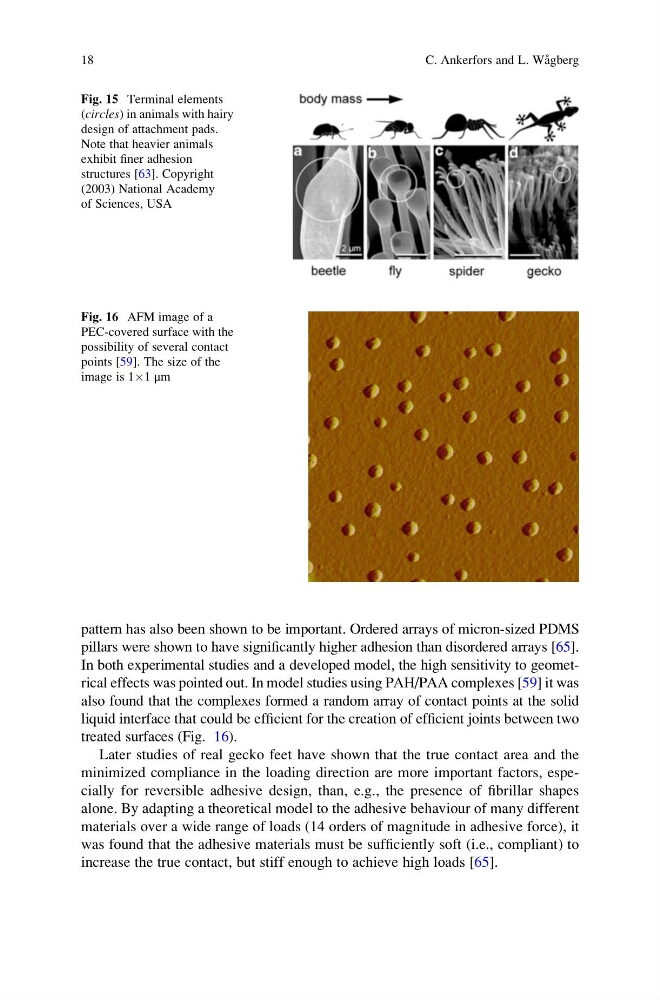
Fig. 15 Terminal elements
(circles) in animals with hairy
design of attachment pads.
Note that heavier animals
exhibit finer adhesion
structures [63]. Copyright
(2003) National Academy
of Sciences, USA
Fig. 16 AFM image of a
PEC-covered surface with the
possibility of several contact
points [59]. The size of the
image is 1Â1 μm
18
C. Ankerfors and L. Wa ˚gberg
pillars were shown to have significantly higher adhesion than disordered arrays [65].
In both experimental studies and a developed model, the high sensitivity to geometrical effects was pointed out. In model studies using PAH/PAA complexes [59] it was
also found that the complexes formed a random array of contact points at the solid
liquid interface that could be efficient for the creation of efficient joints between two
treated surfaces (Fig. 16).
Later studies of real gecko feet have shown that the true contact area and the
minimized compliance in the loading direction are more important factors, especially for reversible adhesive design, than, e.g., the presence of fibrillar shapes
alone. By adapting a theoretical model to the adhesive behaviour of many different
materials over a wide range of loads (14 orders of magnitude in adhesive force), it
was found that the adhesive materials must be sufficiently soft (i.e., compliant) to
increase the true contact, but stiff enough to achieve high loads [65].
Fig. 15 Terminal elements
(circles) in animals with hairy
design of attachment pads.
Note that heavier animals
exhibit finer adhesion
structures [63]. Copyright
(2003) National Academy
of Sciences, USA
Fig. 16 AFM image of a
PEC-covered surface with the
possibility of several contact
points [59]. The size of the
image is 1Â1 μm
18
C. Ankerfors and L. Wa ˚gberg