

Pre-formed complexes of APAM and CPAM with different charge ratios and
their effect on dewatering were studied [62]. The most important finding was a
broader optimum concentration than for single CPAM. Although this paper focused
on the use of PECs for enhancing dewatering, the authors also emphasized the
importance of choosing the right complex type for each purpose and the possibility
of finely tuning the dewatering effect by changing, e.g., the ratio of polycation to
polyanion in the pre-formed complexes.
4 What Controls the Adhesion?
Having seen all the positive effects on paper strength of the addition of PECs, it is of
course interesting to try to elucidate the molecular mechanism behind the positive
effects of the PECs in increasing the adhesion between cellulose surfaces. What
controls the adhesion between surfaces is a more general question that has been
widely debated in recent decades, a discussion that to a great extent originates from
the fascinating adhesive behaviour of the gecko’s feet, allowing the lizards to climb
up a wall or even to hang from the ceiling – and at different humidities.
It has been pointed out that the geometry of the adhering surfaces is of great
importance for the adhesion. By studying the size of the attachment pads of animals
(such as insects, spiders and geckos), it has been shown that animals with a large body
mass increase their adhesion by increasing the number of filaments (setae) at a given
radius of curvature (Fig. 15). An even larger body mass requires a smaller seta
diameter and a smaller radius of curvature. A patterned surface has the advantage
of establishing contact with different surface profiles, and is less sensitive (has an
increased tolerance) to defects in individual contacts [63]. For a flat punch geometry
it was found that the maximum force to separation scaled as n
1/4
, where n is the
number of contact points, and when the posts are finished with a half sphere the
maximum force scales as n
1/2
. The same conclusion was drawn by Lamblet et al. [64]
from a study of PDMS–acrylic adhesive interfaces having pillars with different
height-to-radius ratios and different surface flexibilities. The ordering of the surface
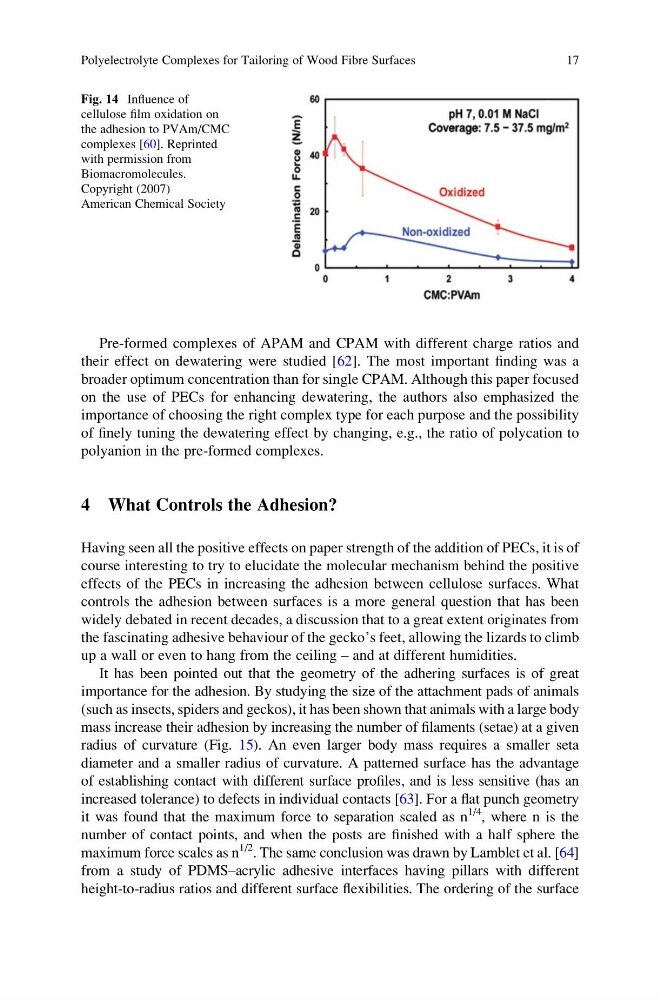
Fig. 14 Influence of
cellulose film oxidation on
the adhesion to PVAm/CMC
complexes [60]. Reprinted
with permission from
Biomacromolecules.
Copyright (2007)
American Chemical Society
Polyelectrolyte Complexes for Tailoring of Wood Fibre Surfaces
17
their effect on dewatering were studied [62]. The most important finding was a
broader optimum concentration than for single CPAM. Although this paper focused
on the use of PECs for enhancing dewatering, the authors also emphasized the
importance of choosing the right complex type for each purpose and the possibility
of finely tuning the dewatering effect by changing, e.g., the ratio of polycation to
polyanion in the pre-formed complexes.
4 What Controls the Adhesion?
Having seen all the positive effects on paper strength of the addition of PECs, it is of
course interesting to try to elucidate the molecular mechanism behind the positive
effects of the PECs in increasing the adhesion between cellulose surfaces. What
controls the adhesion between surfaces is a more general question that has been
widely debated in recent decades, a discussion that to a great extent originates from
the fascinating adhesive behaviour of the gecko’s feet, allowing the lizards to climb
up a wall or even to hang from the ceiling – and at different humidities.
It has been pointed out that the geometry of the adhering surfaces is of great
importance for the adhesion. By studying the size of the attachment pads of animals
(such as insects, spiders and geckos), it has been shown that animals with a large body
mass increase their adhesion by increasing the number of filaments (setae) at a given
radius of curvature (Fig. 15). An even larger body mass requires a smaller seta
diameter and a smaller radius of curvature. A patterned surface has the advantage
of establishing contact with different surface profiles, and is less sensitive (has an
increased tolerance) to defects in individual contacts [63]. For a flat punch geometry
it was found that the maximum force to separation scaled as n
1/4
, where n is the
number of contact points, and when the posts are finished with a half sphere the
maximum force scales as n
1/2
. The same conclusion was drawn by Lamblet et al. [64]
from a study of PDMS–acrylic adhesive interfaces having pillars with different
height-to-radius ratios and different surface flexibilities. The ordering of the surface
Fig. 14 Influence of
cellulose film oxidation on
the adhesion to PVAm/CMC
complexes [60]. Reprinted
with permission from
Biomacromolecules.
Copyright (2007)
American Chemical Society
Polyelectrolyte Complexes for Tailoring of Wood Fibre Surfaces
17