

strength, using the layer-by-layer technique [5] to build up a polyelectrolyte multilayer (PEM) on the fibre surfaces [6, 57, 58]. As previously mentioned, making an in
situ PEC in the presence of pulp fibres is similar to adsorbing the first two layers of a
PEM. To study and compare their effects on the strength of paper sheets formed under
the same conditions, pre-formed PECs from PAA and PAH were compared with
PEMs of the same components [59].
The effects of using PECs and PEMs as strength-enhancing chemicals can be
compared in two ways: with reference to either the adsorbed amount or the number of
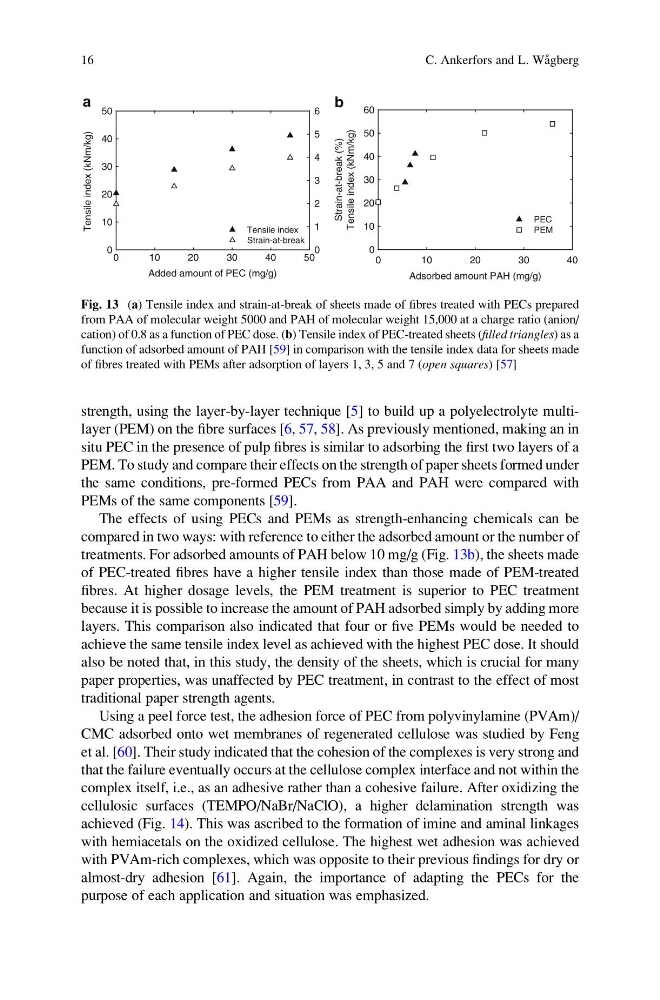
treatments. For adsorbed amounts of PAH below 10 mg/g (Fig. 13b), the sheets made
of PEC-treated fibres have a higher tensile index than those made of PEM-treated
fibres. At higher dosage levels, the PEM treatment is superior to PEC treatment
because it is possible to increase the amount of PAH adsorbed simply by adding more
layers. This comparison also indicated that four or five PEMs would be needed to
achieve the same tensile index level as achieved with the highest PEC dose. It should
also be noted that, in this study, the density of the sheets, which is crucial for many
paper properties, was unaffected by PEC treatment, in contrast to the effect of most
traditional paper strength agents.
Using a peel force test, the adhesion force of PEC from polyvinylamine (PVAm)/
CMC adsorbed onto wet membranes of regenerated cellulose was studied by Feng
et al. [60]. Their study indicated that the cohesion of the complexes is very strong and
that the failure eventually occurs at the cellulose complex interface and not within the
complex itself, i.e., as an adhesive rather than a cohesive failure. After oxidizing the
cellulosic surfaces (TEMPO/NaBr/NaClO), a higher delamination strength was
achieved (Fig. 14). This was ascribed to the formation of imine and aminal linkages
with hemiacetals on the oxidized cellulose. The highest wet adhesion was achieved
with PVAm-rich complexes, which was opposite to their previous findings for dry or
almost-dry adhesion [61]. Again, the importance of adapting the PECs for the
purpose of each application and situation was emphasized.
Added amount of PEC (mg/g)
0
1 0
2 0
3 0
4 0
5 0
Tensile index (kNm/kg)
0
10
20
30
40
50
Strain-at-break (%)
Tensile index (kNm/kg)
0
1
2
3
4
5
6
Tensile index
Strain-at-break
Adsorbed amount PAH (mg/g)
0
1 0
2 0
3 0
4 0
0
10
20
30
40
50
60
PEC
PEM
b
a
Fig. 13 (a) Tensile index and strain-at-break of sheets made of fibres treated with PECs prepared
from PAA of molecular weight 5000 and PAH of molecular weight 15,000 at a charge ratio (anion/
cation) of 0.8 as a function of PEC dose. (b) Tensile index of PEC-treated sheets (filled triangles) as a
function of adsorbed amount of PAH [59] in comparison with the tensile index data for sheets made
of fibres treated with PEMs after adsorption of layers 1, 3, 5 and 7 (open squares) [57]
16
C. Ankerfors and L. Wa ˚gberg
situ PEC in the presence of pulp fibres is similar to adsorbing the first two layers of a
PEM. To study and compare their effects on the strength of paper sheets formed under
the same conditions, pre-formed PECs from PAA and PAH were compared with
PEMs of the same components [59].
The effects of using PECs and PEMs as strength-enhancing chemicals can be
compared in two ways: with reference to either the adsorbed amount or the number of
treatments. For adsorbed amounts of PAH below 10 mg/g (Fig. 13b), the sheets made
of PEC-treated fibres have a higher tensile index than those made of PEM-treated
fibres. At higher dosage levels, the PEM treatment is superior to PEC treatment
because it is possible to increase the amount of PAH adsorbed simply by adding more
layers. This comparison also indicated that four or five PEMs would be needed to
achieve the same tensile index level as achieved with the highest PEC dose. It should
also be noted that, in this study, the density of the sheets, which is crucial for many
paper properties, was unaffected by PEC treatment, in contrast to the effect of most
traditional paper strength agents.
Using a peel force test, the adhesion force of PEC from polyvinylamine (PVAm)/
CMC adsorbed onto wet membranes of regenerated cellulose was studied by Feng
et al. [60]. Their study indicated that the cohesion of the complexes is very strong and
that the failure eventually occurs at the cellulose complex interface and not within the
complex itself, i.e., as an adhesive rather than a cohesive failure. After oxidizing the
cellulosic surfaces (TEMPO/NaBr/NaClO), a higher delamination strength was
achieved (Fig. 14). This was ascribed to the formation of imine and aminal linkages
with hemiacetals on the oxidized cellulose. The highest wet adhesion was achieved
with PVAm-rich complexes, which was opposite to their previous findings for dry or
almost-dry adhesion [61]. Again, the importance of adapting the PECs for the
purpose of each application and situation was emphasized.
Added amount of PEC (mg/g)
0
1 0
2 0
3 0
4 0
5 0
Tensile index (kNm/kg)
0
10
20
30
40
50
Strain-at-break (%)
Tensile index (kNm/kg)
0
1
2
3
4
5
6
Tensile index
Strain-at-break
Adsorbed amount PAH (mg/g)
0
1 0
2 0
3 0
4 0
0
10
20
30
40
50
60
PEC
PEM
b
a
Fig. 13 (a) Tensile index and strain-at-break of sheets made of fibres treated with PECs prepared
from PAA of molecular weight 5000 and PAH of molecular weight 15,000 at a charge ratio (anion/
cation) of 0.8 as a function of PEC dose. (b) Tensile index of PEC-treated sheets (filled triangles) as a
function of adsorbed amount of PAH [59] in comparison with the tensile index data for sheets made
of fibres treated with PEMs after adsorption of layers 1, 3, 5 and 7 (open squares) [57]
16
C. Ankerfors and L. Wa ˚gberg