

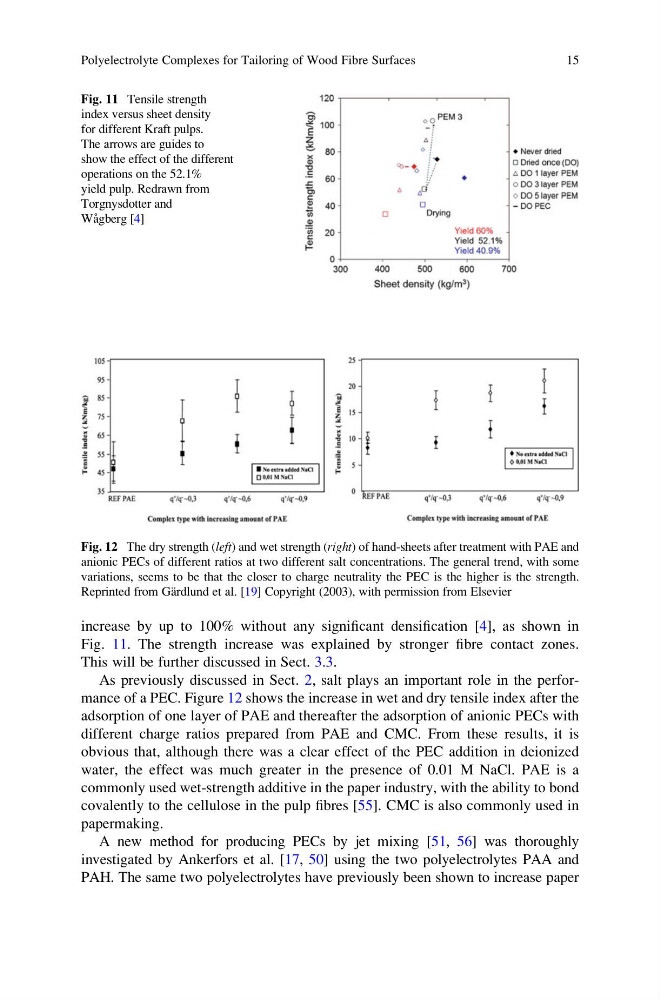
increase by up to 100% without any significant densification [4], as shown in
Fig. 11. The strength increase was explained by stronger fibre contact zones.
This will be further discussed in Sect. 3.3.
As previously discussed in Sect. 2, salt plays an important role in the performance of a PEC. Figure 12 shows the increase in wet and dry tensile index after the
adsorption of one layer of PAE and thereafter the adsorption of anionic PECs with
different charge ratios prepared from PAE and CMC. From these results, it is
obvious that, although there was a clear effect of the PEC addition in deionized
water, the effect was much greater in the presence of 0.01 M NaCl. PAE is a
commonly used wet-strength additive in the paper industry, with the ability to bond
covalently to the cellulose in the pulp fibres [55]. CMC is also commonly used in
papermaking.
A new method for producing PECs by jet mixing [51, 56] was thoroughly
investigated by Ankerfors et al. [17, 50] using the two polyelectrolytes PAA and
PAH. The same two polyelectrolytes have previously been shown to increase paper
Fig. 12 The dry strength (left) and wet strength (right) of hand-sheets after treatment with PAE and
anionic PECs of different ratios at two different salt concentrations. The general trend, with some
variations, seems to be that the closer to charge neutrality the PEC is the higher is the strength.
Reprinted from Ga ¨rdlund et al. [19] Copyright (2003), with permission from Elsevier
Fig. 11 Tensile strength
index versus sheet density
for different Kraft pulps.
The arrows are guides to
show the effect of the different
operations on the 52.1%
yield pulp. Redrawn from
Torgnysdotter and
Wa ˚gberg [4]
Polyelectrolyte Complexes for Tailoring of Wood Fibre Surfaces
15
Fig. 11. The strength increase was explained by stronger fibre contact zones.
This will be further discussed in Sect. 3.3.
As previously discussed in Sect. 2, salt plays an important role in the performance of a PEC. Figure 12 shows the increase in wet and dry tensile index after the
adsorption of one layer of PAE and thereafter the adsorption of anionic PECs with
different charge ratios prepared from PAE and CMC. From these results, it is
obvious that, although there was a clear effect of the PEC addition in deionized
water, the effect was much greater in the presence of 0.01 M NaCl. PAE is a
commonly used wet-strength additive in the paper industry, with the ability to bond
covalently to the cellulose in the pulp fibres [55]. CMC is also commonly used in
papermaking.
A new method for producing PECs by jet mixing [51, 56] was thoroughly
investigated by Ankerfors et al. [17, 50] using the two polyelectrolytes PAA and
PAH. The same two polyelectrolytes have previously been shown to increase paper
Fig. 12 The dry strength (left) and wet strength (right) of hand-sheets after treatment with PAE and
anionic PECs of different ratios at two different salt concentrations. The general trend, with some
variations, seems to be that the closer to charge neutrality the PEC is the higher is the strength.
Reprinted from Ga ¨rdlund et al. [19] Copyright (2003), with permission from Elsevier
Fig. 11 Tensile strength
index versus sheet density
for different Kraft pulps.
The arrows are guides to
show the effect of the different
operations on the 52.1%
yield pulp. Redrawn from
Torgnysdotter and
Wa ˚gberg [4]
Polyelectrolyte Complexes for Tailoring of Wood Fibre Surfaces
15