

In a more applied work, Kraft pulp fibres were treated with PEM or PEC (built by
both PAA and PAH, where the cationic complexes were prepared by titration) [4].
It was pointed out that when designing a strong adhesive joint with a favourable
stress distribution, it is important to have a contact zone of high quality, i.e., high
work of adhesion and large molecular contact area (Fig. 16). Adding PEC or PEM
significantly increased the tensile and compression strength by increasing the
fibre–fibre joint strength [4]. In a continuation of this work, Rayon fibres were
used as a model system and three different surface treatments were used on these
fibres: (i) carboxymethylation to increase the surface charge of the fibres; (ii) PAE
addition; and (iii) PDADMAC addition [66].
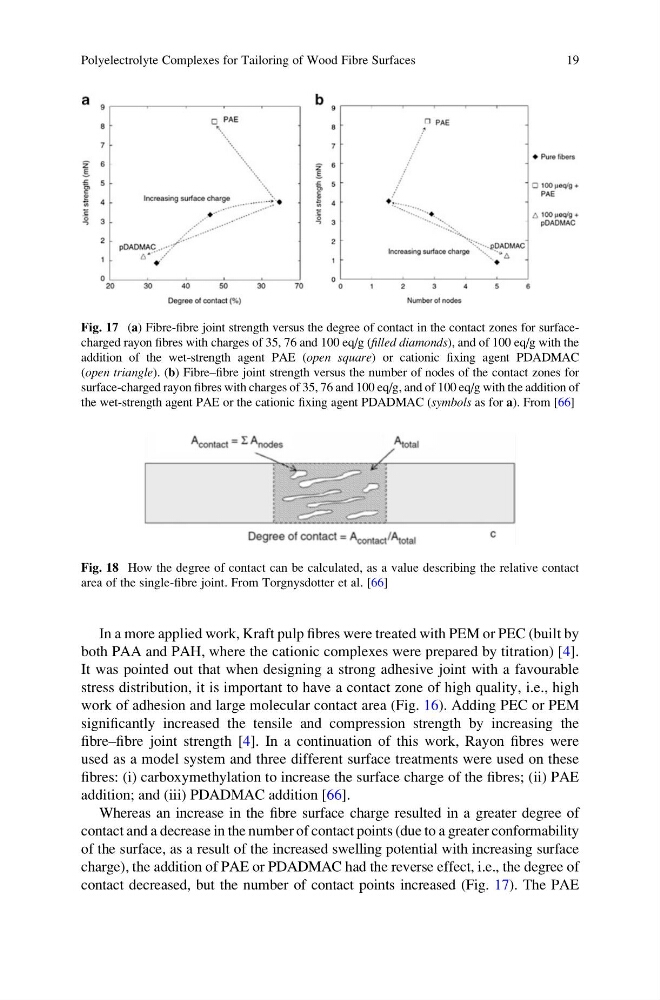
Whereas an increase in the fibre surface charge resulted in a greater degree of
contact and a decrease in the number of contact points (due to a greater conformability
of the surface, as a result of the increased swelling potential with increasing surface
charge), the addition of PAE or PDADMAC had the reverse effect, i.e., the degree of
contact decreased, but the number of contact points increased (Fig. 17). The PAE
Fig. 18 How the degree of contact can be calculated, as a value describing the relative contact
area of the single-fibre joint. From Torgnysdotter et al. [66]
Fig. 17 (a) Fibre-fibre joint strength versus the degree of contact in the contact zones for surfacecharged rayon fibres with charges of 35, 76 and 100 eq/g (filled diamonds), and of 100 eq/g with the
addition of the wet-strength agent PAE (open square) or cationic fixing agent PDADMAC
(open triangle). (b) Fibre–fibre joint strength versus the number of nodes of the contact zones for
surface-charged rayon fibres with charges of 35, 76 and 100 eq/g, and of 100 eq/g with the addition of
the wet-strength agent PAE or the cationic fixing agent PDADMAC (symbols as for a). From [66]
Polyelectrolyte Complexes for Tailoring of Wood Fibre Surfaces
19
both PAA and PAH, where the cationic complexes were prepared by titration) [4].
It was pointed out that when designing a strong adhesive joint with a favourable
stress distribution, it is important to have a contact zone of high quality, i.e., high
work of adhesion and large molecular contact area (Fig. 16). Adding PEC or PEM
significantly increased the tensile and compression strength by increasing the
fibre–fibre joint strength [4]. In a continuation of this work, Rayon fibres were
used as a model system and three different surface treatments were used on these
fibres: (i) carboxymethylation to increase the surface charge of the fibres; (ii) PAE
addition; and (iii) PDADMAC addition [66].
Whereas an increase in the fibre surface charge resulted in a greater degree of
contact and a decrease in the number of contact points (due to a greater conformability
of the surface, as a result of the increased swelling potential with increasing surface
charge), the addition of PAE or PDADMAC had the reverse effect, i.e., the degree of
contact decreased, but the number of contact points increased (Fig. 17). The PAE
Fig. 18 How the degree of contact can be calculated, as a value describing the relative contact
area of the single-fibre joint. From Torgnysdotter et al. [66]
Fig. 17 (a) Fibre-fibre joint strength versus the degree of contact in the contact zones for surfacecharged rayon fibres with charges of 35, 76 and 100 eq/g (filled diamonds), and of 100 eq/g with the
addition of the wet-strength agent PAE (open square) or cationic fixing agent PDADMAC
(open triangle). (b) Fibre–fibre joint strength versus the number of nodes of the contact zones for
surface-charged rayon fibres with charges of 35, 76 and 100 eq/g, and of 100 eq/g with the addition of
the wet-strength agent PAE or the cationic fixing agent PDADMAC (symbols as for a). From [66]
Polyelectrolyte Complexes for Tailoring of Wood Fibre Surfaces
19