

3.1 PECs Produced In Situ
First, the in situ PECs will be considered. In this method, two polyelectrolyte
components are added sequentially to the pulp suspension (e.g., by adding one
polyelectrolyte and then the other component after a pre-selected time delay), forming
PECs in situ. This method leads either to the formation of PECs directly on the fibre
surfaces or to the formation of soluble complexes, colloidally stable PECs or macroscopic precipitates that can be deposited on the fibre surfaces.
The choice of pulp can affect the efficiency of the PEC treatment. Briefly,
chemical pulping (e.g., Kraft pulping or the sulfite process) is a process aiming at a
delignification of the wood fibre walls and thereby a liberation of the wood fibres in
such a way that the shape and structure of the fibres are preserved. In the mechanical
pulping processes (e.g., thermomechanical pulping or chemothermomechanical
pulping), the most characteristic feature is the production of finer fibre material
(referred to as fines) and also stiffer fibres with more charges compared to the
chemical pulps, since the chemical composition of the fibres is more or less
unchanged from that in the wood. The fines material has a very large surface area
and thus also a large proportion of the surface charges.
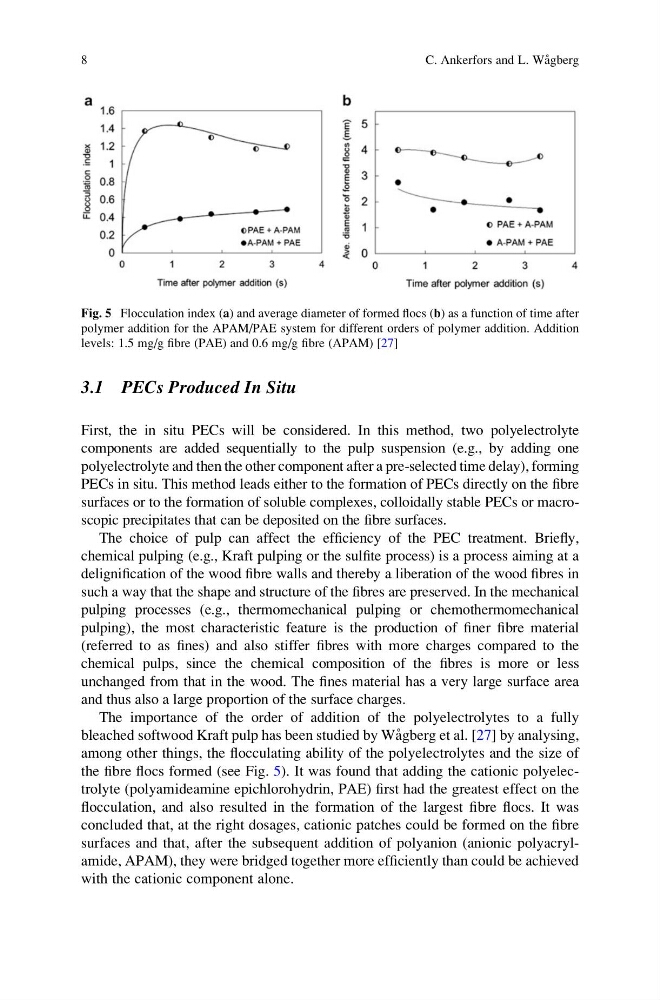
The importance of the order of addition of the polyelectrolytes to a fully
bleached softwood Kraft pulp has been studied by Wa ˚gberg et al. [27] by analysing,
among other things, the flocculating ability of the polyelectrolytes and the size of
the fibre flocs formed (see Fig. 5). It was found that adding the cationic polyelectrolyte (polyamideamine epichlorohydrin, PAE) first had the greatest effect on the
flocculation, and also resulted in the formation of the largest fibre flocs. It was
concluded that, at the right dosages, cationic patches could be formed on the fibre
surfaces and that, after the subsequent addition of polyanion (anionic polyacrylamide, APAM), they were bridged together more efficiently than could be achieved
with the cationic component alone.
Fig. 5 Flocculation index (a) and average diameter of formed flocs (b) as a function of time after
polymer addition for the APAM/PAE system for different orders of polymer addition. Addition
levels: 1.5 mg/g fibre (PAE) and 0.6 mg/g fibre (APAM) [27]
8
C. Ankerfors and L. Wa ˚gberg
First, the in situ PECs will be considered. In this method, two polyelectrolyte
components are added sequentially to the pulp suspension (e.g., by adding one
polyelectrolyte and then the other component after a pre-selected time delay), forming
PECs in situ. This method leads either to the formation of PECs directly on the fibre
surfaces or to the formation of soluble complexes, colloidally stable PECs or macroscopic precipitates that can be deposited on the fibre surfaces.
The choice of pulp can affect the efficiency of the PEC treatment. Briefly,
chemical pulping (e.g., Kraft pulping or the sulfite process) is a process aiming at a
delignification of the wood fibre walls and thereby a liberation of the wood fibres in
such a way that the shape and structure of the fibres are preserved. In the mechanical
pulping processes (e.g., thermomechanical pulping or chemothermomechanical
pulping), the most characteristic feature is the production of finer fibre material
(referred to as fines) and also stiffer fibres with more charges compared to the
chemical pulps, since the chemical composition of the fibres is more or less
unchanged from that in the wood. The fines material has a very large surface area
and thus also a large proportion of the surface charges.
The importance of the order of addition of the polyelectrolytes to a fully
bleached softwood Kraft pulp has been studied by Wa ˚gberg et al. [27] by analysing,
among other things, the flocculating ability of the polyelectrolytes and the size of
the fibre flocs formed (see Fig. 5). It was found that adding the cationic polyelectrolyte (polyamideamine epichlorohydrin, PAE) first had the greatest effect on the
flocculation, and also resulted in the formation of the largest fibre flocs. It was
concluded that, at the right dosages, cationic patches could be formed on the fibre
surfaces and that, after the subsequent addition of polyanion (anionic polyacrylamide, APAM), they were bridged together more efficiently than could be achieved
with the cationic component alone.
Fig. 5 Flocculation index (a) and average diameter of formed flocs (b) as a function of time after
polymer addition for the APAM/PAE system for different orders of polymer addition. Addition
levels: 1.5 mg/g fibre (PAE) and 0.6 mg/g fibre (APAM) [27]
8
C. Ankerfors and L. Wa ˚gberg