

earlier discussion in which it was suggested that the build-up of an osmotic pressure
was the cause of the limited adsorption for the more highly charged systems. For the
low-charged system, this is not so important and there is a more typical
electrosorption process in these systems. Saarinen et al. [25] also reported that
SiO 2 and cellulose basically gave similar trends in adsorption but that the level of
adsorption was different, probably due to a difference in charge, but also because
different systems show different types of interaction with these two model surfaces.
Many types of cellulose fibres have a considerable amount of lignin and
hemicelluloses left on the fibre surfaces, and model experiments using model surfaces
of these compounds are very relevant for understanding the adsorption. Norgren et al.
[26] used model lignin surfaces to study the adsorption of anionic complexes of PAH/
PAA on net negative model surfaces of lignin at pH 7 and a NaCl concentration of
10 mM. Their results showed a significant adsorption of the anionic complexes under
these conditions, which indicated that for lignin model surfaces there is a significant
contribution from nonionic interactions to the adsorbed amount, although this was not
observed for the cellulose surfaces. This shows both a complexity and the possibility
of modifying the properties of cellulose fibres with PECs.
3 PEC for Controlling Adhesive Properties of Fibres
One PEC application with a potential for the pulp and paper industry is to improve
the wet and dry strength of paper by increasing the adhesion between the fibres. For
this purpose, PECs can be produced in two fundamentally different ways: in situ or
by pre-formation (i.e., mixing the polycation and polyanion before addition to the
pulp fibres). Both methods make it possible to improve the contact between fibres by
creating a ductile joint between them. Examples of studies aiming at evaluating the
performance of PECs as a strength agent will be presented, divided into these two
categories.
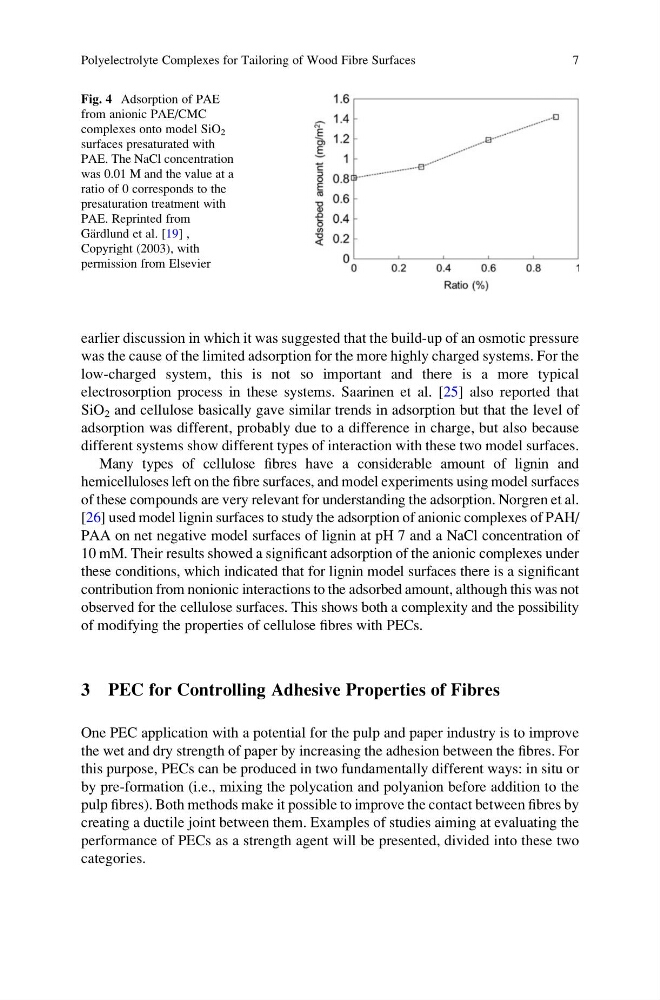
Fig. 4 Adsorption of PAE
from anionic PAE/CMC
complexes onto model SiO 2
surfaces presaturated with
PAE. The NaCl concentration
was 0.01 M and the value at a
ratio of 0 corresponds to the
presaturation treatment with
PAE. Reprinted from
Ga ¨rdlund et al. [19] ,
Copyright (2003), with
permission from Elsevier
Polyelectrolyte Complexes for Tailoring of Wood Fibre Surfaces
7
was the cause of the limited adsorption for the more highly charged systems. For the
low-charged system, this is not so important and there is a more typical
electrosorption process in these systems. Saarinen et al. [25] also reported that
SiO 2 and cellulose basically gave similar trends in adsorption but that the level of
adsorption was different, probably due to a difference in charge, but also because
different systems show different types of interaction with these two model surfaces.
Many types of cellulose fibres have a considerable amount of lignin and
hemicelluloses left on the fibre surfaces, and model experiments using model surfaces
of these compounds are very relevant for understanding the adsorption. Norgren et al.
[26] used model lignin surfaces to study the adsorption of anionic complexes of PAH/
PAA on net negative model surfaces of lignin at pH 7 and a NaCl concentration of
10 mM. Their results showed a significant adsorption of the anionic complexes under
these conditions, which indicated that for lignin model surfaces there is a significant
contribution from nonionic interactions to the adsorbed amount, although this was not
observed for the cellulose surfaces. This shows both a complexity and the possibility
of modifying the properties of cellulose fibres with PECs.
3 PEC for Controlling Adhesive Properties of Fibres
One PEC application with a potential for the pulp and paper industry is to improve
the wet and dry strength of paper by increasing the adhesion between the fibres. For
this purpose, PECs can be produced in two fundamentally different ways: in situ or
by pre-formation (i.e., mixing the polycation and polyanion before addition to the
pulp fibres). Both methods make it possible to improve the contact between fibres by
creating a ductile joint between them. Examples of studies aiming at evaluating the
performance of PECs as a strength agent will be presented, divided into these two
categories.
Fig. 4 Adsorption of PAE
from anionic PAE/CMC
complexes onto model SiO 2
surfaces presaturated with
PAE. The NaCl concentration
was 0.01 M and the value at a
ratio of 0 corresponds to the
presaturation treatment with
PAE. Reprinted from
Ga ¨rdlund et al. [19] ,
Copyright (2003), with
permission from Elsevier
Polyelectrolyte Complexes for Tailoring of Wood Fibre Surfaces
7