

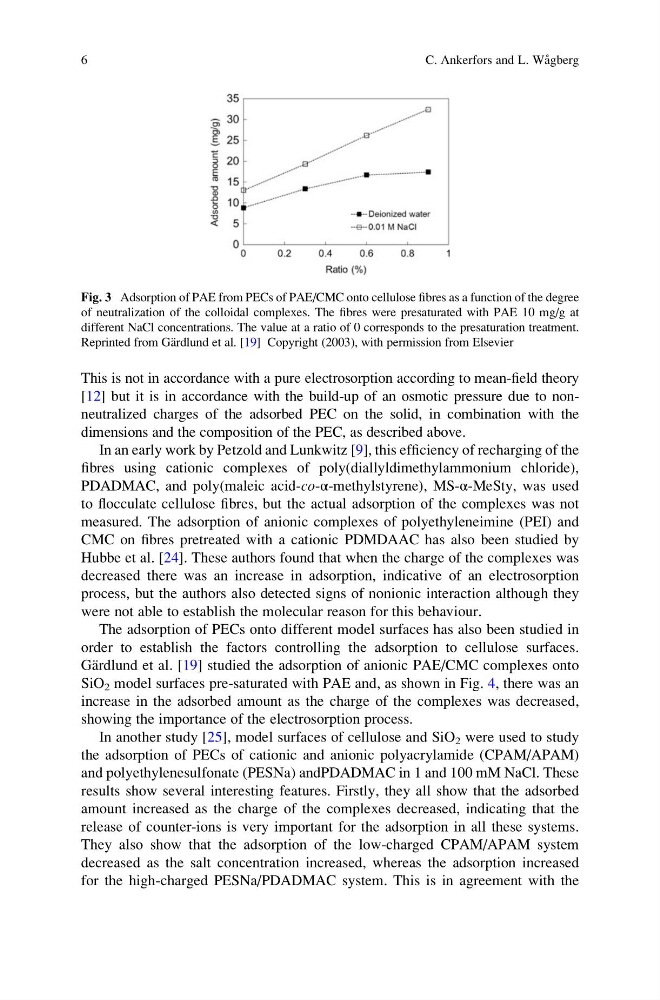
This is not in accordance with a pure electrosorption according to mean-field theory
[12] but it is in accordance with the build-up of an osmotic pressure due to nonneutralized charges of the adsorbed PEC on the solid, in combination with the
dimensions and the composition of the PEC, as described above.
In an early work by Petzold and Lunkwitz [9], this efficiency of recharging of the
fibres using cationic complexes of poly(diallyldimethylammonium chloride),
PDADMAC, and poly(maleic acid-co-α-methylstyrene), MS-α-MeSty, was used
to flocculate cellulose fibres, but the actual adsorption of the complexes was not
measured. The adsorption of anionic complexes of polyethyleneimine (PEI) and
CMC on fibres pretreated with a cationic PDMDAAC has also been studied by
Hubbe et al. [24]. These authors found that when the charge of the complexes was
decreased there was an increase in adsorption, indicative of an electrosorption
process, but the authors also detected signs of nonionic interaction although they
were not able to establish the molecular reason for this behaviour.
The adsorption of PECs onto different model surfaces has also been studied in
order to establish the factors controlling the adsorption to cellulose surfaces.
Ga ¨rdlund et al. [19] studied the adsorption of anionic PAE/CMC complexes onto
SiO 2 model surfaces pre-saturated with PAE and, as shown in Fig. 4, there was an
increase in the adsorbed amount as the charge of the complexes was decreased,
showing the importance of the electrosorption process.
In another study [25], model surfaces of cellulose and SiO 2 were used to study
the adsorption of PECs of cationic and anionic polyacrylamide (CPAM/APAM)
and polyethylenesulfonate (PESNa) andPDADMAC in 1 and 100 mM NaCl. These
results show several interesting features. Firstly, they all show that the adsorbed
amount increased as the charge of the complexes decreased, indicating that the
release of counter-ions is very important for the adsorption in all these systems.
They also show that the adsorption of the low-charged CPAM/APAM system
decreased as the salt concentration increased, whereas the adsorption increased
for the high-charged PESNa/PDADMAC system. This is in agreement with the
Fig. 3 Adsorption of PAE from PECs of PAE/CMC onto cellulose fibres as a function of the degree
of neutralization of the colloidal complexes. The fibres were presaturated with PAE 10 mg/g at
different NaCl concentrations. The value at a ratio of 0 corresponds to the presaturation treatment.
Reprinted from Ga ¨rdlund et al. [19] Copyright (2003), with permission from Elsevier
6
C. Ankerfors and L. Wa ˚gberg
[12] but it is in accordance with the build-up of an osmotic pressure due to nonneutralized charges of the adsorbed PEC on the solid, in combination with the
dimensions and the composition of the PEC, as described above.
In an early work by Petzold and Lunkwitz [9], this efficiency of recharging of the
fibres using cationic complexes of poly(diallyldimethylammonium chloride),
PDADMAC, and poly(maleic acid-co-α-methylstyrene), MS-α-MeSty, was used
to flocculate cellulose fibres, but the actual adsorption of the complexes was not
measured. The adsorption of anionic complexes of polyethyleneimine (PEI) and
CMC on fibres pretreated with a cationic PDMDAAC has also been studied by
Hubbe et al. [24]. These authors found that when the charge of the complexes was
decreased there was an increase in adsorption, indicative of an electrosorption
process, but the authors also detected signs of nonionic interaction although they
were not able to establish the molecular reason for this behaviour.
The adsorption of PECs onto different model surfaces has also been studied in
order to establish the factors controlling the adsorption to cellulose surfaces.
Ga ¨rdlund et al. [19] studied the adsorption of anionic PAE/CMC complexes onto
SiO 2 model surfaces pre-saturated with PAE and, as shown in Fig. 4, there was an
increase in the adsorbed amount as the charge of the complexes was decreased,
showing the importance of the electrosorption process.
In another study [25], model surfaces of cellulose and SiO 2 were used to study
the adsorption of PECs of cationic and anionic polyacrylamide (CPAM/APAM)
and polyethylenesulfonate (PESNa) andPDADMAC in 1 and 100 mM NaCl. These
results show several interesting features. Firstly, they all show that the adsorbed
amount increased as the charge of the complexes decreased, indicating that the
release of counter-ions is very important for the adsorption in all these systems.
They also show that the adsorption of the low-charged CPAM/APAM system
decreased as the salt concentration increased, whereas the adsorption increased
for the high-charged PESNa/PDADMAC system. This is in agreement with the
Fig. 3 Adsorption of PAE from PECs of PAE/CMC onto cellulose fibres as a function of the degree
of neutralization of the colloidal complexes. The fibres were presaturated with PAE 10 mg/g at
different NaCl concentrations. The value at a ratio of 0 corresponds to the presaturation treatment.
Reprinted from Ga ¨rdlund et al. [19] Copyright (2003), with permission from Elsevier
6
C. Ankerfors and L. Wa ˚gberg