

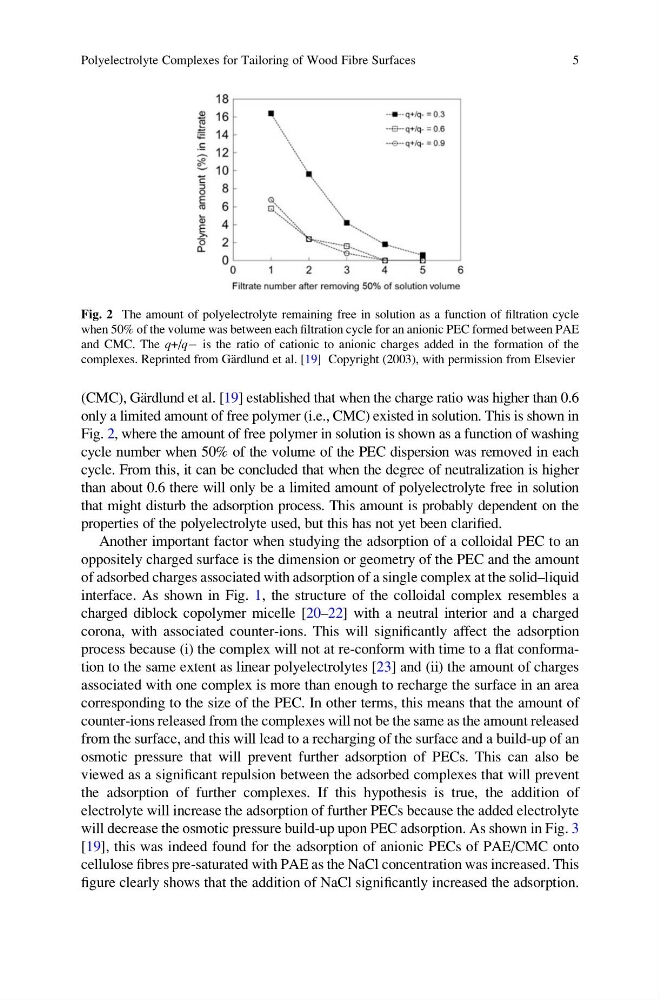
(CMC), Ga ¨rdlund et al. [19] established that when the charge ratio was higher than 0.6
only a limited amount of free polymer (i.e., CMC) existed in solution. This is shown in
Fig. 2, where the amount of free polymer in solution is shown as a function of washing
cycle number when 50% of the volume of the PEC dispersion was removed in each
cycle. From this, it can be concluded that when the degree of neutralization is higher
than about 0.6 there will only be a limited amount of polyelectrolyte free in solution
that might disturb the adsorption process. This amount is probably dependent on the
properties of the polyelectrolyte used, but this has not yet been clarified.
Another important factor when studying the adsorption of a colloidal PEC to an
oppositely charged surface is the dimension or geometry of the PEC and the amount
of adsorbed charges associated with adsorption of a single complex at the solid–liquid
interface. As shown in Fig. 1, the structure of the colloidal complex resembles a
charged diblock copolymer micelle [20–22] with a neutral interior and a charged
corona, with associated counter-ions. This will significantly affect the adsorption
process because (i) the complex will not at re-conform with time to a flat conformation to the same extent as linear polyelectrolytes [23] and (ii) the amount of charges
associated with one complex is more than enough to recharge the surface in an area
corresponding to the size of the PEC. In other terms, this means that the amount of
counter-ions released from the complexes will not be the same as the amount released
from the surface, and this will lead to a recharging of the surface and a build-up of an
osmotic pressure that will prevent further adsorption of PECs. This can also be
viewed as a significant repulsion between the adsorbed complexes that will prevent
the adsorption of further complexes. If this hypothesis is true, the addition of
electrolyte will increase the adsorption of further PECs because the added electrolyte
will decrease the osmotic pressure build-up upon PEC adsorption. As shown in Fig. 3
[19], this was indeed found for the adsorption of anionic PECs of PAE/CMC onto
cellulose fibres pre-saturated with PAE as the NaCl concentration was increased. This
figure clearly shows that the addition of NaCl significantly increased the adsorption.
Fig. 2 The amount of polyelectrolyte remaining free in solution as a function of filtration cycle
when 50% of the volume was between each filtration cycle for an anionic PEC formed between PAE
and CMC. The q+/qÀ is the ratio of cationic to anionic charges added in the formation of the
complexes. Reprinted from Ga ¨rdlund et al. [19] Copyright (2003), with permission from Elsevier
Polyelectrolyte Complexes for Tailoring of Wood Fibre Surfaces
5
only a limited amount of free polymer (i.e., CMC) existed in solution. This is shown in
Fig. 2, where the amount of free polymer in solution is shown as a function of washing
cycle number when 50% of the volume of the PEC dispersion was removed in each
cycle. From this, it can be concluded that when the degree of neutralization is higher
than about 0.6 there will only be a limited amount of polyelectrolyte free in solution
that might disturb the adsorption process. This amount is probably dependent on the
properties of the polyelectrolyte used, but this has not yet been clarified.
Another important factor when studying the adsorption of a colloidal PEC to an
oppositely charged surface is the dimension or geometry of the PEC and the amount
of adsorbed charges associated with adsorption of a single complex at the solid–liquid
interface. As shown in Fig. 1, the structure of the colloidal complex resembles a
charged diblock copolymer micelle [20–22] with a neutral interior and a charged
corona, with associated counter-ions. This will significantly affect the adsorption
process because (i) the complex will not at re-conform with time to a flat conformation to the same extent as linear polyelectrolytes [23] and (ii) the amount of charges
associated with one complex is more than enough to recharge the surface in an area
corresponding to the size of the PEC. In other terms, this means that the amount of
counter-ions released from the complexes will not be the same as the amount released
from the surface, and this will lead to a recharging of the surface and a build-up of an
osmotic pressure that will prevent further adsorption of PECs. This can also be
viewed as a significant repulsion between the adsorbed complexes that will prevent
the adsorption of further complexes. If this hypothesis is true, the addition of
electrolyte will increase the adsorption of further PECs because the added electrolyte
will decrease the osmotic pressure build-up upon PEC adsorption. As shown in Fig. 3
[19], this was indeed found for the adsorption of anionic PECs of PAE/CMC onto
cellulose fibres pre-saturated with PAE as the NaCl concentration was increased. This
figure clearly shows that the addition of NaCl significantly increased the adsorption.
Fig. 2 The amount of polyelectrolyte remaining free in solution as a function of filtration cycle
when 50% of the volume was between each filtration cycle for an anionic PEC formed between PAE
and CMC. The q+/qÀ is the ratio of cationic to anionic charges added in the formation of the
complexes. Reprinted from Ga ¨rdlund et al. [19] Copyright (2003), with permission from Elsevier
Polyelectrolyte Complexes for Tailoring of Wood Fibre Surfaces
5