

there has been a rapid development of our theoretical understanding of the adsorption
processes and the mean-field theories have in general been very successful in
describing polyelectrolyte adsorption at the solid–liquid interface [12, 15]. Good
agreement has also been found between Monte Carlo simulations and thermodynamic
models describing the adsorption of colloids at interfaces [16]. In mean-field models,
it has been clearly demonstrated that the adsorption can be driven by an increase in
entropy of the system due to the release of counter-ions from the polyelectrolyte/
colloid and the solid surface and/or by a positive sign of the surface interaction
parameter χ s [12, 15], which is linked to an enthalpy change associated with the
interaction between the polymer/polyelectrolyte/colloid and the surface. The adsorption of a highly charged polyelectrolyte to an oppositely charged surface is most
commonly driven by the release of counter-ions (i.e., it is entropy driven), but in the
case of a low charge density polyelectrolyte there may be a substantial contribution
from nonionic interactions [12].
It is difficult to categorize colloidal complexes as either high-charged or lowcharged systems because the charge of these materials is dependent on the composition of the complex, i.e., the constituting polyelectrolytes and the surrounding
medium. Another complicating factor is the influence of the excess polyelectrolyte
in the solution because this polyelectrolyte disturbs the adsorption process to an
extent that depends on the charge and size of the polyelectrolyte in solution.
It has been shown [17] that the removal of the excess cationic polyelectrolyte led
to a somewhat greater adsorption of complexes of polyallylamine hydrochloride
(PAH) and polyacrylic acid (PAA) onto SiO 2 surfaces in water, with a net cationic
charge and a degree of neutralization of 0.8, since the excess PAH diffused more
rapidly to the surface and was adsorbed before the larger colloidal complexes could
be adsorbed. When the PAH was removed, the complex adsorption dominated and
the adsorbed amount thus increased. Similar results were found for the adsorption
of cationic lattices onto cellulose fibres with an excess of cationic polyelectrolyte in
solution [18], where it was found that a large excess of the cationic polyelectrolyte
severely affected the amount adsorbed. Both these results show that the amount of
free cationic polyelectrolyte in solution must be controlled in order to safely
elucidate the mechanisms behind the adsorption of PEC onto any surface.
Using a simple filtration procedure on an anionic PEC formed between a cationic
polyamideamine epichlorohydrin condensate (PAE) and carboxymethylcellulose
Charged corona
Neutral core
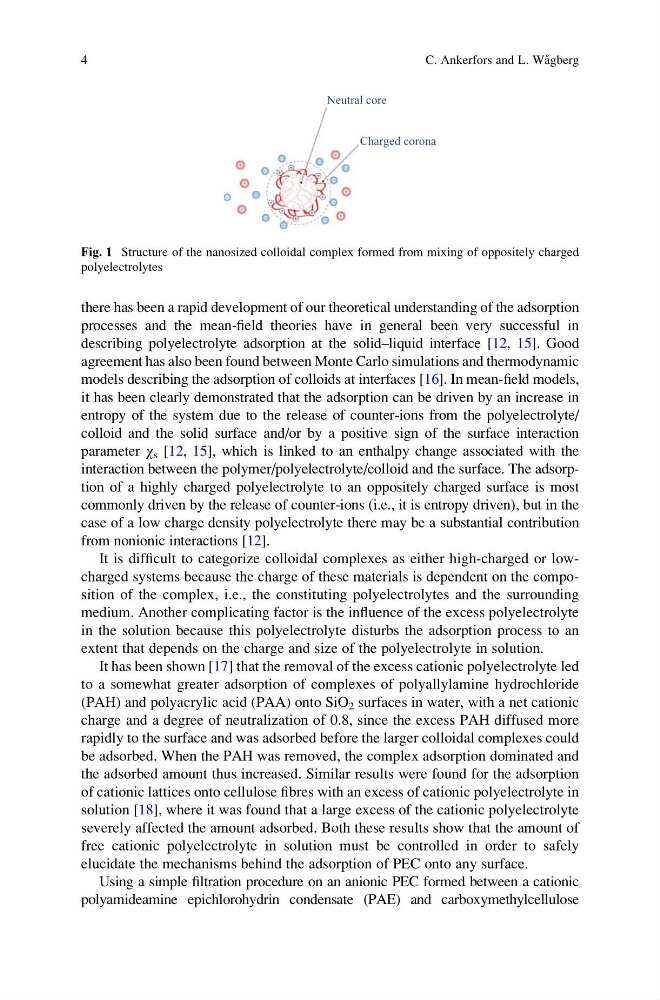
Fig. 1 Structure of the nanosized colloidal complex formed from mixing of oppositely charged
polyelectrolytes
4
C. Ankerfors and L. Wa ˚gberg
processes and the mean-field theories have in general been very successful in
describing polyelectrolyte adsorption at the solid–liquid interface [12, 15]. Good
agreement has also been found between Monte Carlo simulations and thermodynamic
models describing the adsorption of colloids at interfaces [16]. In mean-field models,
it has been clearly demonstrated that the adsorption can be driven by an increase in
entropy of the system due to the release of counter-ions from the polyelectrolyte/
colloid and the solid surface and/or by a positive sign of the surface interaction
parameter χ s [12, 15], which is linked to an enthalpy change associated with the
interaction between the polymer/polyelectrolyte/colloid and the surface. The adsorption of a highly charged polyelectrolyte to an oppositely charged surface is most
commonly driven by the release of counter-ions (i.e., it is entropy driven), but in the
case of a low charge density polyelectrolyte there may be a substantial contribution
from nonionic interactions [12].
It is difficult to categorize colloidal complexes as either high-charged or lowcharged systems because the charge of these materials is dependent on the composition of the complex, i.e., the constituting polyelectrolytes and the surrounding
medium. Another complicating factor is the influence of the excess polyelectrolyte
in the solution because this polyelectrolyte disturbs the adsorption process to an
extent that depends on the charge and size of the polyelectrolyte in solution.
It has been shown [17] that the removal of the excess cationic polyelectrolyte led
to a somewhat greater adsorption of complexes of polyallylamine hydrochloride
(PAH) and polyacrylic acid (PAA) onto SiO 2 surfaces in water, with a net cationic
charge and a degree of neutralization of 0.8, since the excess PAH diffused more
rapidly to the surface and was adsorbed before the larger colloidal complexes could
be adsorbed. When the PAH was removed, the complex adsorption dominated and
the adsorbed amount thus increased. Similar results were found for the adsorption
of cationic lattices onto cellulose fibres with an excess of cationic polyelectrolyte in
solution [18], where it was found that a large excess of the cationic polyelectrolyte
severely affected the amount adsorbed. Both these results show that the amount of
free cationic polyelectrolyte in solution must be controlled in order to safely
elucidate the mechanisms behind the adsorption of PEC onto any surface.
Using a simple filtration procedure on an anionic PEC formed between a cationic
polyamideamine epichlorohydrin condensate (PAE) and carboxymethylcellulose
Charged corona
Neutral core
Fig. 1 Structure of the nanosized colloidal complex formed from mixing of oppositely charged
polyelectrolytes
4
C. Ankerfors and L. Wa ˚gberg