

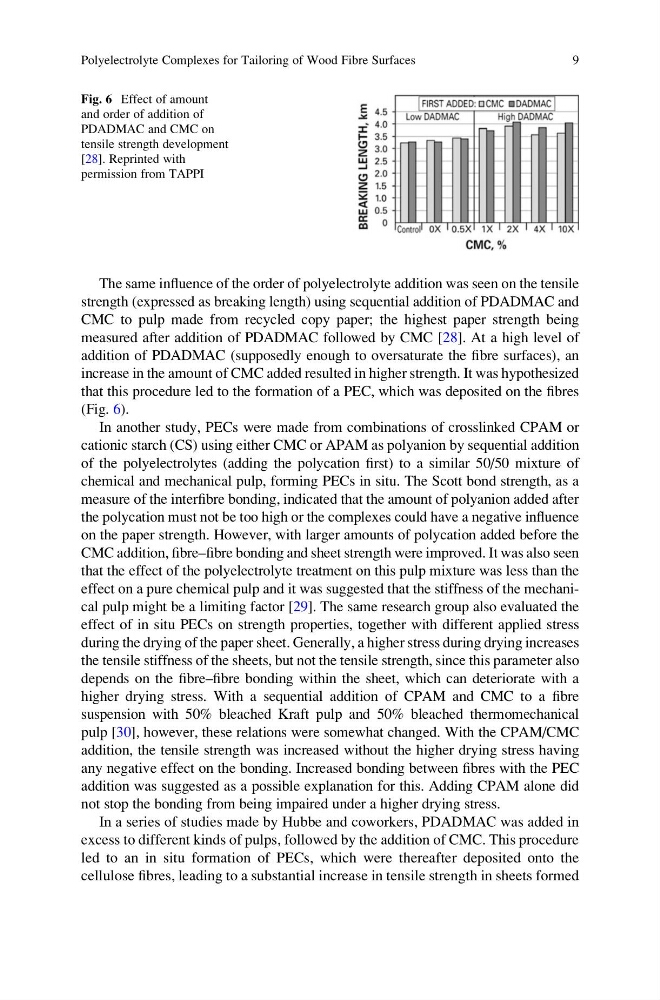
The same influence of the order of polyelectrolyte addition was seen on the tensile
strength (expressed as breaking length) using sequential addition of PDADMAC and
CMC to pulp made from recycled copy paper; the highest paper strength being
measured after addition of PDADMAC followed by CMC [28]. At a high level of
addition of PDADMAC (supposedly enough to oversaturate the fibre surfaces), an
increase in the amount of CMC added resulted in higher strength. It was hypothesized
that this procedure led to the formation of a PEC, which was deposited on the fibres
(Fig. 6).
In another study, PECs were made from combinations of crosslinked CPAM or
cationic starch (CS) using either CMC or APAM as polyanion by sequential addition
of the polyelectrolytes (adding the polycation first) to a similar 50/50 mixture of
chemical and mechanical pulp, forming PECs in situ. The Scott bond strength, as a
measure of the interfibre bonding, indicated that the amount of polyanion added after
the polycation must not be too high or the complexes could have a negative influence
on the paper strength. However, with larger amounts of polycation added before the
CMC addition, fibre–fibre bonding and sheet strength were improved. It was also seen
that the effect of the polyelectrolyte treatment on this pulp mixture was less than the
effect on a pure chemical pulp and it was suggested that the stiffness of the mechanical pulp might be a limiting factor [29]. The same research group also evaluated the
effect of in situ PECs on strength properties, together with different applied stress
during the drying of the paper sheet. Generally, a higher stress during drying increases
the tensile stiffness of the sheets, but not the tensile strength, since this parameter also
depends on the fibre–fibre bonding within the sheet, which can deteriorate with a
higher drying stress. With a sequential addition of CPAM and CMC to a fibre
suspension with 50% bleached Kraft pulp and 50% bleached thermomechanical
pulp [30], however, these relations were somewhat changed. With the CPAM/CMC
addition, the tensile strength was increased without the higher drying stress having
any negative effect on the bonding. Increased bonding between fibres with the PEC
addition was suggested as a possible explanation for this. Adding CPAM alone did
not stop the bonding from being impaired under a higher drying stress.
In a series of studies made by Hubbe and coworkers, PDADMAC was added in
excess to different kinds of pulps, followed by the addition of CMC. This procedure
led to an in situ formation of PECs, which were thereafter deposited onto the
cellulose fibres, leading to a substantial increase in tensile strength in sheets formed
Fig. 6 Effect of amount
and order of addition of
PDADMAC and CMC on
tensile strength development
[28]. Reprinted with
permission from TAPPI
Polyelectrolyte Complexes for Tailoring of Wood Fibre Surfaces
9
strength (expressed as breaking length) using sequential addition of PDADMAC and
CMC to pulp made from recycled copy paper; the highest paper strength being
measured after addition of PDADMAC followed by CMC [28]. At a high level of
addition of PDADMAC (supposedly enough to oversaturate the fibre surfaces), an
increase in the amount of CMC added resulted in higher strength. It was hypothesized
that this procedure led to the formation of a PEC, which was deposited on the fibres
(Fig. 6).
In another study, PECs were made from combinations of crosslinked CPAM or
cationic starch (CS) using either CMC or APAM as polyanion by sequential addition
of the polyelectrolytes (adding the polycation first) to a similar 50/50 mixture of
chemical and mechanical pulp, forming PECs in situ. The Scott bond strength, as a
measure of the interfibre bonding, indicated that the amount of polyanion added after
the polycation must not be too high or the complexes could have a negative influence
on the paper strength. However, with larger amounts of polycation added before the
CMC addition, fibre–fibre bonding and sheet strength were improved. It was also seen
that the effect of the polyelectrolyte treatment on this pulp mixture was less than the
effect on a pure chemical pulp and it was suggested that the stiffness of the mechanical pulp might be a limiting factor [29]. The same research group also evaluated the
effect of in situ PECs on strength properties, together with different applied stress
during the drying of the paper sheet. Generally, a higher stress during drying increases
the tensile stiffness of the sheets, but not the tensile strength, since this parameter also
depends on the fibre–fibre bonding within the sheet, which can deteriorate with a
higher drying stress. With a sequential addition of CPAM and CMC to a fibre
suspension with 50% bleached Kraft pulp and 50% bleached thermomechanical
pulp [30], however, these relations were somewhat changed. With the CPAM/CMC
addition, the tensile strength was increased without the higher drying stress having
any negative effect on the bonding. Increased bonding between fibres with the PEC
addition was suggested as a possible explanation for this. Adding CPAM alone did
not stop the bonding from being impaired under a higher drying stress.
In a series of studies made by Hubbe and coworkers, PDADMAC was added in
excess to different kinds of pulps, followed by the addition of CMC. This procedure
led to an in situ formation of PECs, which were thereafter deposited onto the
cellulose fibres, leading to a substantial increase in tensile strength in sheets formed
Fig. 6 Effect of amount
and order of addition of
PDADMAC and CMC on
tensile strength development
[28]. Reprinted with
permission from TAPPI
Polyelectrolyte Complexes for Tailoring of Wood Fibre Surfaces
9