

increase in imidazole content (from 73.5 to 82.5 mol%), the level of luciferase
expression approximately doubles at each DNA:polymer ratio. However, with a
further 4% increase in imidazole content (from 82.5 to 86.5 mol%), luciferase
expression levels approximately double again. These results suggest a nonlinear
relationship between polymer imidazole content and protein expression. Later
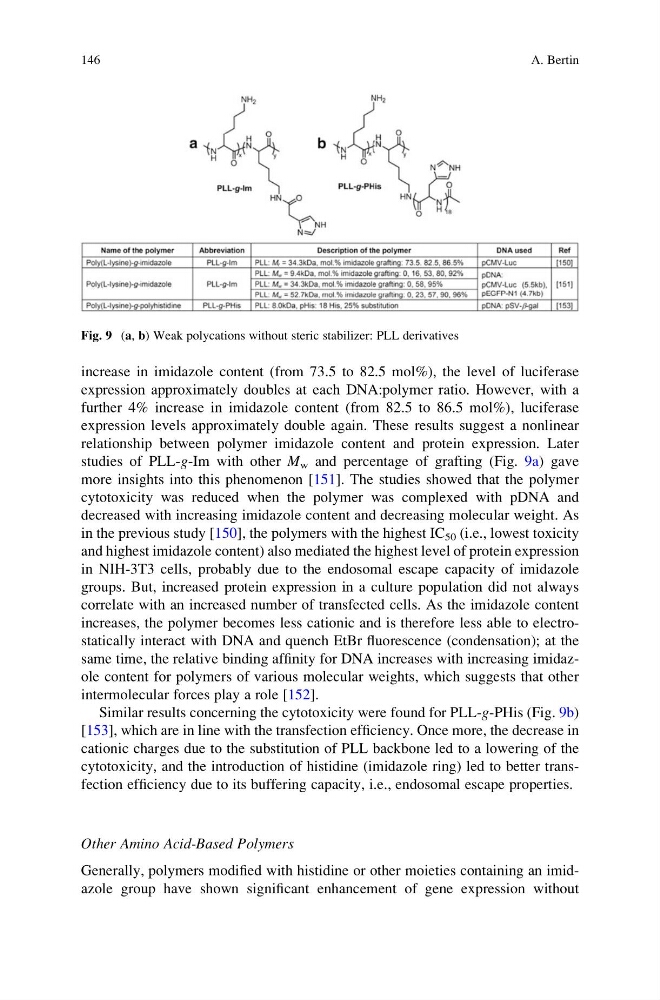
studies of PLL-g-Im with other M w and percentage of grafting (Fig. 9a) gave
more insights into this phenomenon [151]. The studies showed that the polymer
cytotoxicity was reduced when the polymer was complexed with pDNA and
decreased with increasing imidazole content and decreasing molecular weight. As
in the previous study [150], the polymers with the highest IC 50 (i.e., lowest toxicity
and highest imidazole content) also mediated the highest level of protein expression
in NIH-3T3 cells, probably due to the endosomal escape capacity of imidazole
groups. But, increased protein expression in a culture population did not always
correlate with an increased number of transfected cells. As the imidazole content
increases, the polymer becomes less cationic and is therefore less able to electrostatically interact with DNA and quench EtBr fluorescence (condensation); at the
same time, the relative binding affinity for DNA increases with increasing imidazole content for polymers of various molecular weights, which suggests that other
intermolecular forces play a role [152].
Similar results concerning the cytotoxicity were found for PLL-g-PHis (Fig. 9b)
[153], which are in line with the transfection efficiency. Once more, the decrease in
cationic charges due to the substitution of PLL backbone led to a lowering of the
cytotoxicity, and the introduction of histidine (imidazole ring) led to better transfection efficiency due to its buffering capacity, i.e., endosomal escape properties.
Other Amino Acid-Based Polymers
Generally, polymers modified with histidine or other moieties containing an imidazole group have shown significant enhancement of gene expression without
Fig. 9 (a, b) Weak polycations without steric stabilizer: PLL derivatives
146
A. Bertin
expression approximately doubles at each DNA:polymer ratio. However, with a
further 4% increase in imidazole content (from 82.5 to 86.5 mol%), luciferase
expression levels approximately double again. These results suggest a nonlinear
relationship between polymer imidazole content and protein expression. Later
studies of PLL-g-Im with other M w and percentage of grafting (Fig. 9a) gave
more insights into this phenomenon [151]. The studies showed that the polymer
cytotoxicity was reduced when the polymer was complexed with pDNA and
decreased with increasing imidazole content and decreasing molecular weight. As
in the previous study [150], the polymers with the highest IC 50 (i.e., lowest toxicity
and highest imidazole content) also mediated the highest level of protein expression
in NIH-3T3 cells, probably due to the endosomal escape capacity of imidazole
groups. But, increased protein expression in a culture population did not always
correlate with an increased number of transfected cells. As the imidazole content
increases, the polymer becomes less cationic and is therefore less able to electrostatically interact with DNA and quench EtBr fluorescence (condensation); at the
same time, the relative binding affinity for DNA increases with increasing imidazole content for polymers of various molecular weights, which suggests that other
intermolecular forces play a role [152].
Similar results concerning the cytotoxicity were found for PLL-g-PHis (Fig. 9b)
[153], which are in line with the transfection efficiency. Once more, the decrease in
cationic charges due to the substitution of PLL backbone led to a lowering of the
cytotoxicity, and the introduction of histidine (imidazole ring) led to better transfection efficiency due to its buffering capacity, i.e., endosomal escape properties.
Other Amino Acid-Based Polymers
Generally, polymers modified with histidine or other moieties containing an imidazole group have shown significant enhancement of gene expression without
Fig. 9 (a, b) Weak polycations without steric stabilizer: PLL derivatives
146
A. Bertin