

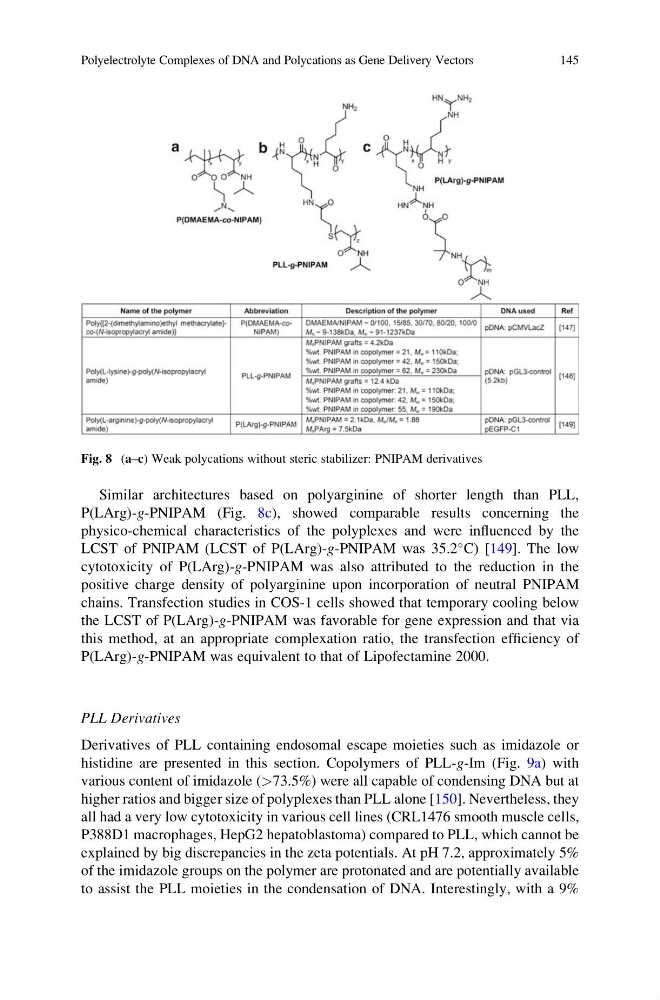
Similar architectures based on polyarginine of shorter length than PLL,
P(LArg)-g-PNIPAM (Fig. 8c), showed comparable results concerning the
physico-chemical characteristics of the polyplexes and were influenced by the
LCST of PNIPAM (LCST of P(LArg)-g-PNIPAM was 35.2
C) [149]. The low
cytotoxicity of P(LArg)-g-PNIPAM was also attributed to the reduction in the
positive charge density of polyarginine upon incorporation of neutral PNIPAM
chains. Transfection studies in COS-1 cells showed that temporary cooling below
the LCST of P(LArg)-g-PNIPAM was favorable for gene expression and that via
this method, at an appropriate complexation ratio, the transfection efficiency of
P(LArg)-g-PNIPAM was equivalent to that of Lipofectamine 2000.
PLL Derivatives
Derivatives of PLL containing endosomal escape moieties such as imidazole or
histidine are presented in this section. Copolymers of PLL-g-Im (Fig. 9a) with
various content of imidazole (>73.5%) were all capable of condensing DNA but at
higher ratios and bigger size of polyplexes than PLL alone [150]. Nevertheless, they
all had a very low cytotoxicity in various cell lines (CRL1476 smooth muscle cells,
P388D1 macrophages, HepG2 hepatoblastoma) compared to PLL, which cannot be
explained by big discrepancies in the zeta potentials. At pH 7.2, approximately 5%
of the imidazole groups on the polymer are protonated and are potentially available
to assist the PLL moieties in the condensation of DNA. Interestingly, with a 9%
Fig. 8 (a–c) Weak polycations without steric stabilizer: PNIPAM derivatives
Polyelectrolyte Complexes of DNA and Polycations as Gene Delivery Vectors
145
P(LArg)-g-PNIPAM (Fig. 8c), showed comparable results concerning the
physico-chemical characteristics of the polyplexes and were influenced by the
LCST of PNIPAM (LCST of P(LArg)-g-PNIPAM was 35.2
C) [149]. The low
cytotoxicity of P(LArg)-g-PNIPAM was also attributed to the reduction in the
positive charge density of polyarginine upon incorporation of neutral PNIPAM
chains. Transfection studies in COS-1 cells showed that temporary cooling below
the LCST of P(LArg)-g-PNIPAM was favorable for gene expression and that via
this method, at an appropriate complexation ratio, the transfection efficiency of
P(LArg)-g-PNIPAM was equivalent to that of Lipofectamine 2000.
PLL Derivatives
Derivatives of PLL containing endosomal escape moieties such as imidazole or
histidine are presented in this section. Copolymers of PLL-g-Im (Fig. 9a) with
various content of imidazole (>73.5%) were all capable of condensing DNA but at
higher ratios and bigger size of polyplexes than PLL alone [150]. Nevertheless, they
all had a very low cytotoxicity in various cell lines (CRL1476 smooth muscle cells,
P388D1 macrophages, HepG2 hepatoblastoma) compared to PLL, which cannot be
explained by big discrepancies in the zeta potentials. At pH 7.2, approximately 5%
of the imidazole groups on the polymer are protonated and are potentially available
to assist the PLL moieties in the condensation of DNA. Interestingly, with a 9%
Fig. 8 (a–c) Weak polycations without steric stabilizer: PNIPAM derivatives
Polyelectrolyte Complexes of DNA and Polycations as Gene Delivery Vectors
145