

Atomic force microscopy (AFM) and electron microscopy techniques allow
imaging the polyplexes. The electron microscopy techniques used, as for other
nanoparticles, are transmission electron microscopy (TEM) and cryo-TEM.
Charge Determination
In the case of strong polyelectrolytes, the number of ionized units corresponds to
the number of dissociable ionic units (see Manning condensation) and is independent of the pH. For weak polyelectrolytes, the number of ionized units at a given pH
is dependent on the pK a . From acid/base titration, their pK a as well as buffering
capacity (illustrated by plotting the pH of a solution containing a polymer as a
function of the volume of acid added) can be determined. The following equation
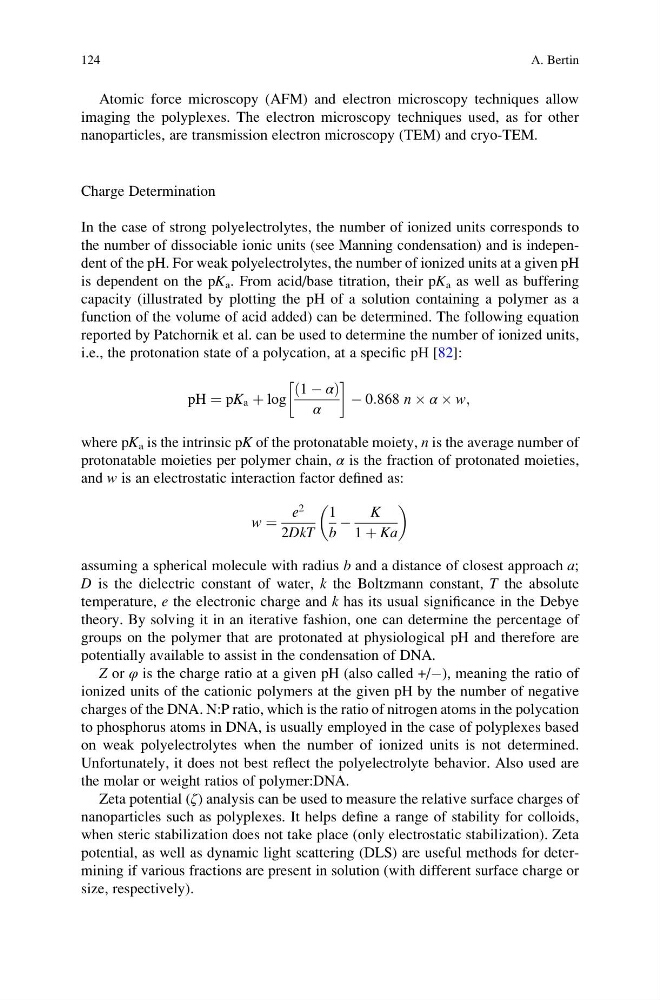
reported by Patchornik et al. can be used to determine the number of ionized units,
i.e., the protonation state of a polycation, at a specific pH [82]:
pH ¼ pK a þ log
1 À α
ð
Þ
α
À 0:868 n  α  w;
where pK a is the intrinsic pK of the protonatable moiety, n is the average number of
protonatable moieties per polymer chain, α is the fraction of protonated moieties,
and w is an electrostatic interaction factor defined as:
w ¼
e
2
2DkT
1
b
À
K
1 þ Ka
assuming a spherical molecule with radius b and a distance of closest approach a;
D is the dielectric constant of water, k the Boltzmann constant, T the absolute
temperature, e the electronic charge and k has its usual significance in the Debye
theory. By solving it in an iterative fashion, one can determine the percentage of
groups on the polymer that are protonated at physiological pH and therefore are
potentially available to assist in the condensation of DNA.
Z or φ is the charge ratio at a given pH (also called +/À), meaning the ratio of
ionized units of the cationic polymers at the given pH by the number of negative
charges of the DNA. N:P ratio, which is the ratio of nitrogen atoms in the polycation
to phosphorus atoms in DNA, is usually employed in the case of polyplexes based
on weak polyelectrolytes when the number of ionized units is not determined.
Unfortunately, it does not best reflect the polyelectrolyte behavior. Also used are
the molar or weight ratios of polymer:DNA.
Zeta potential (ζ) analysis can be used to measure the relative surface charges of
nanoparticles such as polyplexes. It helps define a range of stability for colloids,
when steric stabilization does not take place (only electrostatic stabilization). Zeta
potential, as well as dynamic light scattering (DLS) are useful methods for determining if various fractions are present in solution (with different surface charge or
size, respectively).
124
A. Bertin
imaging the polyplexes. The electron microscopy techniques used, as for other
nanoparticles, are transmission electron microscopy (TEM) and cryo-TEM.
Charge Determination
In the case of strong polyelectrolytes, the number of ionized units corresponds to
the number of dissociable ionic units (see Manning condensation) and is independent of the pH. For weak polyelectrolytes, the number of ionized units at a given pH
is dependent on the pK a . From acid/base titration, their pK a as well as buffering
capacity (illustrated by plotting the pH of a solution containing a polymer as a
function of the volume of acid added) can be determined. The following equation
reported by Patchornik et al. can be used to determine the number of ionized units,
i.e., the protonation state of a polycation, at a specific pH [82]:
pH ¼ pK a þ log
1 À α
ð
Þ
α
À 0:868 n  α  w;
where pK a is the intrinsic pK of the protonatable moiety, n is the average number of
protonatable moieties per polymer chain, α is the fraction of protonated moieties,
and w is an electrostatic interaction factor defined as:
w ¼
e
2
2DkT
1
b
À
K
1 þ Ka
assuming a spherical molecule with radius b and a distance of closest approach a;
D is the dielectric constant of water, k the Boltzmann constant, T the absolute
temperature, e the electronic charge and k has its usual significance in the Debye
theory. By solving it in an iterative fashion, one can determine the percentage of
groups on the polymer that are protonated at physiological pH and therefore are
potentially available to assist in the condensation of DNA.
Z or φ is the charge ratio at a given pH (also called +/À), meaning the ratio of
ionized units of the cationic polymers at the given pH by the number of negative
charges of the DNA. N:P ratio, which is the ratio of nitrogen atoms in the polycation
to phosphorus atoms in DNA, is usually employed in the case of polyplexes based
on weak polyelectrolytes when the number of ionized units is not determined.
Unfortunately, it does not best reflect the polyelectrolyte behavior. Also used are
the molar or weight ratios of polymer:DNA.
Zeta potential (ζ) analysis can be used to measure the relative surface charges of
nanoparticles such as polyplexes. It helps define a range of stability for colloids,
when steric stabilization does not take place (only electrostatic stabilization). Zeta
potential, as well as dynamic light scattering (DLS) are useful methods for determining if various fractions are present in solution (with different surface charge or
size, respectively).
124
A. Bertin