

Agarose gel electrophoresis separates macromolecules on the basis of both
charge and size, and the immobilization of DNA on a gel in the presence of cationic
polymer can be used to determine the conditions under which self-assembly and/or
charge neutralization occurs. It should be noted that retardation of polyplexes can
be due to neutralization of the positive charge or to an increase in mass.
Strength of the Complexation
Ethidium bromide (EtBr) is commonly used as a fluorescent nucleic acid stain in
techniques such as agarose gel electrophoresis. When excited by 530 nm light,
EtBr emits fluorescence at 610 nm, with an almost 20-fold increase in intensity
after intercalating into DNA base pairs due to π-stacking with the nucleobases
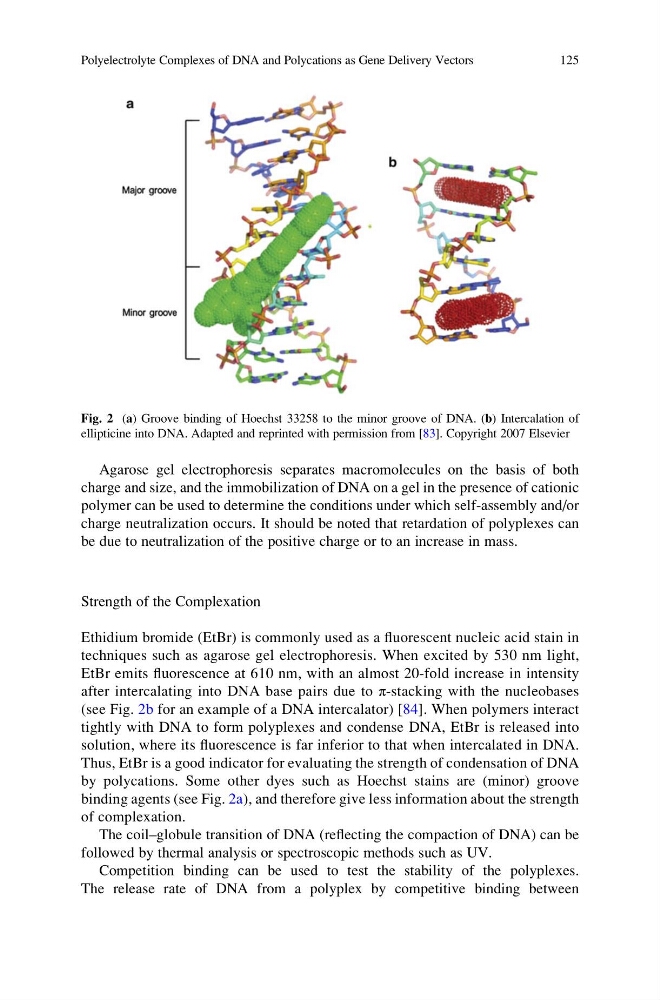
(see Fig. 2b for an example of a DNA intercalator) [84]. When polymers interact
tightly with DNA to form polyplexes and condense DNA, EtBr is released into
solution, where its fluorescence is far inferior to that when intercalated in DNA.
Thus, EtBr is a good indicator for evaluating the strength of condensation of DNA
by polycations. Some other dyes such as Hoechst stains are (minor) groove
binding agents (see Fig. 2a), and therefore give less information about the strength
of complexation.
The coil–globule transition of DNA (reflecting the compaction of DNA) can be
followed by thermal analysis or spectroscopic methods such as UV.
Competition binding can be used to test the stability of the polyplexes.
The release rate of DNA from a polyplex by competitive binding between
Fig. 2 (a) Groove binding of Hoechst 33258 to the minor groove of DNA. (b) Intercalation of
ellipticine into DNA. Adapted and reprinted with permission from [83]. Copyright 2007 Elsevier
Polyelectrolyte Complexes of DNA and Polycations as Gene Delivery Vectors
125
charge and size, and the immobilization of DNA on a gel in the presence of cationic
polymer can be used to determine the conditions under which self-assembly and/or
charge neutralization occurs. It should be noted that retardation of polyplexes can
be due to neutralization of the positive charge or to an increase in mass.
Strength of the Complexation
Ethidium bromide (EtBr) is commonly used as a fluorescent nucleic acid stain in
techniques such as agarose gel electrophoresis. When excited by 530 nm light,
EtBr emits fluorescence at 610 nm, with an almost 20-fold increase in intensity
after intercalating into DNA base pairs due to π-stacking with the nucleobases
(see Fig. 2b for an example of a DNA intercalator) [84]. When polymers interact
tightly with DNA to form polyplexes and condense DNA, EtBr is released into
solution, where its fluorescence is far inferior to that when intercalated in DNA.
Thus, EtBr is a good indicator for evaluating the strength of condensation of DNA
by polycations. Some other dyes such as Hoechst stains are (minor) groove
binding agents (see Fig. 2a), and therefore give less information about the strength
of complexation.
The coil–globule transition of DNA (reflecting the compaction of DNA) can be
followed by thermal analysis or spectroscopic methods such as UV.
Competition binding can be used to test the stability of the polyplexes.
The release rate of DNA from a polyplex by competitive binding between
Fig. 2 (a) Groove binding of Hoechst 33258 to the minor groove of DNA. (b) Intercalation of
ellipticine into DNA. Adapted and reprinted with permission from [83]. Copyright 2007 Elsevier
Polyelectrolyte Complexes of DNA and Polycations as Gene Delivery Vectors
125