

1.3.4 Characterization of Polyplexes
The final polyplexes either precipitate if they are water insoluble or form a colloidal
system (particles that have a diameter less than a micrometer evenly dispersed in
aqueous media in this case) if they are sufficiently stabilized even after complexation.
In both cases, these polymer–DNA complexes can be characterized using a variety of
analytical techniques, which will be presented in the next paragraph.
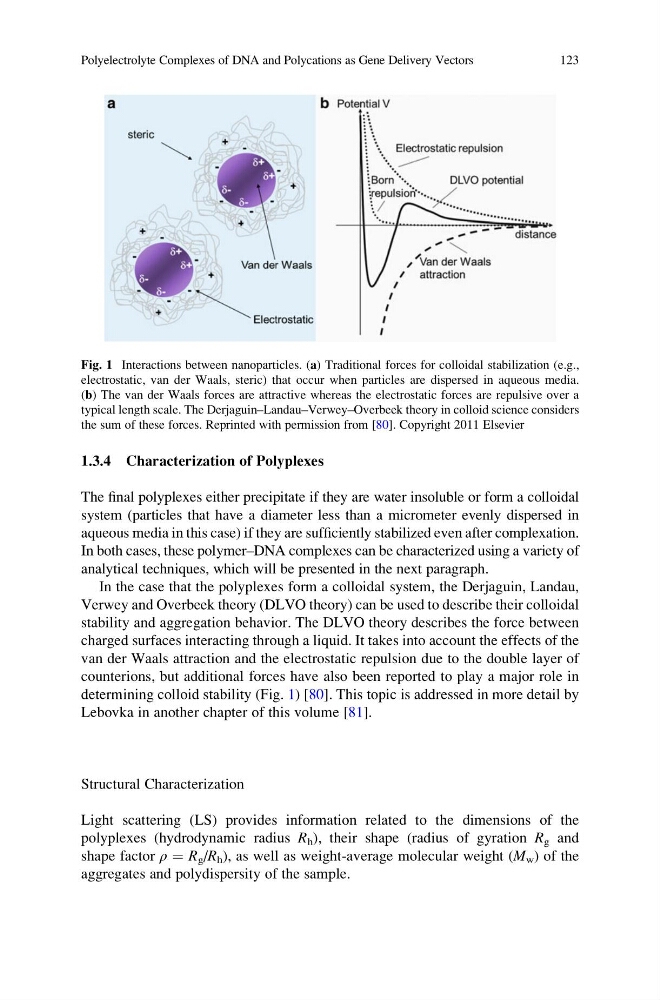
In the case that the polyplexes form a colloidal system, the Derjaguin, Landau,
Verwey and Overbeek theory (DLVO theory) can be used to describe their colloidal
stability and aggregation behavior. The DLVO theory describes the force between
charged surfaces interacting through a liquid. It takes into account the effects of the
van der Waals attraction and the electrostatic repulsion due to the double layer of
counterions, but additional forces have also been reported to play a major role in
determining colloid stability (Fig. 1) [80]. This topic is addressed in more detail by
Lebovka in another chapter of this volume [81].
Structural Characterization
Light scattering (LS) provides information related to the dimensions of the
polyplexes (hydrodynamic radius R h ), their shape (radius of gyration R g and
shape factor ρ ¼ R g /R h ), as well as weight-average molecular weight (M w ) of the
aggregates and polydispersity of the sample.
Fig. 1 Interactions between nanoparticles. (a) Traditional forces for colloidal stabilization (e.g.,
electrostatic, van der Waals, steric) that occur when particles are dispersed in aqueous media.
(b) The van der Waals forces are attractive whereas the electrostatic forces are repulsive over a
typical length scale. The Derjaguin–Landau–Verwey–Overbeek theory in colloid science considers
the sum of these forces. Reprinted with permission from [80]. Copyright 2011 Elsevier
Polyelectrolyte Complexes of DNA and Polycations as Gene Delivery Vectors
123
The final polyplexes either precipitate if they are water insoluble or form a colloidal
system (particles that have a diameter less than a micrometer evenly dispersed in
aqueous media in this case) if they are sufficiently stabilized even after complexation.
In both cases, these polymer–DNA complexes can be characterized using a variety of
analytical techniques, which will be presented in the next paragraph.
In the case that the polyplexes form a colloidal system, the Derjaguin, Landau,
Verwey and Overbeek theory (DLVO theory) can be used to describe their colloidal
stability and aggregation behavior. The DLVO theory describes the force between
charged surfaces interacting through a liquid. It takes into account the effects of the
van der Waals attraction and the electrostatic repulsion due to the double layer of
counterions, but additional forces have also been reported to play a major role in
determining colloid stability (Fig. 1) [80]. This topic is addressed in more detail by
Lebovka in another chapter of this volume [81].
Structural Characterization
Light scattering (LS) provides information related to the dimensions of the
polyplexes (hydrodynamic radius R h ), their shape (radius of gyration R g and
shape factor ρ ¼ R g /R h ), as well as weight-average molecular weight (M w ) of the
aggregates and polydispersity of the sample.
Fig. 1 Interactions between nanoparticles. (a) Traditional forces for colloidal stabilization (e.g.,
electrostatic, van der Waals, steric) that occur when particles are dispersed in aqueous media.
(b) The van der Waals forces are attractive whereas the electrostatic forces are repulsive over a
typical length scale. The Derjaguin–Landau–Verwey–Overbeek theory in colloid science considers
the sum of these forces. Reprinted with permission from [80]. Copyright 2011 Elsevier
Polyelectrolyte Complexes of DNA and Polycations as Gene Delivery Vectors
123