

i.e., in vivo (dilution effect and competition with other polyanions or polycations
present in the blood stream).
Insoluble Polyplexes
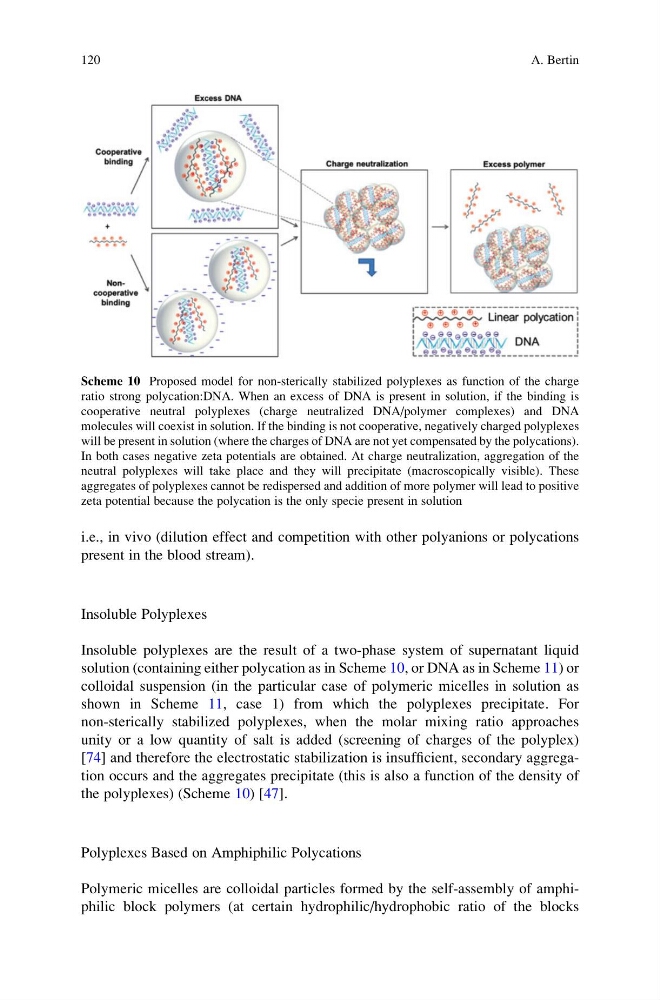
Insoluble polyplexes are the result of a two-phase system of supernatant liquid
solution (containing either polycation as in Scheme 10, or DNA as in Scheme 11) or
colloidal suspension (in the particular case of polymeric micelles in solution as
shown in Scheme 11, case 1) from which the polyplexes precipitate. For
non-sterically stabilized polyplexes, when the molar mixing ratio approaches
unity or a low quantity of salt is added (screening of charges of the polyplex)
[74] and therefore the electrostatic stabilization is insufficient, secondary aggregation occurs and the aggregates precipitate (this is also a function of the density of
the polyplexes) (Scheme 10) [47].
Polyplexes Based on Amphiphilic Polycations
Polymeric micelles are colloidal particles formed by the self-assembly of amphiphilic block polymers (at certain hydrophilic/hydrophobic ratio of the blocks
Scheme 10 Proposed model for non-sterically stabilized polyplexes as function of the charge
ratio strong polycation:DNA. When an excess of DNA is present in solution, if the binding is
cooperative neutral polyplexes (charge neutralized DNA/polymer complexes) and DNA
molecules will coexist in solution. If the binding is not cooperative, negatively charged polyplexes
will be present in solution (where the charges of DNA are not yet compensated by the polycations).
In both cases negative zeta potentials are obtained. At charge neutralization, aggregation of the
neutral polyplexes will take place and they will precipitate (macroscopically visible). These
aggregates of polyplexes cannot be redispersed and addition of more polymer will lead to positive
zeta potential because the polycation is the only specie present in solution
120
A. Bertin
present in the blood stream).
Insoluble Polyplexes
Insoluble polyplexes are the result of a two-phase system of supernatant liquid
solution (containing either polycation as in Scheme 10, or DNA as in Scheme 11) or
colloidal suspension (in the particular case of polymeric micelles in solution as
shown in Scheme 11, case 1) from which the polyplexes precipitate. For
non-sterically stabilized polyplexes, when the molar mixing ratio approaches
unity or a low quantity of salt is added (screening of charges of the polyplex)
[74] and therefore the electrostatic stabilization is insufficient, secondary aggregation occurs and the aggregates precipitate (this is also a function of the density of
the polyplexes) (Scheme 10) [47].
Polyplexes Based on Amphiphilic Polycations
Polymeric micelles are colloidal particles formed by the self-assembly of amphiphilic block polymers (at certain hydrophilic/hydrophobic ratio of the blocks
Scheme 10 Proposed model for non-sterically stabilized polyplexes as function of the charge
ratio strong polycation:DNA. When an excess of DNA is present in solution, if the binding is
cooperative neutral polyplexes (charge neutralized DNA/polymer complexes) and DNA
molecules will coexist in solution. If the binding is not cooperative, negatively charged polyplexes
will be present in solution (where the charges of DNA are not yet compensated by the polycations).
In both cases negative zeta potentials are obtained. At charge neutralization, aggregation of the
neutral polyplexes will take place and they will precipitate (macroscopically visible). These
aggregates of polyplexes cannot be redispersed and addition of more polymer will lead to positive
zeta potential because the polycation is the only specie present in solution
120
A. Bertin