

individual polycations, for instance by means of dialysis (dilution could eventually
have an influence on the stability of the polyplexes by influencing the equilibrium
between polycation and PIC micelle). In both cases (excess polycation adsorbed or
not at the surface of the polyplex), this would explain the big discrepancies between
the physico-chemical characteristics of polyplexes and their performances in vitro.
Even if the mixture of polymer and polyplex shows a positive zeta potential, this
does not mean that the polyplex containing the therapeutic gene is positively
charged. As a consequence, if the polyplex itself is neutral, it will not interact
favorably with the cell membrane and thus will not lead to high transfection
because of the low cellular uptake. Also, even if the polyplex has a positive zeta
potential due to the polycations adsorbed on the surface of the neutral polyplexes,
the polycation would probably be easily displaced after intravenous injection,
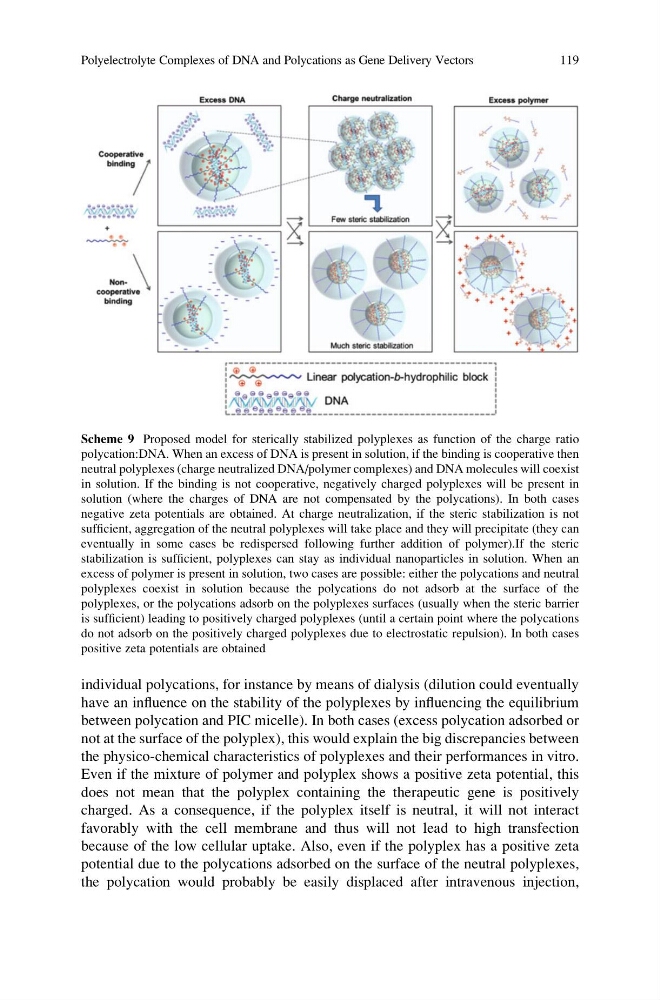
Scheme 9 Proposed model for sterically stabilized polyplexes as function of the charge ratio
polycation:DNA. When an excess of DNA is present in solution, if the binding is cooperative then
neutral polyplexes (charge neutralized DNA/polymer complexes) and DNA molecules will coexist
in solution. If the binding is not cooperative, negatively charged polyplexes will be present in
solution (where the charges of DNA are not compensated by the polycations). In both cases
negative zeta potentials are obtained. At charge neutralization, if the steric stabilization is not
sufficient, aggregation of the neutral polyplexes will take place and they will precipitate (they can
eventually in some cases be redispersed following further addition of polymer).If the steric
stabilization is sufficient, polyplexes can stay as individual nanoparticles in solution. When an
excess of polymer is present in solution, two cases are possible: either the polycations and neutral
polyplexes coexist in solution because the polycations do not adsorb at the surface of the
polyplexes, or the polycations adsorb on the polyplexes surfaces (usually when the steric barrier
is sufficient) leading to positively charged polyplexes (until a certain point where the polycations
do not adsorb on the positively charged polyplexes due to electrostatic repulsion). In both cases
positive zeta potentials are obtained
Polyelectrolyte Complexes of DNA and Polycations as Gene Delivery Vectors
119
have an influence on the stability of the polyplexes by influencing the equilibrium
between polycation and PIC micelle). In both cases (excess polycation adsorbed or
not at the surface of the polyplex), this would explain the big discrepancies between
the physico-chemical characteristics of polyplexes and their performances in vitro.
Even if the mixture of polymer and polyplex shows a positive zeta potential, this
does not mean that the polyplex containing the therapeutic gene is positively
charged. As a consequence, if the polyplex itself is neutral, it will not interact
favorably with the cell membrane and thus will not lead to high transfection
because of the low cellular uptake. Also, even if the polyplex has a positive zeta
potential due to the polycations adsorbed on the surface of the neutral polyplexes,
the polycation would probably be easily displaced after intravenous injection,
Scheme 9 Proposed model for sterically stabilized polyplexes as function of the charge ratio
polycation:DNA. When an excess of DNA is present in solution, if the binding is cooperative then
neutral polyplexes (charge neutralized DNA/polymer complexes) and DNA molecules will coexist
in solution. If the binding is not cooperative, negatively charged polyplexes will be present in
solution (where the charges of DNA are not compensated by the polycations). In both cases
negative zeta potentials are obtained. At charge neutralization, if the steric stabilization is not
sufficient, aggregation of the neutral polyplexes will take place and they will precipitate (they can
eventually in some cases be redispersed following further addition of polymer).If the steric
stabilization is sufficient, polyplexes can stay as individual nanoparticles in solution. When an
excess of polymer is present in solution, two cases are possible: either the polycations and neutral
polyplexes coexist in solution because the polycations do not adsorb at the surface of the
polyplexes, or the polycations adsorb on the polyplexes surfaces (usually when the steric barrier
is sufficient) leading to positively charged polyplexes (until a certain point where the polycations
do not adsorb on the positively charged polyplexes due to electrostatic repulsion). In both cases
positive zeta potentials are obtained
Polyelectrolyte Complexes of DNA and Polycations as Gene Delivery Vectors
119