

solutions of PVA of various molecular weights. Therefore, it is desirable to
perform some preliminary experiments with polymeric precursors of different
molecular weights in order to search for an optimum value of this parameter.
3. The formation rate of crosslinks between the polymer chains is also a factor
capable of hindering the gelation processes inside the UFLMP. When the
reactions proceed slowly, the crosslinks are generated rather uniformly throughout the UFLMP. However, for the fast reactions, the polymer chains are rapidly
bridged by the introduction of the first crosslinks, once the primary network is
formed, the subsequent crosslinks in highly viscous UFLMP are strongly hampered. This effect can result in a pronounced inhomogeneity in the crosslink
density distribution within the network. To minimize this effect and, thus, to
prepare cryogels with reproducible properties and porous morphology, one can
reduce the reaction rates and the initial concentration of the precursors.
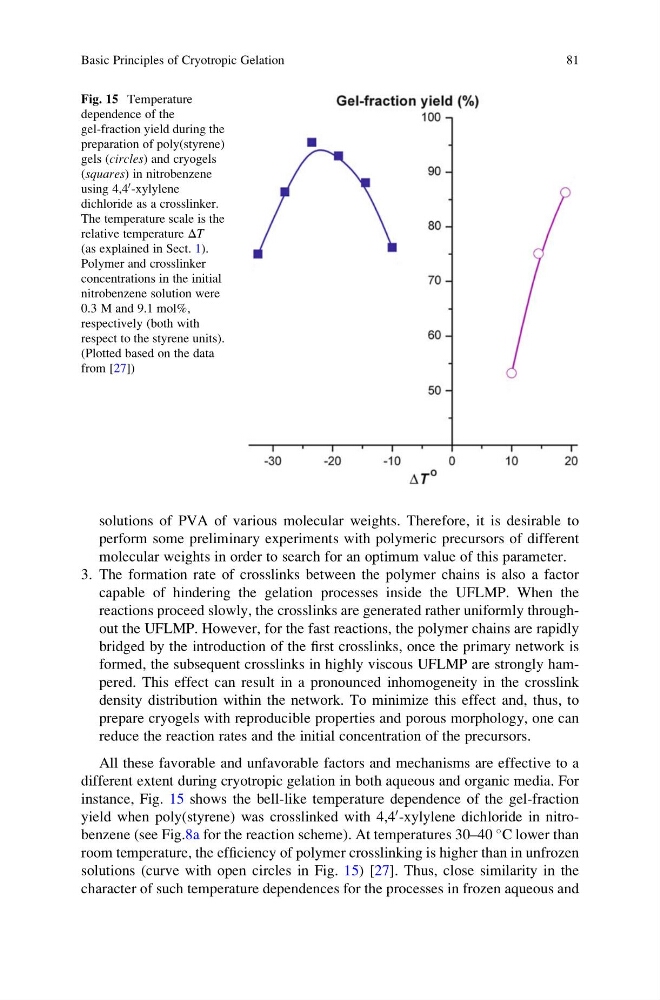
All these favorable and unfavorable factors and mechanisms are effective to a
different extent during cryotropic gelation in both aqueous and organic media. For
instance, Fig. 15 shows the bell-like temperature dependence of the gel-fraction
yield when poly(styrene) was crosslinked with 4,4
0 -xylylene dichloride in nitrobenzene (see Fig.8a for the reaction scheme). At temperatures 30–40
C lower than
room temperature, the efficiency of polymer crosslinking is higher than in unfrozen
solutions (curve with open circles in Fig. 15) [27]. Thus, close similarity in the
character of such temperature dependences for the processes in frozen aqueous and
Fig. 15 Temperature
dependence of the
gel-fraction yield during the
preparation of poly(styrene)
gels (circles) and cryogels
(squares) in nitrobenzene
using 4,4
0 -xylylene
dichloride as a crosslinker.
The temperature scale is the
relative temperature ΔT
(as explained in Sect. 1).
Polymer and crosslinker
concentrations in the initial
nitrobenzene solution were
0.3 M and 9.1 mol%,
respectively (both with
respect to the styrene units).
(Plotted based on the data
from [27])
Basic Principles of Cryotropic Gelation
81
perform some preliminary experiments with polymeric precursors of different
molecular weights in order to search for an optimum value of this parameter.
3. The formation rate of crosslinks between the polymer chains is also a factor
capable of hindering the gelation processes inside the UFLMP. When the
reactions proceed slowly, the crosslinks are generated rather uniformly throughout the UFLMP. However, for the fast reactions, the polymer chains are rapidly
bridged by the introduction of the first crosslinks, once the primary network is
formed, the subsequent crosslinks in highly viscous UFLMP are strongly hampered. This effect can result in a pronounced inhomogeneity in the crosslink
density distribution within the network. To minimize this effect and, thus, to
prepare cryogels with reproducible properties and porous morphology, one can
reduce the reaction rates and the initial concentration of the precursors.
All these favorable and unfavorable factors and mechanisms are effective to a
different extent during cryotropic gelation in both aqueous and organic media. For
instance, Fig. 15 shows the bell-like temperature dependence of the gel-fraction
yield when poly(styrene) was crosslinked with 4,4
0 -xylylene dichloride in nitrobenzene (see Fig.8a for the reaction scheme). At temperatures 30–40
C lower than
room temperature, the efficiency of polymer crosslinking is higher than in unfrozen
solutions (curve with open circles in Fig. 15) [27]. Thus, close similarity in the
character of such temperature dependences for the processes in frozen aqueous and
Fig. 15 Temperature
dependence of the
gel-fraction yield during the
preparation of poly(styrene)
gels (circles) and cryogels
(squares) in nitrobenzene
using 4,4
0 -xylylene
dichloride as a crosslinker.
The temperature scale is the
relative temperature ΔT
(as explained in Sect. 1).
Polymer and crosslinker
concentrations in the initial
nitrobenzene solution were
0.3 M and 9.1 mol%,
respectively (both with
respect to the styrene units).
(Plotted based on the data
from [27])
Basic Principles of Cryotropic Gelation
81