

1. According to the Arrhenius principle, a decrease in temperature lowers the
thermal mobility of the solutes and thus, decelerates the reactions. This is the
most significant unfavorable factor affecting the cryogelation process.
2. The high viscosity of UFLMP is the second unfavorable factor for cryotropic gel
formation. This factor is significant for cryogelation reactions starting from
polymeric precursors. Since the lower the temperature of a moderately frozen
system, the larger the amount of frozen solvent and, thus, the higher the polymer
concentration in UFLMP, the resulting high viscosity strongly hinders the
translational and segmental mobilities of the polymeric precursors and interferes
with their interactions. The molecular weight of the polymeric precursors also
affects the course of gel formation. The higher the molecular weight of the
polymeric solute, the higher is the extent of coil overlap and, hence, the higher is
the probability of intermolecular interactions. On the other hand, the higher the
chain length of the polymers, the higher is the viscosity of the equiconcentrated
polymer solutions. Thus, these two trends act oppositely and compete against
each other in the course of gel formation. This is also the reason why a bell-like
dependence of the gelation efficiency on the molecular weight of the polymeric
precursors is often observed. For particular examples, see [32, 44, 155] dealing
with the synthesis of chitosan and poly(acrylamide) cryogels via crosslinking by
glutaraldehyde, and with the noncovalent cryotropic gelation of aqueous
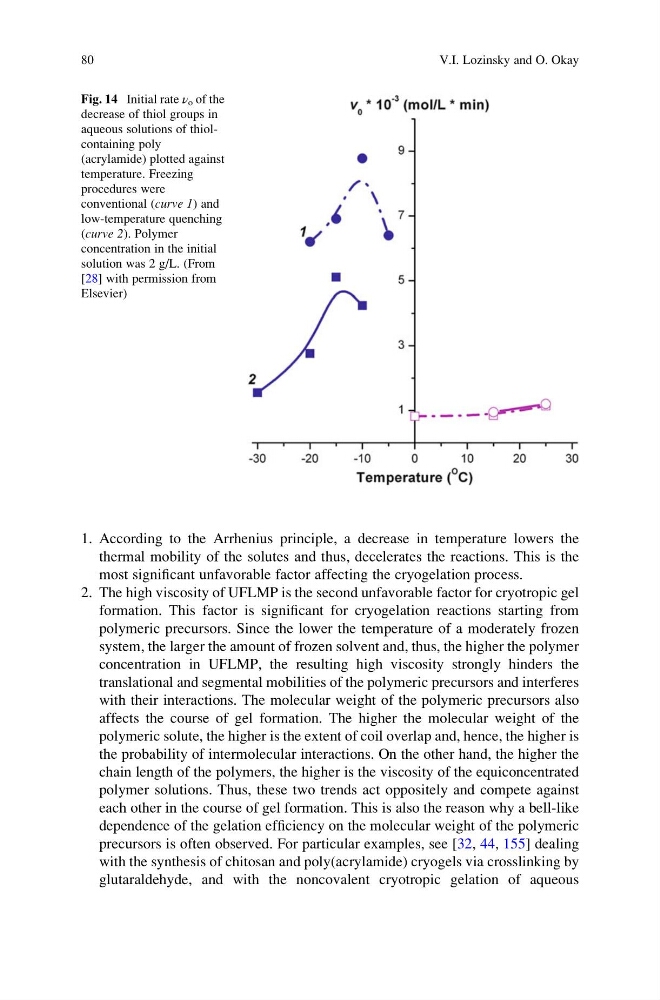
Fig. 14 Initial rate ν o of the
decrease of thiol groups in
aqueous solutions of thiolcontaining poly
(acrylamide) plotted against
temperature. Freezing
procedures were
conventional (curve 1) and
low-temperature quenching
(curve 2). Polymer
concentration in the initial
solution was 2 g/L. (From
[28] with permission from
Elsevier)
80
V.I. Lozinsky and O. Okay
thermal mobility of the solutes and thus, decelerates the reactions. This is the
most significant unfavorable factor affecting the cryogelation process.
2. The high viscosity of UFLMP is the second unfavorable factor for cryotropic gel
formation. This factor is significant for cryogelation reactions starting from
polymeric precursors. Since the lower the temperature of a moderately frozen
system, the larger the amount of frozen solvent and, thus, the higher the polymer
concentration in UFLMP, the resulting high viscosity strongly hinders the
translational and segmental mobilities of the polymeric precursors and interferes
with their interactions. The molecular weight of the polymeric precursors also
affects the course of gel formation. The higher the molecular weight of the
polymeric solute, the higher is the extent of coil overlap and, hence, the higher is
the probability of intermolecular interactions. On the other hand, the higher the
chain length of the polymers, the higher is the viscosity of the equiconcentrated
polymer solutions. Thus, these two trends act oppositely and compete against
each other in the course of gel formation. This is also the reason why a bell-like
dependence of the gelation efficiency on the molecular weight of the polymeric
precursors is often observed. For particular examples, see [32, 44, 155] dealing
with the synthesis of chitosan and poly(acrylamide) cryogels via crosslinking by
glutaraldehyde, and with the noncovalent cryotropic gelation of aqueous
Fig. 14 Initial rate ν o of the
decrease of thiol groups in
aqueous solutions of thiolcontaining poly
(acrylamide) plotted against
temperature. Freezing
procedures were
conventional (curve 1) and
low-temperature quenching
(curve 2). Polymer
concentration in the initial
solution was 2 g/L. (From
[28] with permission from
Elsevier)
80
V.I. Lozinsky and O. Okay