

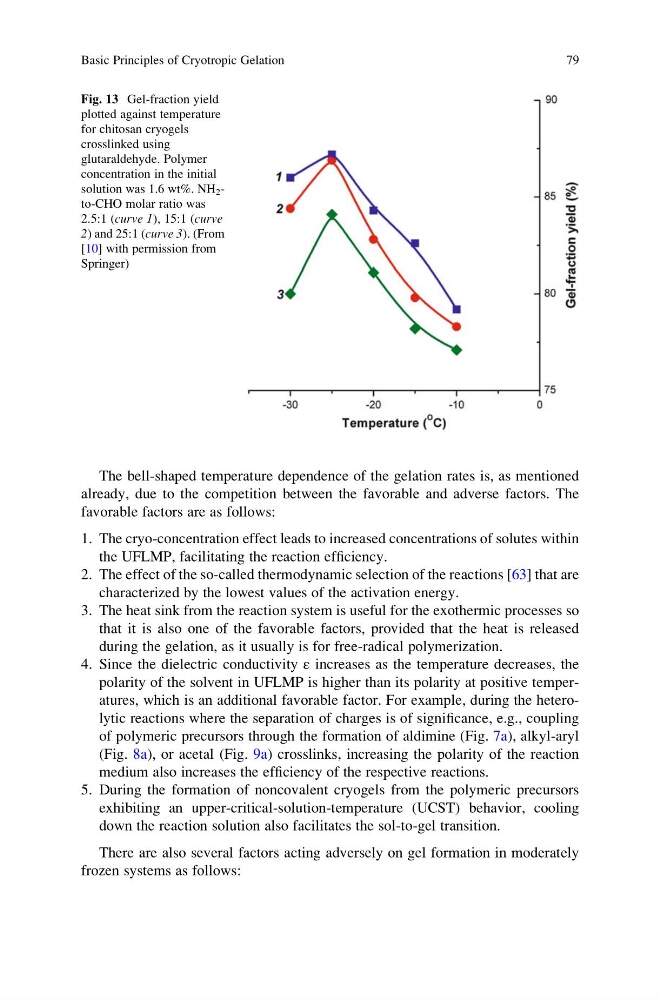
The bell-shaped temperature dependence of the gelation rates is, as mentioned
already, due to the competition between the favorable and adverse factors. The
favorable factors are as follows:
1. The cryo-concentration effect leads to increased concentrations of solutes within
the UFLMP, facilitating the reaction efficiency.
2. The effect of the so-called thermodynamic selection of the reactions [63] that are
characterized by the lowest values of the activation energy.
3. The heat sink from the reaction system is useful for the exothermic processes so
that it is also one of the favorable factors, provided that the heat is released
during the gelation, as it usually is for free-radical polymerization.
4. Since the dielectric conductivity ε increases as the temperature decreases, the
polarity of the solvent in UFLMP is higher than its polarity at positive temperatures, which is an additional favorable factor. For example, during the heterolytic reactions where the separation of charges is of significance, e.g., coupling
of polymeric precursors through the formation of aldimine (Fig. 7a), alkyl-aryl
(Fig. 8a), or acetal (Fig. 9a) crosslinks, increasing the polarity of the reaction
medium also increases the efficiency of the respective reactions.
5. During the formation of noncovalent cryogels from the polymeric precursors
exhibiting an upper-critical-solution-temperature (UCST) behavior, cooling
down the reaction solution also facilitates the sol-to-gel transition.
There are also several factors acting adversely on gel formation in moderately
frozen systems as follows:
Fig. 13 Gel-fraction yield
plotted against temperature
for chitosan cryogels
crosslinked using
glutaraldehyde. Polymer
concentration in the initial
solution was 1.6 wt%. NH 2 -
to-CHO molar ratio was
2.5:1 (curve 1), 15:1 (curve
2) and 25:1 (curve 3). (From
[10] with permission from
Springer)
Basic Principles of Cryotropic Gelation
79
already, due to the competition between the favorable and adverse factors. The
favorable factors are as follows:
1. The cryo-concentration effect leads to increased concentrations of solutes within
the UFLMP, facilitating the reaction efficiency.
2. The effect of the so-called thermodynamic selection of the reactions [63] that are
characterized by the lowest values of the activation energy.
3. The heat sink from the reaction system is useful for the exothermic processes so
that it is also one of the favorable factors, provided that the heat is released
during the gelation, as it usually is for free-radical polymerization.
4. Since the dielectric conductivity ε increases as the temperature decreases, the
polarity of the solvent in UFLMP is higher than its polarity at positive temperatures, which is an additional favorable factor. For example, during the heterolytic reactions where the separation of charges is of significance, e.g., coupling
of polymeric precursors through the formation of aldimine (Fig. 7a), alkyl-aryl
(Fig. 8a), or acetal (Fig. 9a) crosslinks, increasing the polarity of the reaction
medium also increases the efficiency of the respective reactions.
5. During the formation of noncovalent cryogels from the polymeric precursors
exhibiting an upper-critical-solution-temperature (UCST) behavior, cooling
down the reaction solution also facilitates the sol-to-gel transition.
There are also several factors acting adversely on gel formation in moderately
frozen systems as follows:
Fig. 13 Gel-fraction yield
plotted against temperature
for chitosan cryogels
crosslinked using
glutaraldehyde. Polymer
concentration in the initial
solution was 1.6 wt%. NH 2 -
to-CHO molar ratio was
2.5:1 (curve 1), 15:1 (curve
2) and 25:1 (curve 3). (From
[10] with permission from
Springer)
Basic Principles of Cryotropic Gelation
79