

underwent the first thermal cycle of the freeze–thaw cycling process [59]. This
changed the microstructure of the PVA-C, causing the crystallites to orient in the
direction of the stress. Details of the nanostructure of the anisotropic PVA-C have
been studied using SANS and USANS [11]. Differences for tensile properties
between the longitudinal and perpendicular directions increased as the initial strain
applied after the first cycle was increased. The porcine aorta has a higher strength in
the circumferential direction than in the axial direction by a factor of 1.75 at a strain
of 65 % [42]. These properties are closely matched by the anisotropic PVA-C
prepared using three FTCs at an initial strain of 75 %. Finally, stress relaxation tests
show that the anisotropic PVA relaxes as fast as porcine aortic tissue and to a lower
residual stress, making it a promising material for aortic tissue replacement applications, including heart valves and vascular grafts. Preparation of prototype vascular grafts using the anisotropic PVA-C has been demonstrated [10].
In the process of expanding the mechanical properties range of PVA-C by the
creation of the PVA-BC nanocomposite [42], an anisotropic PVA-BC
nanocomposite was also prepared using a procedure similar to that for the anisotropic PVA-C [59]. This anisotropic PVA-BC nanocomposite proved to be a
material that possesses mechanical properties that closely match those of the
porcine aorta, thus making it an attractive material for replacement vascular graft
preparation and other cardiovascular applications. The material properties of the
anisotropic PVA-BC have been incorporated into the design of a one-piece trileaflet
heart valve using a nonlinear finite element modeling method [101].
5.2 PVA-C Tissue Hybrid
For medical device application of PVA-C, it is certainly important that its mechanical properties closely match the tissue it is replacing and are compatible with the
tissue environment it is implanted into. However, for cardiovascular devices, which
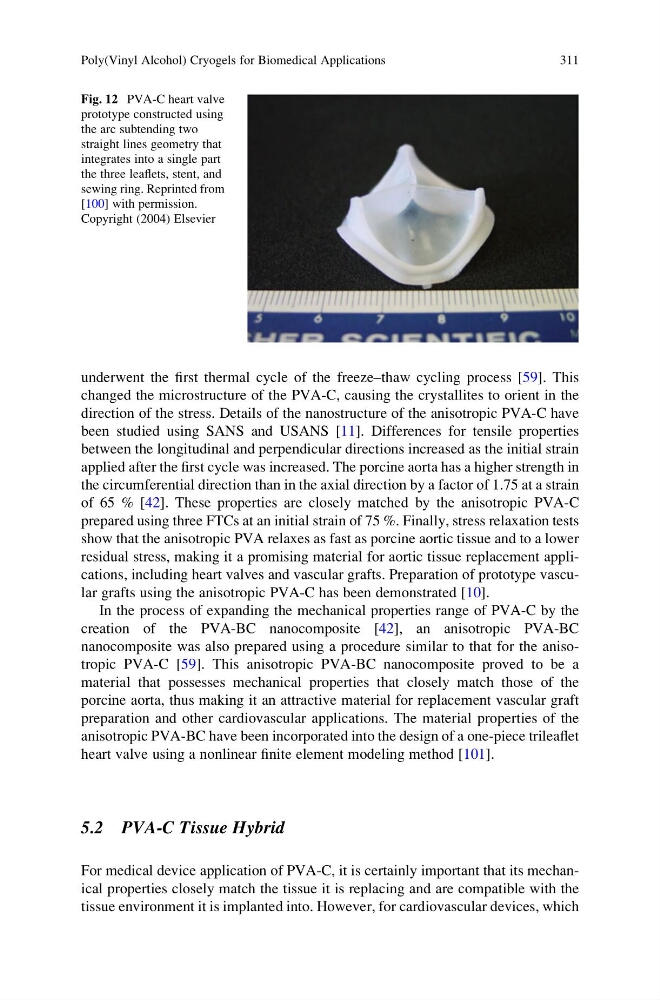
Fig. 12 PVA-C heart valve
prototype constructed using
the arc subtending two
straight lines geometry that
integrates into a single part
the three leaflets, stent, and
sewing ring. Reprinted from
[100] with permission.
Copyright (2004) Elsevier
Poly(Vinyl Alcohol) Cryogels for Biomedical Applications
311
changed the microstructure of the PVA-C, causing the crystallites to orient in the
direction of the stress. Details of the nanostructure of the anisotropic PVA-C have
been studied using SANS and USANS [11]. Differences for tensile properties
between the longitudinal and perpendicular directions increased as the initial strain
applied after the first cycle was increased. The porcine aorta has a higher strength in
the circumferential direction than in the axial direction by a factor of 1.75 at a strain
of 65 % [42]. These properties are closely matched by the anisotropic PVA-C
prepared using three FTCs at an initial strain of 75 %. Finally, stress relaxation tests
show that the anisotropic PVA relaxes as fast as porcine aortic tissue and to a lower
residual stress, making it a promising material for aortic tissue replacement applications, including heart valves and vascular grafts. Preparation of prototype vascular grafts using the anisotropic PVA-C has been demonstrated [10].
In the process of expanding the mechanical properties range of PVA-C by the
creation of the PVA-BC nanocomposite [42], an anisotropic PVA-BC
nanocomposite was also prepared using a procedure similar to that for the anisotropic PVA-C [59]. This anisotropic PVA-BC nanocomposite proved to be a
material that possesses mechanical properties that closely match those of the
porcine aorta, thus making it an attractive material for replacement vascular graft
preparation and other cardiovascular applications. The material properties of the
anisotropic PVA-BC have been incorporated into the design of a one-piece trileaflet
heart valve using a nonlinear finite element modeling method [101].
5.2 PVA-C Tissue Hybrid
For medical device application of PVA-C, it is certainly important that its mechanical properties closely match the tissue it is replacing and are compatible with the
tissue environment it is implanted into. However, for cardiovascular devices, which
Fig. 12 PVA-C heart valve
prototype constructed using
the arc subtending two
straight lines geometry that
integrates into a single part
the three leaflets, stent, and
sewing ring. Reprinted from
[100] with permission.
Copyright (2004) Elsevier
Poly(Vinyl Alcohol) Cryogels for Biomedical Applications
311