

earlier study, it was found that BSA release was mainly by means of a diffusion
mechanism. The diffusion coefficients of BSA could be controlled over a 20-fold
range by adjusting the processing parameters, including the number of FTCs, PVA
concentration, and freezing and thawing rates.
Increasing the number of thermal cycles decreases the release rate (Fig. 6).
Every thermal cycle after the first FTC resulted in an increase in the local PVA
concentration in the polymer-rich regions concomitant with an increase in the
volume fraction of the crystalline regions [61]. This leads to an increase in the
time required for the movement of BSA through the amorphous zones of the
polymer-rich region, resulting in the observed decrease in the release rate.
Decreasing the freezing rate also decreases the release rate at constant thawing
rate. The effect of changing thawing rate is similar to that of changing freezing rate
(Fig. 7). A decrease in the freezing or thawing rate allows more time for the
polymer chains to reorganize themselves into ordered domains, resulting in an
increase in the volume fraction of crystalline PVA and/or increase in the size of
the crystalline domains. This leads to a decrease in BSA mobility in the PVA matrix
and thus to a decrease in its release rate.
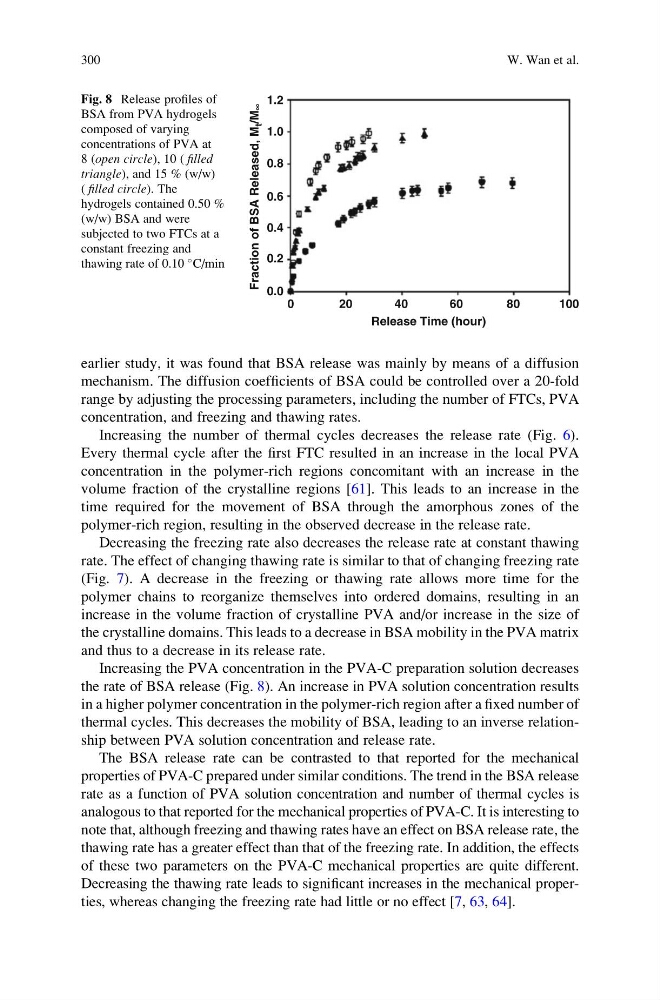
Increasing the PVA concentration in the PVA-C preparation solution decreases
the rate of BSA release (Fig. 8). An increase in PVA solution concentration results
in a higher polymer concentration in the polymer-rich region after a fixed number of
thermal cycles. This decreases the mobility of BSA, leading to an inverse relationship between PVA solution concentration and release rate.
The BSA release rate can be contrasted to that reported for the mechanical
properties of PVA-C prepared under similar conditions. The trend in the BSA release
rate as a function of PVA solution concentration and number of thermal cycles is
analogous to that reported for the mechanical properties of PVA-C. It is interesting to
note that, although freezing and thawing rates have an effect on BSA release rate, the
thawing rate has a greater effect than that of the freezing rate. In addition, the effects
of these two parameters on the PVA-C mechanical properties are quite different.
Decreasing the thawing rate leads to significant increases in the mechanical properties, whereas changing the freezing rate had little or no effect [7, 63, 64].
20
Release Time (hour)
60
80
40
100
0
0.6
Fraction of BSA Released, M
t /M•
1.2
1.0
0.8
0.4
0.2
0.0
Fig. 8 Release profiles of
BSA from PVA hydrogels
composed of varying
concentrations of PVA at
8 (open circle), 10 ( filled
triangle), and 15 % (w/w)
( filled circle). The
hydrogels contained 0.50 %
(w/w) BSA and were
subjected to two FTCs at a
constant freezing and
thawing rate of 0.10
C/min
300
W. Wan et al.
mechanism. The diffusion coefficients of BSA could be controlled over a 20-fold
range by adjusting the processing parameters, including the number of FTCs, PVA
concentration, and freezing and thawing rates.
Increasing the number of thermal cycles decreases the release rate (Fig. 6).
Every thermal cycle after the first FTC resulted in an increase in the local PVA
concentration in the polymer-rich regions concomitant with an increase in the
volume fraction of the crystalline regions [61]. This leads to an increase in the
time required for the movement of BSA through the amorphous zones of the
polymer-rich region, resulting in the observed decrease in the release rate.
Decreasing the freezing rate also decreases the release rate at constant thawing
rate. The effect of changing thawing rate is similar to that of changing freezing rate
(Fig. 7). A decrease in the freezing or thawing rate allows more time for the
polymer chains to reorganize themselves into ordered domains, resulting in an
increase in the volume fraction of crystalline PVA and/or increase in the size of
the crystalline domains. This leads to a decrease in BSA mobility in the PVA matrix
and thus to a decrease in its release rate.
Increasing the PVA concentration in the PVA-C preparation solution decreases
the rate of BSA release (Fig. 8). An increase in PVA solution concentration results
in a higher polymer concentration in the polymer-rich region after a fixed number of
thermal cycles. This decreases the mobility of BSA, leading to an inverse relationship between PVA solution concentration and release rate.
The BSA release rate can be contrasted to that reported for the mechanical
properties of PVA-C prepared under similar conditions. The trend in the BSA release
rate as a function of PVA solution concentration and number of thermal cycles is
analogous to that reported for the mechanical properties of PVA-C. It is interesting to
note that, although freezing and thawing rates have an effect on BSA release rate, the
thawing rate has a greater effect than that of the freezing rate. In addition, the effects
of these two parameters on the PVA-C mechanical properties are quite different.
Decreasing the thawing rate leads to significant increases in the mechanical properties, whereas changing the freezing rate had little or no effect [7, 63, 64].
20
Release Time (hour)
60
80
40
100
0
0.6
Fraction of BSA Released, M
t /M•
1.2
1.0
0.8
0.4
0.2
0.0
Fig. 8 Release profiles of
BSA from PVA hydrogels
composed of varying
concentrations of PVA at
8 (open circle), 10 ( filled
triangle), and 15 % (w/w)
( filled circle). The
hydrogels contained 0.50 %
(w/w) BSA and were
subjected to two FTCs at a
constant freezing and
thawing rate of 0.10
C/min
300
W. Wan et al.