

are consistent with what is known about the PVA matrix structure and the effects of
changing the processing parameters [62]. Building on these results, a comprehensive and systematic study was undertaken by our group to provide a global view of
the effect of processing (number of FTCs, freezing rate, thawing rate) and composition (PVA concentration) parameters on protein release. PVA-C films prepared by
freeze–thaw cycling were used as model drug delivery vehicles with BSA as the
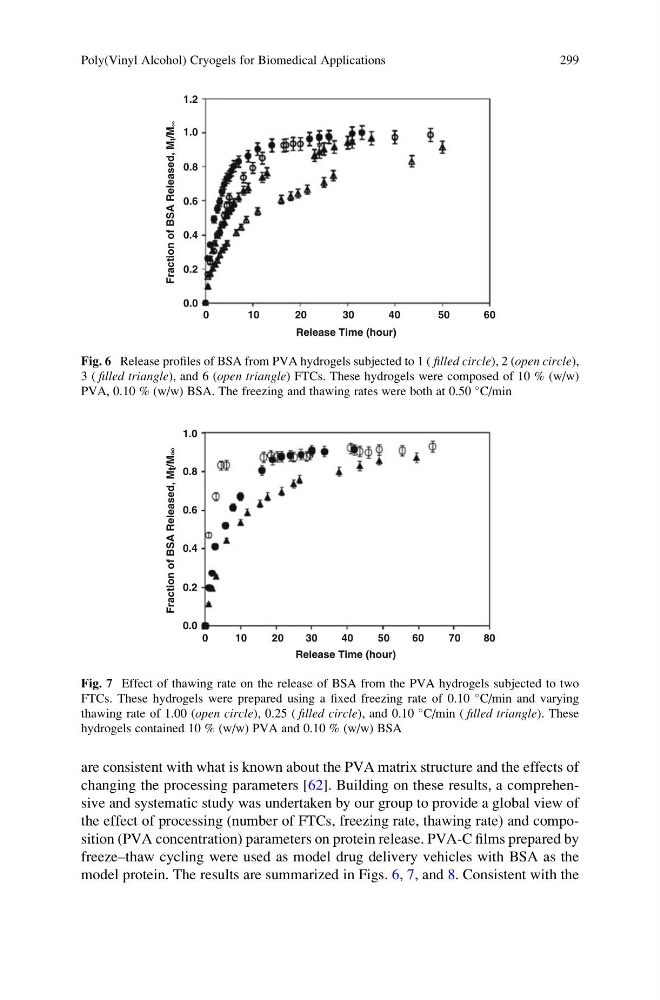
model protein. The results are summarized in Figs. 6, 7, and 8. Consistent with the
20
Release Time (hour)
60
50
40
30
10
0
0.6
Fraction of BSA Released, Mt/M•
1.2
1.0
0.8
0.4
0.2
0.0
Fig. 6 Release profiles of BSA from PVA hydrogels subjected to 1 ( filled circle), 2 (open circle),
3 ( filled triangle), and 6 (open triangle) FTCs. These hydrogels were composed of 10 % (w/w)
PVA, 0.10 % (w/w) BSA. The freezing and thawing rates were both at 0.50
C/min
20
Release Time (hour)
80
70
60
50
40
30
10
0
0.6
Fraction of BSA Released, M
t /M
•
1.0
0.8
0.4
0.2
0.0
Fig. 7 Effect of thawing rate on the release of BSA from the PVA hydrogels subjected to two
FTCs. These hydrogels were prepared using a fixed freezing rate of 0.10
C/min and varying
thawing rate of 1.00 (open circle), 0.25 ( filled circle), and 0.10
C/min ( filled triangle). These
hydrogels contained 10 % (w/w) PVA and 0.10 % (w/w) BSA
Poly(Vinyl Alcohol) Cryogels for Biomedical Applications
299
changing the processing parameters [62]. Building on these results, a comprehensive and systematic study was undertaken by our group to provide a global view of
the effect of processing (number of FTCs, freezing rate, thawing rate) and composition (PVA concentration) parameters on protein release. PVA-C films prepared by
freeze–thaw cycling were used as model drug delivery vehicles with BSA as the
model protein. The results are summarized in Figs. 6, 7, and 8. Consistent with the
20
Release Time (hour)
60
50
40
30
10
0
0.6
Fraction of BSA Released, Mt/M•
1.2
1.0
0.8
0.4
0.2
0.0
Fig. 6 Release profiles of BSA from PVA hydrogels subjected to 1 ( filled circle), 2 (open circle),
3 ( filled triangle), and 6 (open triangle) FTCs. These hydrogels were composed of 10 % (w/w)
PVA, 0.10 % (w/w) BSA. The freezing and thawing rates were both at 0.50
C/min
20
Release Time (hour)
80
70
60
50
40
30
10
0
0.6
Fraction of BSA Released, M
t /M
•
1.0
0.8
0.4
0.2
0.0
Fig. 7 Effect of thawing rate on the release of BSA from the PVA hydrogels subjected to two
FTCs. These hydrogels were prepared using a fixed freezing rate of 0.10
C/min and varying
thawing rate of 1.00 (open circle), 0.25 ( filled circle), and 0.10
C/min ( filled triangle). These
hydrogels contained 10 % (w/w) PVA and 0.10 % (w/w) BSA
Poly(Vinyl Alcohol) Cryogels for Biomedical Applications
299