

Although the close parallel between the effects of processing parameters on
diffusion and the mechanical properties of PVA-C can be clearly seen, the structural characteristics leading to these observations are quite different. For mechanical properties, the changing stiffness as a function of processing condition is a
result of the changing volume fraction of crystalline regions of the material. On the
other hand, the diffusion properties are more a function of the properties of the
amorphous zone of the polymer-rich regions, largely affected by PVA concentration. Indirectly, the crystalline regions affect the amorphous zone by dictating how
tightly the polymer chains are packed, thus making the number of FTCs, freezing
rate, and thawing rate contributing parameters to the diffusive properties.
Irrespective of the origin of these two observed properties, they could be used to
create medical devices with integrated controlled release function, such as the drugeluting coronary stent, by tuning the mechanical and diffusion properties of the
PVA hydrogel simultaneously.
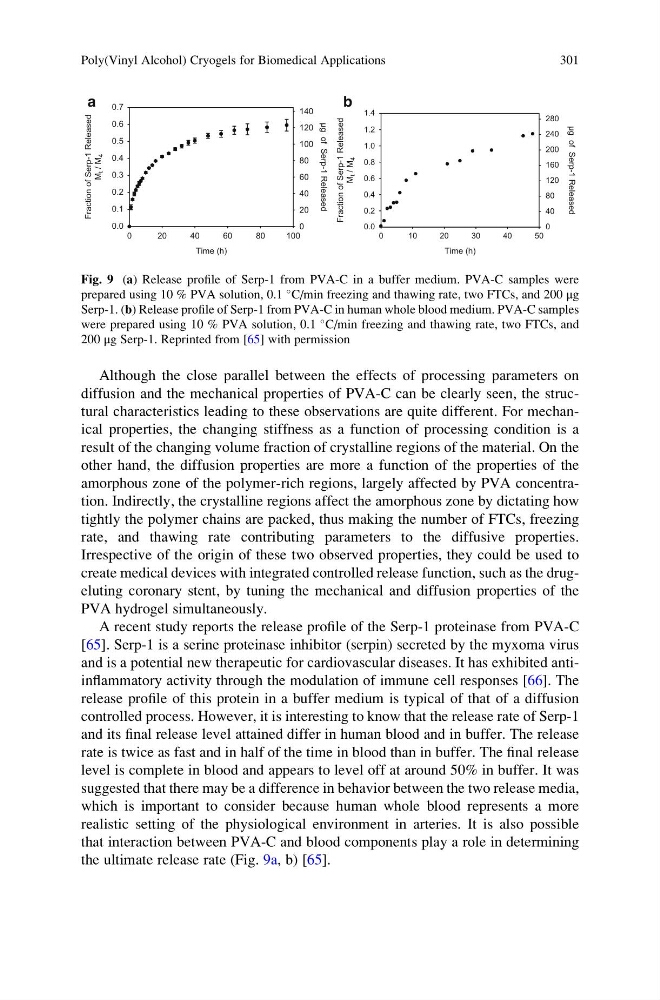
A recent study reports the release profile of the Serp-1 proteinase from PVA-C
[65]. Serp-1 is a serine proteinase inhibitor (serpin) secreted by the myxoma virus
and is a potential new therapeutic for cardiovascular diseases. It has exhibited antiinflammatory activity through the modulation of immune cell responses [66]. The
release profile of this protein in a buffer medium is typical of that of a diffusion
controlled process. However, it is interesting to know that the release rate of Serp-1
and its final release level attained differ in human blood and in buffer. The release
rate is twice as fast and in half of the time in blood than in buffer. The final release
level is complete in blood and appears to level off at around 50% in buffer. It was
suggested that there may be a difference in behavior between the two release media,
which is important to consider because human whole blood represents a more
realistic setting of the physiological environment in arteries. It is also possible
that interaction between PVA-C and blood components play a role in determining
the ultimate release rate (Fig. 9a, b) [65].
0
2 0
4 0
6 0
8 0
1 0 0
0.0
0.1
0.2
0.3
0.4
0.5
0.6
0.7
0
20
40
60
80
100
120
140
0
1 0
2 0
3 0
4 0
5 0
0.0
0.2
0.4
0.6
0.8
1.0
1.2
1.4
0
40
80
120
160
200
240
280
Fraction of Serp-1 Released
M
t / M
4
Fraction of Serp-1 Released
M
t / M
4
Time (h)
Time (h)
µg of Serp-1 Released
µg of Serp-1 Released
a
b
Fig. 9 (a) Release profile of Serp-1 from PVA-C in a buffer medium. PVA-C samples were
prepared using 10 % PVA solution, 0.1
C/min freezing and thawing rate, two FTCs, and 200 μg
Serp-1. (b) Release profile of Serp-1 from PVA-C in human whole blood medium. PVA-C samples
were prepared using 10 % PVA solution, 0.1
C/min freezing and thawing rate, two FTCs, and
200 μg Serp-1. Reprinted from [65] with permission
Poly(Vinyl Alcohol) Cryogels for Biomedical Applications
301
diffusion and the mechanical properties of PVA-C can be clearly seen, the structural characteristics leading to these observations are quite different. For mechanical properties, the changing stiffness as a function of processing condition is a
result of the changing volume fraction of crystalline regions of the material. On the
other hand, the diffusion properties are more a function of the properties of the
amorphous zone of the polymer-rich regions, largely affected by PVA concentration. Indirectly, the crystalline regions affect the amorphous zone by dictating how
tightly the polymer chains are packed, thus making the number of FTCs, freezing
rate, and thawing rate contributing parameters to the diffusive properties.
Irrespective of the origin of these two observed properties, they could be used to
create medical devices with integrated controlled release function, such as the drugeluting coronary stent, by tuning the mechanical and diffusion properties of the
PVA hydrogel simultaneously.
A recent study reports the release profile of the Serp-1 proteinase from PVA-C
[65]. Serp-1 is a serine proteinase inhibitor (serpin) secreted by the myxoma virus
and is a potential new therapeutic for cardiovascular diseases. It has exhibited antiinflammatory activity through the modulation of immune cell responses [66]. The
release profile of this protein in a buffer medium is typical of that of a diffusion
controlled process. However, it is interesting to know that the release rate of Serp-1
and its final release level attained differ in human blood and in buffer. The release
rate is twice as fast and in half of the time in blood than in buffer. The final release
level is complete in blood and appears to level off at around 50% in buffer. It was
suggested that there may be a difference in behavior between the two release media,
which is important to consider because human whole blood represents a more
realistic setting of the physiological environment in arteries. It is also possible
that interaction between PVA-C and blood components play a role in determining
the ultimate release rate (Fig. 9a, b) [65].
0
2 0
4 0
6 0
8 0
1 0 0
0.0
0.1
0.2
0.3
0.4
0.5
0.6
0.7
0
20
40
60
80
100
120
140
0
1 0
2 0
3 0
4 0
5 0
0.0
0.2
0.4
0.6
0.8
1.0
1.2
1.4
0
40
80
120
160
200
240
280
Fraction of Serp-1 Released
M
t / M
4
Fraction of Serp-1 Released
M
t / M
4
Time (h)
Time (h)
µg of Serp-1 Released
µg of Serp-1 Released
a
b
Fig. 9 (a) Release profile of Serp-1 from PVA-C in a buffer medium. PVA-C samples were
prepared using 10 % PVA solution, 0.1
C/min freezing and thawing rate, two FTCs, and 200 μg
Serp-1. (b) Release profile of Serp-1 from PVA-C in human whole blood medium. PVA-C samples
were prepared using 10 % PVA solution, 0.1
C/min freezing and thawing rate, two FTCs, and
200 μg Serp-1. Reprinted from [65] with permission
Poly(Vinyl Alcohol) Cryogels for Biomedical Applications
301