

binding capacity, it has also been reported that the formation of composites can lead
to improved mechanical stability of the gel.
From Table 2, it can be seen that a range of different materials have been used to
create composite cryogels. An extreme case is the entrapment of microemulsions,
which led to a preparation with one solid and one liquid phase with very different
properties [79].
With the development of nanosized adsorbents, it may become more important
to “pack” these nanoparticles such that they can be used conveniently. Cryogels
offer an interesting alternative for this. Molecular imprinted polymers will be
discussed later in Sect. 11.
8.3 Double Polymer Networks
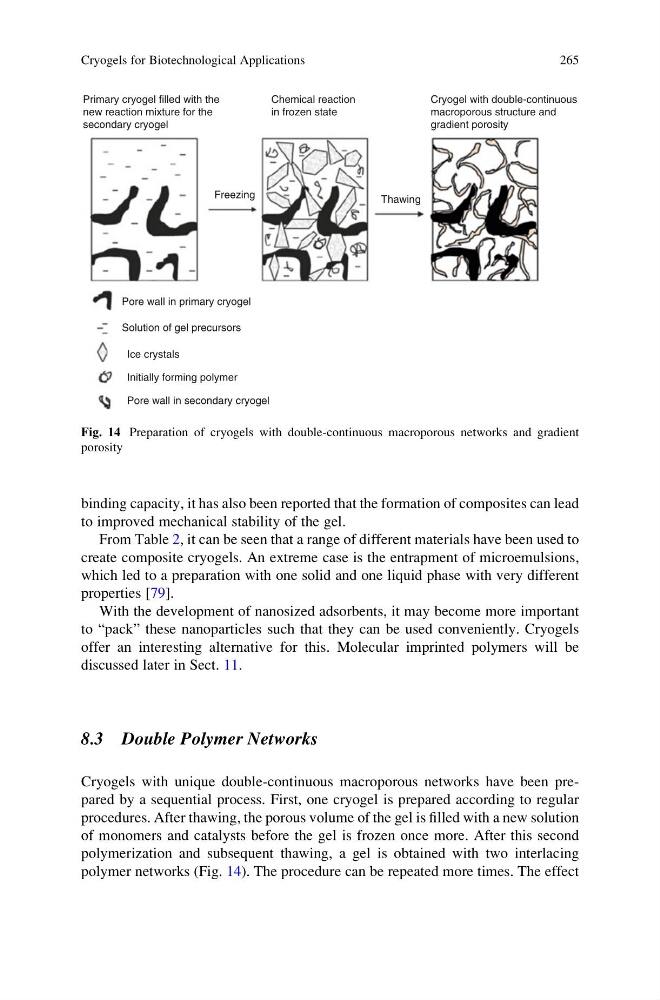
Cryogels with unique double-continuous macroporous networks have been prepared by a sequential process. First, one cryogel is prepared according to regular
procedures. After thawing, the porous volume of the gel is filled with a new solution
of monomers and catalysts before the gel is frozen once more. After this second
polymerization and subsequent thawing, a gel is obtained with two interlacing
polymer networks (Fig. 14). The procedure can be repeated more times. The effect
Freezing
Solution of gel precursors
Ice crystals
Pore wall in secondary cryogel
Initially forming polymer
Pore wall in primary cryogel
Cryogel with double-continuous
macroporous structure and
gradient porosity
Thawing
Chemical reaction
in frozen state
Primary cryogel filled with the
new reaction mixture for the
secondary cryogel
Fig. 14 Preparation of cryogels with double-continuous macroporous networks and gradient
porosity
Cryogels for Biotechnological Applications
265
to improved mechanical stability of the gel.
From Table 2, it can be seen that a range of different materials have been used to
create composite cryogels. An extreme case is the entrapment of microemulsions,
which led to a preparation with one solid and one liquid phase with very different
properties [79].
With the development of nanosized adsorbents, it may become more important
to “pack” these nanoparticles such that they can be used conveniently. Cryogels
offer an interesting alternative for this. Molecular imprinted polymers will be
discussed later in Sect. 11.
8.3 Double Polymer Networks
Cryogels with unique double-continuous macroporous networks have been prepared by a sequential process. First, one cryogel is prepared according to regular
procedures. After thawing, the porous volume of the gel is filled with a new solution
of monomers and catalysts before the gel is frozen once more. After this second
polymerization and subsequent thawing, a gel is obtained with two interlacing
polymer networks (Fig. 14). The procedure can be repeated more times. The effect
Freezing
Solution of gel precursors
Ice crystals
Pore wall in secondary cryogel
Initially forming polymer
Pore wall in primary cryogel
Cryogel with double-continuous
macroporous structure and
gradient porosity
Thawing
Chemical reaction
in frozen state
Primary cryogel filled with the
new reaction mixture for the
secondary cryogel
Fig. 14 Preparation of cryogels with double-continuous macroporous networks and gradient
porosity
Cryogels for Biotechnological Applications
265