

far more efficient at capturing BSA than short chains. The explanation for this
behavior is that the small molecules penetrate and gain access to the charged groups
where they bind, whereas proteins are excluded at tight polymers on the pore walls
because of steric reasons, but are favored when long polymers are present because
then multipoint attachment can take place.
That grafting contributes to improving the capacity was clearly shown. If no
grafting was done, then 0.65 mg/mL was adsorbed, whereas with a grafting of
105 % (w/w) then 12 mg/mL was adsorbed. This represents an 18-fold increase in
capacity, but is still far lower than that reached with the conventional tighter gels.
A cation-exchange cryogel was produced by in-situ graft-polymerization with
sulfo groups to an acrylamide cryogel [70]. The grafting was performed using
potassium diperiodocuprate in a similar mode to that used by Savina
et al. [66]. The new ion-exchanger was evaluated using lysozyme as a target. The
capacity was still low, even though it was increased as compared to non-grafted
gels. However, it was argued that the possibility of operating at high flow velocities
could partially compensate for the low capacity because each cycle can be run much
faster.
One example where grafted cryogels were successfully applied is the capture of
plasmid DNA from non-clarified bacterial lysate using a polycation-grafted
monolith [71].
8.2 Composite Cryogels for Separation Purposes
Entrapment of adsorbent particles within a cryogel has been studied as a method to
improve the binding capacity. There are also some cases where entrapment was
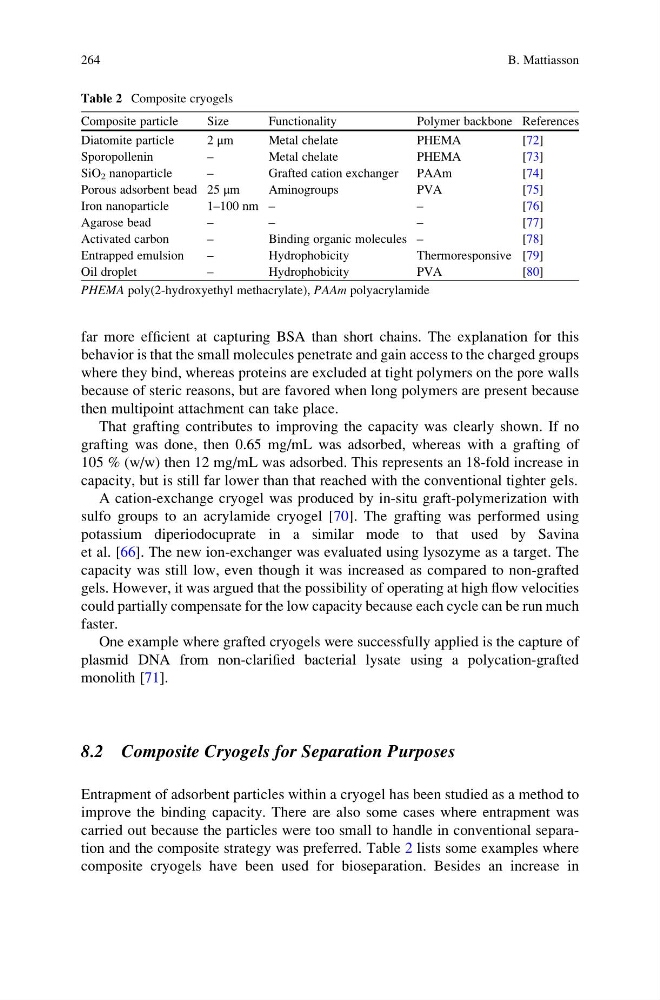
carried out because the particles were too small to handle in conventional separation and the composite strategy was preferred. Table 2 lists some examples where
composite cryogels have been used for bioseparation. Besides an increase in
Table 2 Composite cryogels
Composite particle
Size
Functionality
Polymer backbone References
Diatomite particle
2 μm
Metal chelate
PHEMA
[72]
Sporopollenin
–
Metal chelate
PHEMA
[73]
SiO 2 nanoparticle
–
Grafted cation exchanger PAAm
[74]
Porous adsorbent bead 25 μm
Aminogroups
PVA
[75]
Iron nanoparticle
1–100 nm –
–
[76]
Agarose bead
–
–
–
[77]
Activated carbon
–
Binding organic molecules –
[78]
Entrapped emulsion
–
Hydrophobicity
Thermoresponsive [79]
Oil droplet
–
Hydrophobicity
PVA
[80]
PHEMA poly(2-hydroxyethyl methacrylate), PAAm polyacrylamide
264
B. Mattiasson
behavior is that the small molecules penetrate and gain access to the charged groups
where they bind, whereas proteins are excluded at tight polymers on the pore walls
because of steric reasons, but are favored when long polymers are present because
then multipoint attachment can take place.
That grafting contributes to improving the capacity was clearly shown. If no
grafting was done, then 0.65 mg/mL was adsorbed, whereas with a grafting of
105 % (w/w) then 12 mg/mL was adsorbed. This represents an 18-fold increase in
capacity, but is still far lower than that reached with the conventional tighter gels.
A cation-exchange cryogel was produced by in-situ graft-polymerization with
sulfo groups to an acrylamide cryogel [70]. The grafting was performed using
potassium diperiodocuprate in a similar mode to that used by Savina
et al. [66]. The new ion-exchanger was evaluated using lysozyme as a target. The
capacity was still low, even though it was increased as compared to non-grafted
gels. However, it was argued that the possibility of operating at high flow velocities
could partially compensate for the low capacity because each cycle can be run much
faster.
One example where grafted cryogels were successfully applied is the capture of
plasmid DNA from non-clarified bacterial lysate using a polycation-grafted
monolith [71].
8.2 Composite Cryogels for Separation Purposes
Entrapment of adsorbent particles within a cryogel has been studied as a method to
improve the binding capacity. There are also some cases where entrapment was
carried out because the particles were too small to handle in conventional separation and the composite strategy was preferred. Table 2 lists some examples where
composite cryogels have been used for bioseparation. Besides an increase in
Table 2 Composite cryogels
Composite particle
Size
Functionality
Polymer backbone References
Diatomite particle
2 μm
Metal chelate
PHEMA
[72]
Sporopollenin
–
Metal chelate
PHEMA
[73]
SiO 2 nanoparticle
–
Grafted cation exchanger PAAm
[74]
Porous adsorbent bead 25 μm
Aminogroups
PVA
[75]
Iron nanoparticle
1–100 nm –
–
[76]
Agarose bead
–
–
–
[77]
Activated carbon
–
Binding organic molecules –
[78]
Entrapped emulsion
–
Hydrophobicity
Thermoresponsive [79]
Oil droplet
–
Hydrophobicity
PVA
[80]
PHEMA poly(2-hydroxyethyl methacrylate), PAAm polyacrylamide
264
B. Mattiasson