

of working with double polymer networks is that the capacity for binding target
molecules increases and the mechanical stability is also improved. This latter might
be important for tissue engineering applications. By using two different polymer
systems, it is possible to study the final preparation using confocal microscopy and
then clearly see the interconnected networks. The flow-rate through the gel is
reduced by the procedure. When dealing with gels that are mechanically weak, it
might be possible to combine such a material with a stronger network, like a
skeleton, to stabilize the structure (see SEM photos in Fig. 1) [81].
9 Separation of Proteins
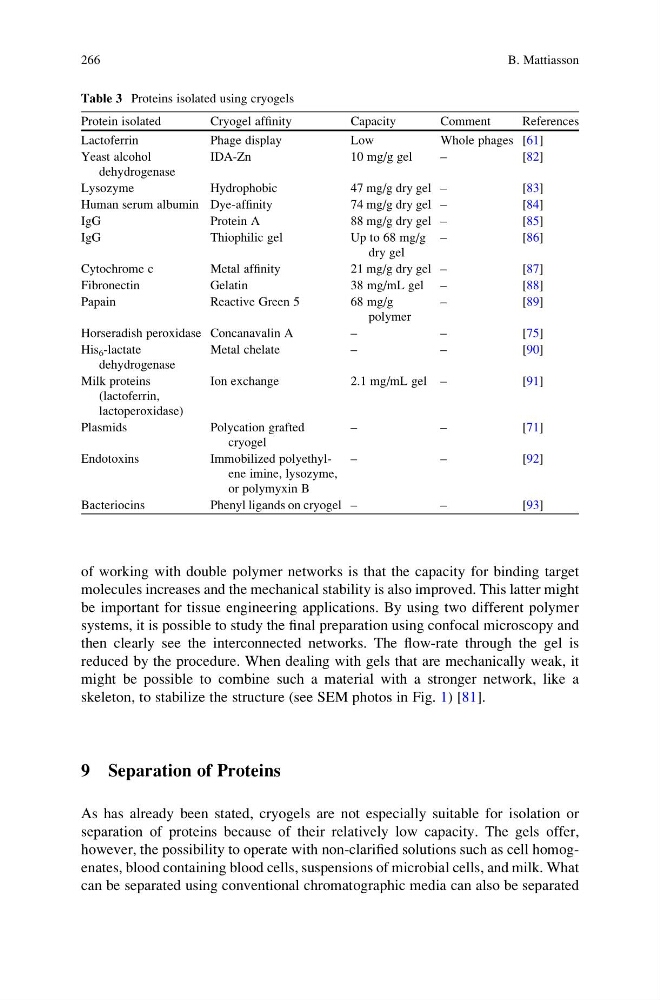
As has already been stated, cryogels are not especially suitable for isolation or
separation of proteins because of their relatively low capacity. The gels offer,
however, the possibility to operate with non-clarified solutions such as cell homogenates, blood containing blood cells, suspensions of microbial cells, and milk. What
can be separated using conventional chromatographic media can also be separated
Table 3 Proteins isolated using cryogels
Protein isolated
Cryogel affinity
Capacity
Comment
References
Lactoferrin
Phage display
Low
Whole phages [61]
Yeast alcohol
dehydrogenase
IDA-Zn
10 mg/g gel
–
[82]
Lysozyme
Hydrophobic
47 mg/g dry gel –
[83]
Human serum albumin Dye-affinity
74 mg/g dry gel –
[84]
IgG
Protein A
88 mg/g dry gel –
[85]
IgG
Thiophilic gel
Up to 68 mg/g
dry gel
–
[ 86]
Cytochrome c
Metal affinity
21 mg/g dry gel –
[87]
Fibronectin
Gelatin
38 mg/mL gel –
[88]
Papain
Reactive Green 5
68 mg/g
polymer
–
[ 89]
Horseradish peroxidase Concanavalin A
–
–
[75]
His 6 -lactate
dehydrogenase
Metal chelate
–
–
[90]
Milk proteins
(lactoferrin,
lactoperoxidase)
Ion exchange
2.1 mg/mL gel –
[91]
Plasmids
Polycation grafted
cryogel
–
–
[ 71]
Endotoxins
Immobilized polyethylene imine, lysozyme,
or polymyxin B
–
–
[ 92]
Bacteriocins
Phenyl ligands on cryogel –
–
[93]
266
B. Mattiasson
molecules increases and the mechanical stability is also improved. This latter might
be important for tissue engineering applications. By using two different polymer
systems, it is possible to study the final preparation using confocal microscopy and
then clearly see the interconnected networks. The flow-rate through the gel is
reduced by the procedure. When dealing with gels that are mechanically weak, it
might be possible to combine such a material with a stronger network, like a
skeleton, to stabilize the structure (see SEM photos in Fig. 1) [81].
9 Separation of Proteins
As has already been stated, cryogels are not especially suitable for isolation or
separation of proteins because of their relatively low capacity. The gels offer,
however, the possibility to operate with non-clarified solutions such as cell homogenates, blood containing blood cells, suspensions of microbial cells, and milk. What
can be separated using conventional chromatographic media can also be separated
Table 3 Proteins isolated using cryogels
Protein isolated
Cryogel affinity
Capacity
Comment
References
Lactoferrin
Phage display
Low
Whole phages [61]
Yeast alcohol
dehydrogenase
IDA-Zn
10 mg/g gel
–
[82]
Lysozyme
Hydrophobic
47 mg/g dry gel –
[83]
Human serum albumin Dye-affinity
74 mg/g dry gel –
[84]
IgG
Protein A
88 mg/g dry gel –
[85]
IgG
Thiophilic gel
Up to 68 mg/g
dry gel
–
[ 86]
Cytochrome c
Metal affinity
21 mg/g dry gel –
[87]
Fibronectin
Gelatin
38 mg/mL gel –
[88]
Papain
Reactive Green 5
68 mg/g
polymer
–
[ 89]
Horseradish peroxidase Concanavalin A
–
–
[75]
His 6 -lactate
dehydrogenase
Metal chelate
–
–
[90]
Milk proteins
(lactoferrin,
lactoperoxidase)
Ion exchange
2.1 mg/mL gel –
[91]
Plasmids
Polycation grafted
cryogel
–
–
[ 71]
Endotoxins
Immobilized polyethylene imine, lysozyme,
or polymyxin B
–
–
[ 92]
Bacteriocins
Phenyl ligands on cryogel –
–
[93]
266
B. Mattiasson