

One can also turn the affinity interactions around in the sense that lactoferrin can
be immobilized and then the phages can be captured and subsequently eluted after
proper washing. By such an affinity step, one could pass a phage library through an
affinity column, capture those phages with affinity for the affinity ligand, and wash
out the rest. This could be regarded as an alternative to the conventional panning
procedures that are labor- and time-demanding. However, it is also possible to take
the technology one step further due to the large pores of the cryogel. After having
captured phages on the immobilized ligand and washing away those that do not
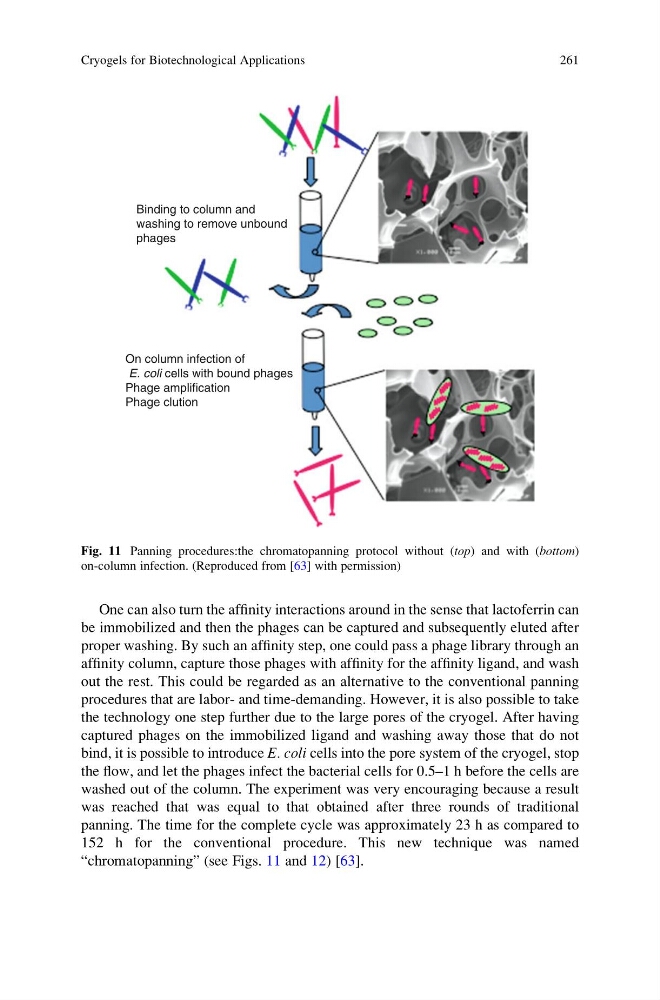
bind, it is possible to introduce E. coli cells into the pore system of the cryogel, stop
the flow, and let the phages infect the bacterial cells for 0.5–1 h before the cells are
washed out of the column. The experiment was very encouraging because a result
was reached that was equal to that obtained after three rounds of traditional
panning. The time for the complete cycle was approximately 23 h as compared to
152 h for the conventional procedure. This new technique was named
“chromatopanning” (see Figs. 11 and 12) [63].
On column infection of
E. coli cells with bound phages
Phage amplification
Phage clution
Binding to column and
washing to remove unbound
phages
Fig. 11 Panning procedures:the chromatopanning protocol without (top) and with (bottom)
on-column infection. (Reproduced from [63] with permission)
Cryogels for Biotechnological Applications
261
be immobilized and then the phages can be captured and subsequently eluted after
proper washing. By such an affinity step, one could pass a phage library through an
affinity column, capture those phages with affinity for the affinity ligand, and wash
out the rest. This could be regarded as an alternative to the conventional panning
procedures that are labor- and time-demanding. However, it is also possible to take
the technology one step further due to the large pores of the cryogel. After having
captured phages on the immobilized ligand and washing away those that do not
bind, it is possible to introduce E. coli cells into the pore system of the cryogel, stop
the flow, and let the phages infect the bacterial cells for 0.5–1 h before the cells are
washed out of the column. The experiment was very encouraging because a result
was reached that was equal to that obtained after three rounds of traditional
panning. The time for the complete cycle was approximately 23 h as compared to
152 h for the conventional procedure. This new technique was named
“chromatopanning” (see Figs. 11 and 12) [63].
On column infection of
E. coli cells with bound phages
Phage amplification
Phage clution
Binding to column and
washing to remove unbound
phages
Fig. 11 Panning procedures:the chromatopanning protocol without (top) and with (bottom)
on-column infection. (Reproduced from [63] with permission)
Cryogels for Biotechnological Applications
261