

7.3 Viruses and Phages
Besides separation of cells, it is also possible to isolate biological particles such as
organelles, viruses, and phages.
A library of affinity ligands that have great potential, but have not been utilized
to their full potential, is the phage display library. Phages are filamentous particles
of approximately 1 μm length and a diameter of about 6 nm. When dealing with
cryogels, the pore dimensions allow one to operate with intact phages, even if they
are 1 μm long. A library of M 13 phages was screened for binders that would
capture lactoferrin. The selected phages were immobilized in a cryogel and the
adsorbent was used for capturing lactoferrin from defatted milk. Bound lactoferrin
was eluted with 1 M NaCl and a purity of 95 % was obtained. One should be aware
that this type of gel has low capacity, but could be of interest in initial screening
phases when one needs to obtain small amounts of relatively pure protein [61, 62].
0
20
40
60
80
100
120
0
0.1
0.2
0.3
0.4
Recovered cells, %
Eluent concentration, M
-D-manno-pyranoside
-D-mannopyranoside+compression
Glucose
Glucose+compression
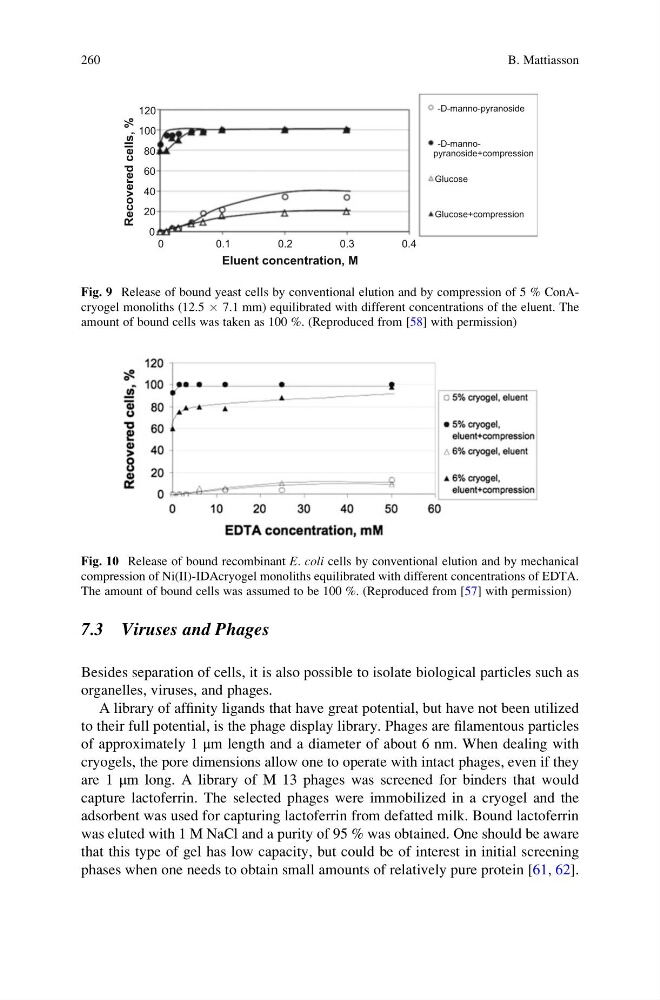
Fig. 9 Release of bound yeast cells by conventional elution and by compression of 5 % ConAcryogel monoliths (12.5 Â 7.1 mm) equilibrated with different concentrations of the eluent. The
amount of bound cells was taken as 100 %. (Reproduced from [58] with permission)
Fig. 10 Release of bound recombinant E. coli cells by conventional elution and by mechanical
compression of Ni(II)-IDAcryogel monoliths equilibrated with different concentrations of EDTA.
The amount of bound cells was assumed to be 100 %. (Reproduced from [57] with permission)
260
B. Mattiasson
Besides separation of cells, it is also possible to isolate biological particles such as
organelles, viruses, and phages.
A library of affinity ligands that have great potential, but have not been utilized
to their full potential, is the phage display library. Phages are filamentous particles
of approximately 1 μm length and a diameter of about 6 nm. When dealing with
cryogels, the pore dimensions allow one to operate with intact phages, even if they
are 1 μm long. A library of M 13 phages was screened for binders that would
capture lactoferrin. The selected phages were immobilized in a cryogel and the
adsorbent was used for capturing lactoferrin from defatted milk. Bound lactoferrin
was eluted with 1 M NaCl and a purity of 95 % was obtained. One should be aware
that this type of gel has low capacity, but could be of interest in initial screening
phases when one needs to obtain small amounts of relatively pure protein [61, 62].
0
20
40
60
80
100
120
0
0.1
0.2
0.3
0.4
Recovered cells, %
Eluent concentration, M
-D-manno-pyranoside
-D-mannopyranoside+compression
Glucose
Glucose+compression
Fig. 9 Release of bound yeast cells by conventional elution and by compression of 5 % ConAcryogel monoliths (12.5 Â 7.1 mm) equilibrated with different concentrations of the eluent. The
amount of bound cells was taken as 100 %. (Reproduced from [58] with permission)
Fig. 10 Release of bound recombinant E. coli cells by conventional elution and by mechanical
compression of Ni(II)-IDAcryogel monoliths equilibrated with different concentrations of EDTA.
The amount of bound cells was assumed to be 100 %. (Reproduced from [57] with permission)
260
B. Mattiasson