

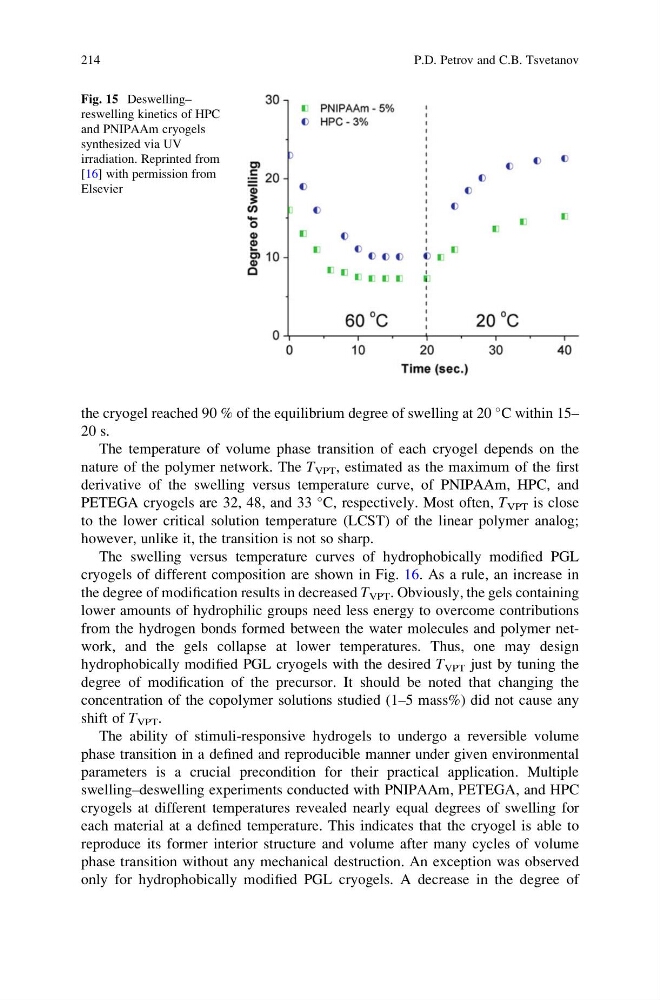
the cryogel reached 90 % of the equilibrium degree of swelling at 20
C within 15–
20 s.
The temperature of volume phase transition of each cryogel depends on the
nature of the polymer network. The T VPT , estimated as the maximum of the first
derivative of the swelling versus temperature curve, of PNIPAAm, HPC, and
PETEGA cryogels are 32, 48, and 33
C, respectively. Most often, T VPT is close
to the lower critical solution temperature (LCST) of the linear polymer analog;
however, unlike it, the transition is not so sharp.
The swelling versus temperature curves of hydrophobically modified PGL
cryogels of different composition are shown in Fig. 16. As a rule, an increase in
the degree of modification results in decreased T VPT . Obviously, the gels containing
lower amounts of hydrophilic groups need less energy to overcome contributions
from the hydrogen bonds formed between the water molecules and polymer network, and the gels collapse at lower temperatures. Thus, one may design
hydrophobically modified PGL cryogels with the desired T VPT just by tuning the
degree of modification of the precursor. It should be noted that changing the
concentration of the copolymer solutions studied (1–5 mass%) did not cause any
shift of T VPT .
The ability of stimuli-responsive hydrogels to undergo a reversible volume
phase transition in a defined and reproducible manner under given environmental
parameters is a crucial precondition for their practical application. Multiple
swelling–deswelling experiments conducted with PNIPAAm, PETEGA, and HPC
cryogels at different temperatures revealed nearly equal degrees of swelling for
each material at a defined temperature. This indicates that the cryogel is able to
reproduce its former interior structure and volume after many cycles of volume
phase transition without any mechanical destruction. An exception was observed
only for hydrophobically modified PGL cryogels. A decrease in the degree of
Fig. 15 Deswelling–
reswelling kinetics of HPC
and PNIPAAm cryogels
synthesized via UV
irradiation. Reprinted from
[16] with permission from
Elsevier
214
P.D. Petrov and C.B. Tsvetanov
C within 15–
20 s.
The temperature of volume phase transition of each cryogel depends on the
nature of the polymer network. The T VPT , estimated as the maximum of the first
derivative of the swelling versus temperature curve, of PNIPAAm, HPC, and
PETEGA cryogels are 32, 48, and 33
C, respectively. Most often, T VPT is close
to the lower critical solution temperature (LCST) of the linear polymer analog;
however, unlike it, the transition is not so sharp.
The swelling versus temperature curves of hydrophobically modified PGL
cryogels of different composition are shown in Fig. 16. As a rule, an increase in
the degree of modification results in decreased T VPT . Obviously, the gels containing
lower amounts of hydrophilic groups need less energy to overcome contributions
from the hydrogen bonds formed between the water molecules and polymer network, and the gels collapse at lower temperatures. Thus, one may design
hydrophobically modified PGL cryogels with the desired T VPT just by tuning the
degree of modification of the precursor. It should be noted that changing the
concentration of the copolymer solutions studied (1–5 mass%) did not cause any
shift of T VPT .
The ability of stimuli-responsive hydrogels to undergo a reversible volume
phase transition in a defined and reproducible manner under given environmental
parameters is a crucial precondition for their practical application. Multiple
swelling–deswelling experiments conducted with PNIPAAm, PETEGA, and HPC
cryogels at different temperatures revealed nearly equal degrees of swelling for
each material at a defined temperature. This indicates that the cryogel is able to
reproduce its former interior structure and volume after many cycles of volume
phase transition without any mechanical destruction. An exception was observed
only for hydrophobically modified PGL cryogels. A decrease in the degree of
Fig. 15 Deswelling–
reswelling kinetics of HPC
and PNIPAAm cryogels
synthesized via UV
irradiation. Reprinted from
[16] with permission from
Elsevier
214
P.D. Petrov and C.B. Tsvetanov