

swelling was found after the fifth cycle of temperature changes and was caused by
separation of small pieces from the edge of the cryogel. This destruction is
attributed to the lower strength of ether bonds in the PGL network upon mechanical
deformation accompanied by the temperature changes.
5 Nanocomposites Based on Polymer Cryogels
Fabrication of nanocomposite cryogels is a versatile platform for imparting specific
properties to the material. Basically, the specific heterogeneous structure of the
cryogel makes possible the incorporation of nanosized fillers via two different
routes: into the cryogel walls and into the cryogel channels. This, however, may
lead to nanocomposite cryogels with different behaviors and properties, even
though they were prepared from the same initial components. For instance, two
types of HPC cryogels containing silver nanoparticles (AgNPs), either entrapped
into the gel walls (polymer matrix) or included into the pores, were synthesized via
UV-induced crosslinking [16]. AgNPs were immobilized in the channels of the gel
by immersing a pre-made freeze-dried HPC cryogel in an aqueous dispersion of
AgNPs. The freeze-drying process preserves the spongy-like macroporous structure
of materials and, thus, the dispersion can easily fill the channels (interconnected
pores) of the dry cryogel in a few seconds. The second approach is based on mixing
of AgNPs and polymer prior to freezing and crosslinking. Cryogenic treatment led
to phase-separated ice crystals and nonfrozen liquid microphase containing AgNPs,
reagents, and physically bound water. Because the reaction of crosslinking occurs
only in the liquid microphase forming the gel walls, AgNPs were embedded into the
crosslinked polymer matrix. It is noteworthy that both types of materials exhibited
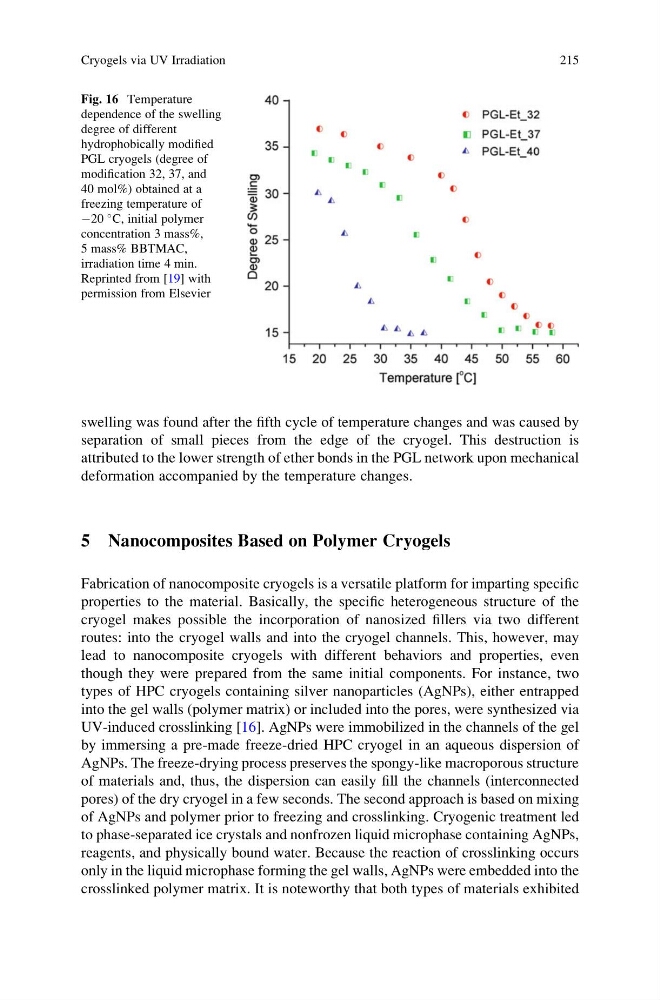
Fig. 16 Temperature
dependence of the swelling
degree of different
hydrophobically modified
PGL cryogels (degree of
modification 32, 37, and
40 mol%) obtained at a
freezing temperature of
À20
C, initial polymer
concentration 3 mass%,
5 mass% BBTMAC,
irradiation time 4 min.
Reprinted from [19] with
permission from Elsevier
Cryogels via UV Irradiation
215
separation of small pieces from the edge of the cryogel. This destruction is
attributed to the lower strength of ether bonds in the PGL network upon mechanical
deformation accompanied by the temperature changes.
5 Nanocomposites Based on Polymer Cryogels
Fabrication of nanocomposite cryogels is a versatile platform for imparting specific
properties to the material. Basically, the specific heterogeneous structure of the
cryogel makes possible the incorporation of nanosized fillers via two different
routes: into the cryogel walls and into the cryogel channels. This, however, may
lead to nanocomposite cryogels with different behaviors and properties, even
though they were prepared from the same initial components. For instance, two
types of HPC cryogels containing silver nanoparticles (AgNPs), either entrapped
into the gel walls (polymer matrix) or included into the pores, were synthesized via
UV-induced crosslinking [16]. AgNPs were immobilized in the channels of the gel
by immersing a pre-made freeze-dried HPC cryogel in an aqueous dispersion of
AgNPs. The freeze-drying process preserves the spongy-like macroporous structure
of materials and, thus, the dispersion can easily fill the channels (interconnected
pores) of the dry cryogel in a few seconds. The second approach is based on mixing
of AgNPs and polymer prior to freezing and crosslinking. Cryogenic treatment led
to phase-separated ice crystals and nonfrozen liquid microphase containing AgNPs,
reagents, and physically bound water. Because the reaction of crosslinking occurs
only in the liquid microphase forming the gel walls, AgNPs were embedded into the
crosslinked polymer matrix. It is noteworthy that both types of materials exhibited
Fig. 16 Temperature
dependence of the swelling
degree of different
hydrophobically modified
PGL cryogels (degree of
modification 32, 37, and
40 mol%) obtained at a
freezing temperature of
À20
C, initial polymer
concentration 3 mass%,
5 mass% BBTMAC,
irradiation time 4 min.
Reprinted from [19] with
permission from Elsevier
Cryogels via UV Irradiation
215