

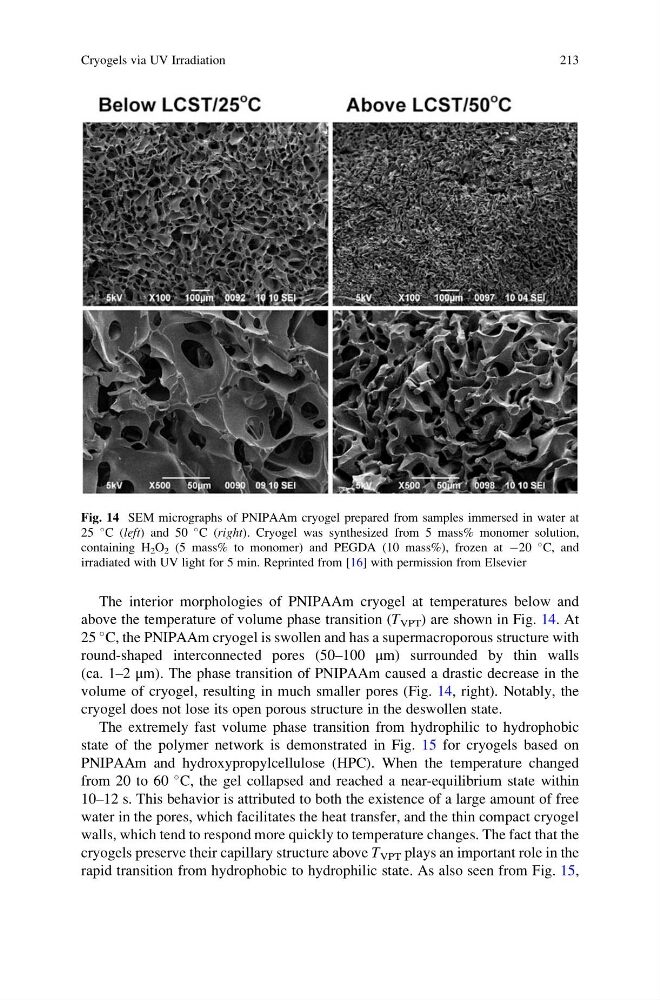
The interior morphologies of PNIPAAm cryogel at temperatures below and
above the temperature of volume phase transition (T VPT ) are shown in Fig. 14. At
25
C, the PNIPAAm cryogel is swollen and has a supermacroporous structure with
round-shaped interconnected pores (50–100 μm) surrounded by thin walls
(ca. 1–2 μm). The phase transition of PNIPAAm caused a drastic decrease in the
volume of cryogel, resulting in much smaller pores (Fig. 14, right). Notably, the
cryogel does not lose its open porous structure in the deswollen state.
The extremely fast volume phase transition from hydrophilic to hydrophobic
state of the polymer network is demonstrated in Fig. 15 for cryogels based on
PNIPAAm and hydroxypropylcellulose (HPC). When the temperature changed
from 20 to 60
C, the gel collapsed and reached a near-equilibrium state within
10–12 s. This behavior is attributed to both the existence of a large amount of free
water in the pores, which facilitates the heat transfer, and the thin compact cryogel
walls, which tend to respond more quickly to temperature changes. The fact that the
cryogels preserve their capillary structure above T VPT plays an important role in the
rapid transition from hydrophobic to hydrophilic state. As also seen from Fig. 15,
Fig. 14 SEM micrographs of PNIPAAm cryogel prepared from samples immersed in water at
25
C (left) and 50
C (right). Cryogel was synthesized from 5 mass% monomer solution,
containing H 2 O 2 (5 mass% to monomer) and PEGDA (10 mass%), frozen at À20
C, and
irradiated with UV light for 5 min. Reprinted from [16] with permission from Elsevier
Cryogels via UV Irradiation
213
above the temperature of volume phase transition (T VPT ) are shown in Fig. 14. At
25
C, the PNIPAAm cryogel is swollen and has a supermacroporous structure with
round-shaped interconnected pores (50–100 μm) surrounded by thin walls
(ca. 1–2 μm). The phase transition of PNIPAAm caused a drastic decrease in the
volume of cryogel, resulting in much smaller pores (Fig. 14, right). Notably, the
cryogel does not lose its open porous structure in the deswollen state.
The extremely fast volume phase transition from hydrophilic to hydrophobic
state of the polymer network is demonstrated in Fig. 15 for cryogels based on
PNIPAAm and hydroxypropylcellulose (HPC). When the temperature changed
from 20 to 60
C, the gel collapsed and reached a near-equilibrium state within
10–12 s. This behavior is attributed to both the existence of a large amount of free
water in the pores, which facilitates the heat transfer, and the thin compact cryogel
walls, which tend to respond more quickly to temperature changes. The fact that the
cryogels preserve their capillary structure above T VPT plays an important role in the
rapid transition from hydrophobic to hydrophilic state. As also seen from Fig. 15,
Fig. 14 SEM micrographs of PNIPAAm cryogel prepared from samples immersed in water at
25
C (left) and 50
C (right). Cryogel was synthesized from 5 mass% monomer solution,
containing H 2 O 2 (5 mass% to monomer) and PEGDA (10 mass%), frozen at À20
C, and
irradiated with UV light for 5 min. Reprinted from [16] with permission from Elsevier
Cryogels via UV Irradiation
213