

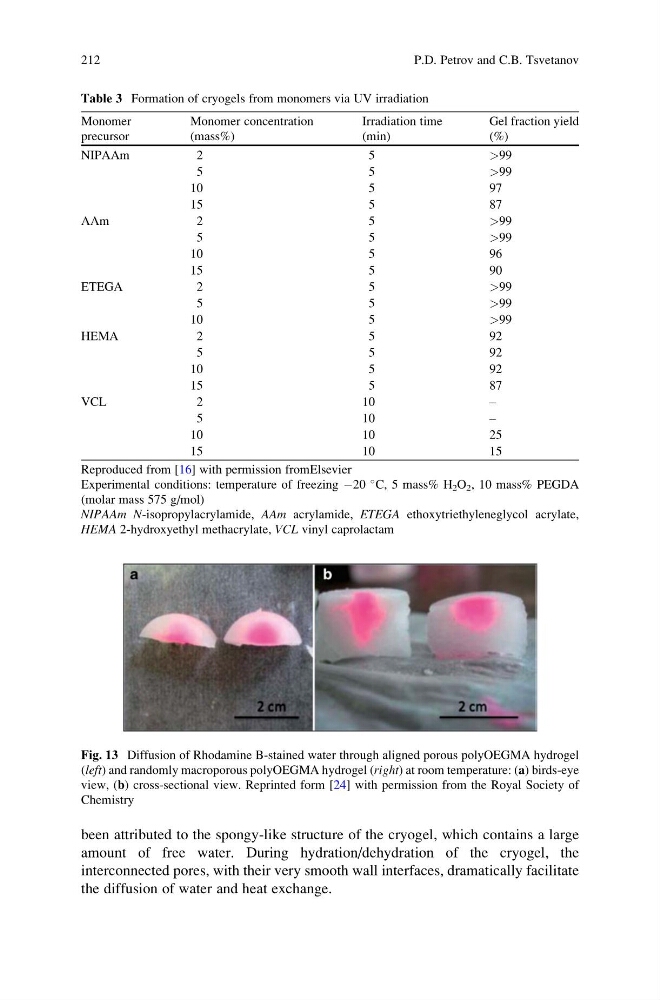
been attributed to the spongy-like structure of the cryogel, which contains a large
amount of free water. During hydration/dehydration of the cryogel, the
interconnected pores, with their very smooth wall interfaces, dramatically facilitate
the diffusion of water and heat exchange.
Fig. 13 Diffusion of Rhodamine B-stained water through aligned porous polyOEGMA hydrogel
(left) and randomly macroporous polyOEGMA hydrogel (right) at room temperature: (a) birds-eye
view, (b) cross-sectional view. Reprinted form [24] with permission from the Royal Society of
Chemistry
Table 3 Formation of cryogels from monomers via UV irradiation
Monomer
precursor
Monomer concentration
(mass%)
Irradiation time
(min)
Gel fraction yield
(%)
NIPAAm
2
5
>99
5
5
>99
10
5
97
15
5
87
AAm
2
5
>99
5
5
>99
10
5
96
15
5
90
ETEGA
2
5
>99
5
5
>99
10
5
>99
HEMA
2
5
92
5
5
9 2
10
5
92
15
5
87
VCL
2
10
–
5
1 0
–
10
10
25
15
10
15
Reproduced from [16] with permission fromElsevier
Experimental conditions: temperature of freezing À20
C, 5 mass% H 2 O 2 , 10 mass% PEGDA
(molar mass 575 g/mol)
NIPAAm N-isopropylacrylamide, AAm acrylamide, ETEGA ethoxytriethyleneglycol acrylate,
HEMA 2-hydroxyethyl methacrylate, VCL vinyl caprolactam
212
P.D. Petrov and C.B. Tsvetanov
amount of free water. During hydration/dehydration of the cryogel, the
interconnected pores, with their very smooth wall interfaces, dramatically facilitate
the diffusion of water and heat exchange.
Fig. 13 Diffusion of Rhodamine B-stained water through aligned porous polyOEGMA hydrogel
(left) and randomly macroporous polyOEGMA hydrogel (right) at room temperature: (a) birds-eye
view, (b) cross-sectional view. Reprinted form [24] with permission from the Royal Society of
Chemistry
Table 3 Formation of cryogels from monomers via UV irradiation
Monomer
precursor
Monomer concentration
(mass%)
Irradiation time
(min)
Gel fraction yield
(%)
NIPAAm
2
5
>99
5
5
>99
10
5
97
15
5
87
AAm
2
5
>99
5
5
>99
10
5
96
15
5
90
ETEGA
2
5
>99
5
5
>99
10
5
>99
HEMA
2
5
92
5
5
9 2
10
5
92
15
5
87
VCL
2
10
–
5
1 0
–
10
10
25
15
10
15
Reproduced from [16] with permission fromElsevier
Experimental conditions: temperature of freezing À20
C, 5 mass% H 2 O 2 , 10 mass% PEGDA
(molar mass 575 g/mol)
NIPAAm N-isopropylacrylamide, AAm acrylamide, ETEGA ethoxytriethyleneglycol acrylate,
HEMA 2-hydroxyethyl methacrylate, VCL vinyl caprolactam
212
P.D. Petrov and C.B. Tsvetanov