

It was found that the GF yield of cryogels prepared by irradiation of frozen
aqueous solutions of HEC (concentration 3 mass%, 5 mass% BBTMAC) with UV
light at an irradiation dose rate of 5.7 J/cm
2 min increases with the irradiation time
in the first 2 min and then reaches a constant value. Consequently, 2 min of
irradiation is adequate for crosslinking of HEC in a frozen aqueous system and
results in cryogels of good quality (the material maintains its integrity and original
shape in water). The extremely short time required for the formation of a polymer
network avoids the side effects of excessive heating during irradiation.
The dependence of the GF yield of HEC cryogels, crosslinked at À20
C, on the
initial concentration of HEC solutions is shown in Fig. 4.
Cryogels are formed at substantially low polymer concentrations, which is
attributed to the cryo-concentration phenomenon. The GF yield increases with
Table 1 Cryogels obtained via UV irradiation of frozen systems based on aqueous solutions of
nonionic and cationic cellulose derivatives
Cellulose derivative
Molar mass (g/mol)
Gel fraction yield
max (%)
Degree of swelling
HEC
a
1,300,000
95
13
HEC
a
300,000
78
15
HEC
a
90,000
51
22
Quaternized HEC
b
900,000
75
12
HPMC
c
120,000
50
22
MC
d
88,000
46
25
Reproduced from [11] with permission from Elsevier
Experimental conditions: 2–5 mass% BBTMAC, irradiation time 2 min (irradiation dose
11.4 J/cm
2 , input power 93 mW/cm
2
, maximum wavelength at 365 nm)
HEC 2-hydroxyethylcellulose, HPMC (hydroxypropyl)methylcellulose, MC methylcellulose
a
Degree of substitution (DS) 1.5; molar degree of substitution (MS) 2.5
b
MS of quaternary ammonium moiety 0.4
c
DS 1.1–1.6; MS 0.1–0.3
d
DS 1.5–1.9
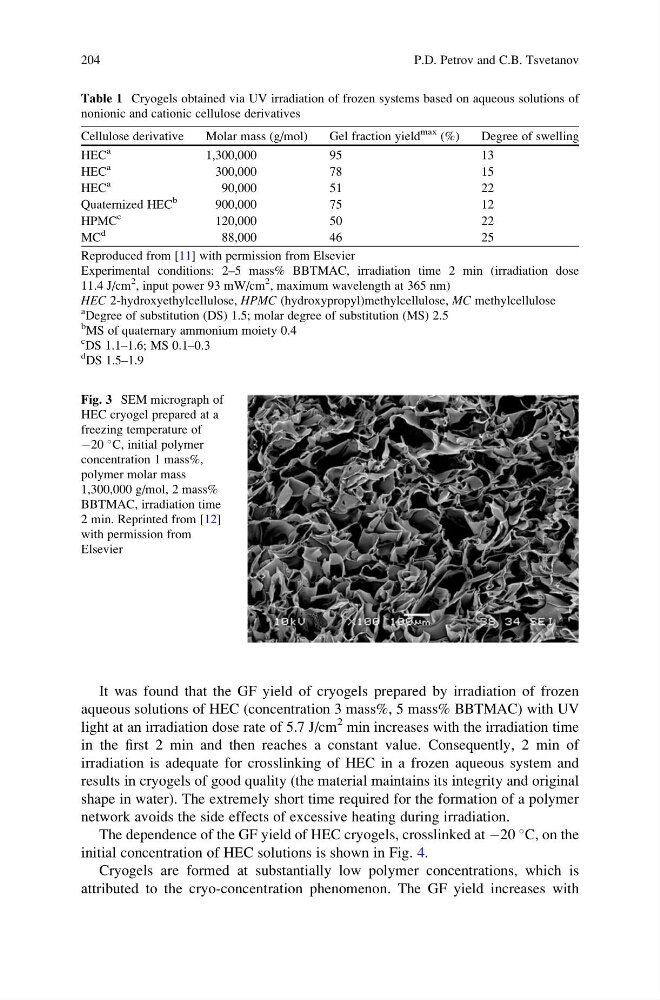
Fig. 3 SEM micrograph of
HEC cryogel prepared at a
freezing temperature of
À20
C, initial polymer
concentration 1 mass%,
polymer molar mass
1,300,000 g/mol, 2 mass%
BBTMAC, irradiation time
2 min. Reprinted from [12]
with permission from
Elsevier
204
P.D. Petrov and C.B. Tsvetanov
aqueous solutions of HEC (concentration 3 mass%, 5 mass% BBTMAC) with UV
light at an irradiation dose rate of 5.7 J/cm
2 min increases with the irradiation time
in the first 2 min and then reaches a constant value. Consequently, 2 min of
irradiation is adequate for crosslinking of HEC in a frozen aqueous system and
results in cryogels of good quality (the material maintains its integrity and original
shape in water). The extremely short time required for the formation of a polymer
network avoids the side effects of excessive heating during irradiation.
The dependence of the GF yield of HEC cryogels, crosslinked at À20
C, on the
initial concentration of HEC solutions is shown in Fig. 4.
Cryogels are formed at substantially low polymer concentrations, which is
attributed to the cryo-concentration phenomenon. The GF yield increases with
Table 1 Cryogels obtained via UV irradiation of frozen systems based on aqueous solutions of
nonionic and cationic cellulose derivatives
Cellulose derivative
Molar mass (g/mol)
Gel fraction yield
max (%)
Degree of swelling
HEC
a
1,300,000
95
13
HEC
a
300,000
78
15
HEC
a
90,000
51
22
Quaternized HEC
b
900,000
75
12
HPMC
c
120,000
50
22
MC
d
88,000
46
25
Reproduced from [11] with permission from Elsevier
Experimental conditions: 2–5 mass% BBTMAC, irradiation time 2 min (irradiation dose
11.4 J/cm
2 , input power 93 mW/cm
2
, maximum wavelength at 365 nm)
HEC 2-hydroxyethylcellulose, HPMC (hydroxypropyl)methylcellulose, MC methylcellulose
a
Degree of substitution (DS) 1.5; molar degree of substitution (MS) 2.5
b
MS of quaternary ammonium moiety 0.4
c
DS 1.1–1.6; MS 0.1–0.3
d
DS 1.5–1.9
Fig. 3 SEM micrograph of
HEC cryogel prepared at a
freezing temperature of
À20
C, initial polymer
concentration 1 mass%,
polymer molar mass
1,300,000 g/mol, 2 mass%
BBTMAC, irradiation time
2 min. Reprinted from [12]
with permission from
Elsevier
204
P.D. Petrov and C.B. Tsvetanov