

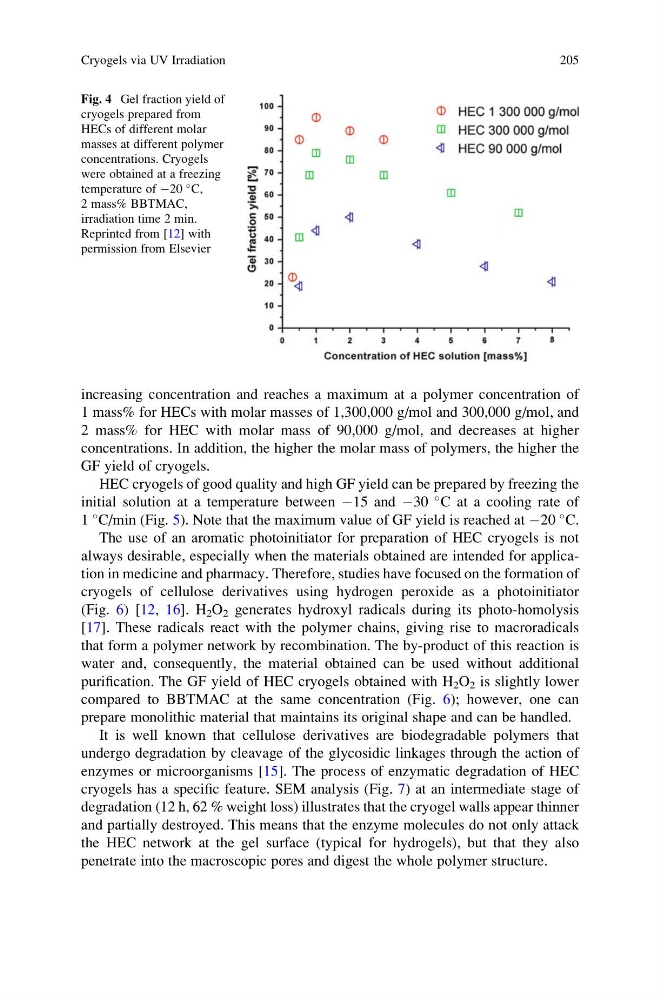
increasing concentration and reaches a maximum at a polymer concentration of
1 mass% for HECs with molar masses of 1,300,000 g/mol and 300,000 g/mol, and
2 mass% for HEC with molar mass of 90,000 g/mol, and decreases at higher
concentrations. In addition, the higher the molar mass of polymers, the higher the
GF yield of cryogels.
HEC cryogels of good quality and high GF yield can be prepared by freezing the
initial solution at a temperature between À15 and À30
C at a cooling rate of
1
C/min (Fig. 5). Note that the maximum value of GF yield is reached at À20
C.
The use of an aromatic photoinitiator for preparation of HEC cryogels is not
always desirable, especially when the materials obtained are intended for application in medicine and pharmacy. Therefore, studies have focused on the formation of
cryogels of cellulose derivatives using hydrogen peroxide as a photoinitiator
(Fig. 6) [12, 16]. H 2 O 2 generates hydroxyl radicals during its photo-homolysis
[17]. These radicals react with the polymer chains, giving rise to macroradicals
that form a polymer network by recombination. The by-product of this reaction is
water and, consequently, the material obtained can be used without additional
purification. The GF yield of HEC cryogels obtained with H 2 O 2 is slightly lower
compared to BBTMAC at the same concentration (Fig. 6); however, one can
prepare monolithic material that maintains its original shape and can be handled.
It is well known that cellulose derivatives are biodegradable polymers that
undergo degradation by cleavage of the glycosidic linkages through the action of
enzymes or microorganisms [15]. The process of enzymatic degradation of HEC
cryogels has a specific feature. SEM analysis (Fig. 7) at an intermediate stage of
degradation (12 h, 62 % weight loss) illustrates that the cryogel walls appear thinner
and partially destroyed. This means that the enzyme molecules do not only attack
the HEC network at the gel surface (typical for hydrogels), but that they also
penetrate into the macroscopic pores and digest the whole polymer structure.
Fig. 4 Gel fraction yield of
cryogels prepared from
HECs of different molar
masses at different polymer
concentrations. Cryogels
were obtained at a freezing
temperature of À20
C,
2 mass% BBTMAC,
irradiation time 2 min.
Reprinted from [12] with
permission from Elsevier
Cryogels via UV Irradiation
205
1 mass% for HECs with molar masses of 1,300,000 g/mol and 300,000 g/mol, and
2 mass% for HEC with molar mass of 90,000 g/mol, and decreases at higher
concentrations. In addition, the higher the molar mass of polymers, the higher the
GF yield of cryogels.
HEC cryogels of good quality and high GF yield can be prepared by freezing the
initial solution at a temperature between À15 and À30
C at a cooling rate of
1
C/min (Fig. 5). Note that the maximum value of GF yield is reached at À20
C.
The use of an aromatic photoinitiator for preparation of HEC cryogels is not
always desirable, especially when the materials obtained are intended for application in medicine and pharmacy. Therefore, studies have focused on the formation of
cryogels of cellulose derivatives using hydrogen peroxide as a photoinitiator
(Fig. 6) [12, 16]. H 2 O 2 generates hydroxyl radicals during its photo-homolysis
[17]. These radicals react with the polymer chains, giving rise to macroradicals
that form a polymer network by recombination. The by-product of this reaction is
water and, consequently, the material obtained can be used without additional
purification. The GF yield of HEC cryogels obtained with H 2 O 2 is slightly lower
compared to BBTMAC at the same concentration (Fig. 6); however, one can
prepare monolithic material that maintains its original shape and can be handled.
It is well known that cellulose derivatives are biodegradable polymers that
undergo degradation by cleavage of the glycosidic linkages through the action of
enzymes or microorganisms [15]. The process of enzymatic degradation of HEC
cryogels has a specific feature. SEM analysis (Fig. 7) at an intermediate stage of
degradation (12 h, 62 % weight loss) illustrates that the cryogel walls appear thinner
and partially destroyed. This means that the enzyme molecules do not only attack
the HEC network at the gel surface (typical for hydrogels), but that they also
penetrate into the macroscopic pores and digest the whole polymer structure.
Fig. 4 Gel fraction yield of
cryogels prepared from
HECs of different molar
masses at different polymer
concentrations. Cryogels
were obtained at a freezing
temperature of À20
C,
2 mass% BBTMAC,
irradiation time 2 min.
Reprinted from [12] with
permission from Elsevier
Cryogels via UV Irradiation
205