

occur predominantly under the chosen experimental conditions. It has been
described that two processes, degradation and crosslinking, are in competition at
high-energy irradiation of cellulose derivatives with either an electron beam or
gamma-rays [13–15]. When exposed to ionizing radiation at ambient temperature
in the solid state and in aqueous solutions, the cellulose derivatives undergo
degradation, whereas the best results for crosslinking have been obtained at
paste-like conditions (25–40 mass%, depending on the polymer). Based on the
theory of cryotropic gelation, it is assumed that most of the solvent forms crystals
during freezing of aqueous solutions of cellulose derivatives, whereas the polymer,
the photoinitiator, and the water molecules connected to the polymer through
hydrogen bonds (non-freezable solvent) form a nonfrozen liquid microphase.
Obviously, the polymer concentration in the liquid microphase is very high (cryoconcentration effect) and the reaction conditions closely resemble the conditions of
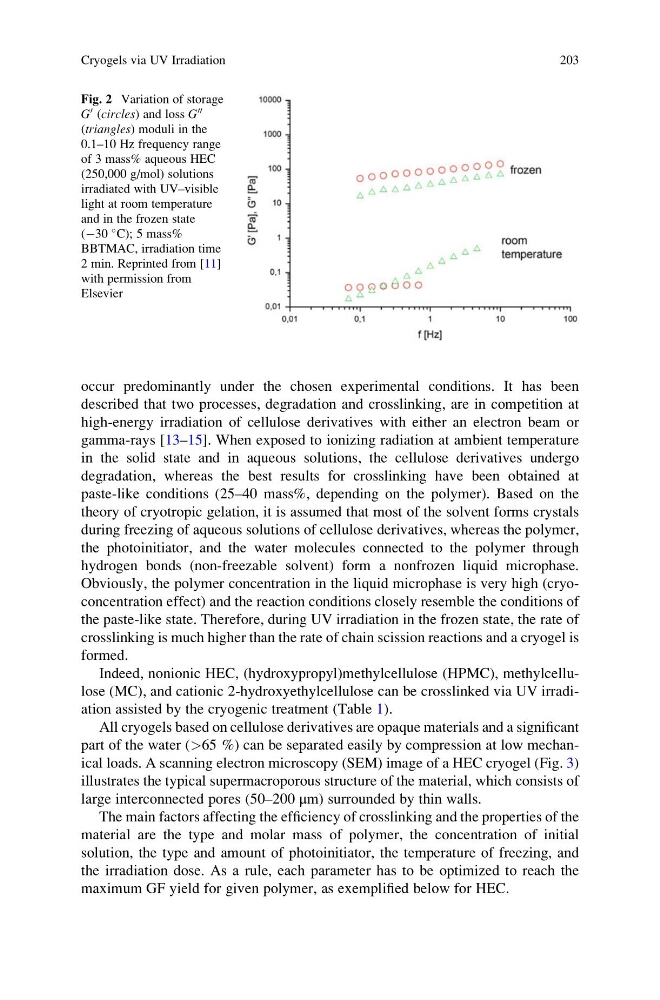
the paste-like state. Therefore, during UV irradiation in the frozen state, the rate of
crosslinking is much higher than the rate of chain scission reactions and a cryogel is
formed.
Indeed, nonionic HEC, (hydroxypropyl)methylcellulose (HPMC), methylcellulose (MC), and cationic 2-hydroxyethylcellulose can be crosslinked via UV irradiation assisted by the cryogenic treatment (Table 1).
All cryogels based on cellulose derivatives are opaque materials and a significant
part of the water (>65 %) can be separated easily by compression at low mechanical loads. A scanning electron microscopy (SEM) image of a HEC cryogel (Fig. 3)
illustrates the typical supermacroporous structure of the material, which consists of
large interconnected pores (50–200 μm) surrounded by thin walls.
The main factors affecting the efficiency of crosslinking and the properties of the
material are the type and molar mass of polymer, the concentration of initial
solution, the type and amount of photoinitiator, the temperature of freezing, and
the irradiation dose. As a rule, each parameter has to be optimized to reach the
maximum GF yield for given polymer, as exemplified below for HEC.
Fig. 2 Variation of storage
G
0 (circles) and loss G
00
(triangles) moduli in the
0.1–10 Hz frequency range
of 3 mass% aqueous HEC
(250,000 g/mol) solutions
irradiated with UV–visible
light at room temperature
and in the frozen state
(À30
C); 5 mass%
BBTMAC, irradiation time
2 min. Reprinted from [11]
with permission from
Elsevier
Cryogels via UV Irradiation
203
described that two processes, degradation and crosslinking, are in competition at
high-energy irradiation of cellulose derivatives with either an electron beam or
gamma-rays [13–15]. When exposed to ionizing radiation at ambient temperature
in the solid state and in aqueous solutions, the cellulose derivatives undergo
degradation, whereas the best results for crosslinking have been obtained at
paste-like conditions (25–40 mass%, depending on the polymer). Based on the
theory of cryotropic gelation, it is assumed that most of the solvent forms crystals
during freezing of aqueous solutions of cellulose derivatives, whereas the polymer,
the photoinitiator, and the water molecules connected to the polymer through
hydrogen bonds (non-freezable solvent) form a nonfrozen liquid microphase.
Obviously, the polymer concentration in the liquid microphase is very high (cryoconcentration effect) and the reaction conditions closely resemble the conditions of
the paste-like state. Therefore, during UV irradiation in the frozen state, the rate of
crosslinking is much higher than the rate of chain scission reactions and a cryogel is
formed.
Indeed, nonionic HEC, (hydroxypropyl)methylcellulose (HPMC), methylcellulose (MC), and cationic 2-hydroxyethylcellulose can be crosslinked via UV irradiation assisted by the cryogenic treatment (Table 1).
All cryogels based on cellulose derivatives are opaque materials and a significant
part of the water (>65 %) can be separated easily by compression at low mechanical loads. A scanning electron microscopy (SEM) image of a HEC cryogel (Fig. 3)
illustrates the typical supermacroporous structure of the material, which consists of
large interconnected pores (50–200 μm) surrounded by thin walls.
The main factors affecting the efficiency of crosslinking and the properties of the
material are the type and molar mass of polymer, the concentration of initial
solution, the type and amount of photoinitiator, the temperature of freezing, and
the irradiation dose. As a rule, each parameter has to be optimized to reach the
maximum GF yield for given polymer, as exemplified below for HEC.
Fig. 2 Variation of storage
G
0 (circles) and loss G
00
(triangles) moduli in the
0.1–10 Hz frequency range
of 3 mass% aqueous HEC
(250,000 g/mol) solutions
irradiated with UV–visible
light at room temperature
and in the frozen state
(À30
C); 5 mass%
BBTMAC, irradiation time
2 min. Reprinted from [11]
with permission from
Elsevier
Cryogels via UV Irradiation
203