

with the aid of a photoinitiator. A substantial advantage of this method is the fact
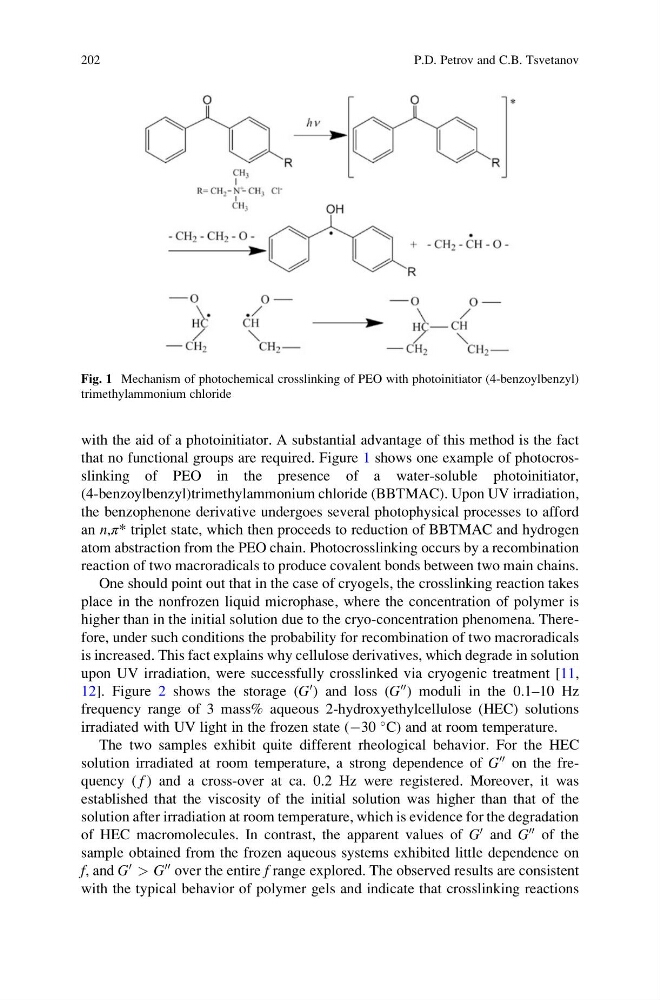
that no functional groups are required. Figure 1 shows one example of photocrosslinking of PEO in the presence of a water-soluble photoinitiator,
(4-benzoylbenzyl)trimethylammonium chloride (BBTMAC). Upon UV irradiation,
the benzophenone derivative undergoes several photophysical processes to afford
an n,π* triplet state, which then proceeds to reduction of BBTMAC and hydrogen
atom abstraction from the PEO chain. Photocrosslinking occurs by a recombination
reaction of two macroradicals to produce covalent bonds between two main chains.
One should point out that in the case of cryogels, the crosslinking reaction takes
place in the nonfrozen liquid microphase, where the concentration of polymer is
higher than in the initial solution due to the cryo-concentration phenomena. Therefore, under such conditions the probability for recombination of two macroradicals
is increased. This fact explains why cellulose derivatives, which degrade in solution
upon UV irradiation, were successfully crosslinked via cryogenic treatment [11,
12]. Figure 2 shows the storage (G
0 ) and loss (G
00 ) moduli in the 0.1–10 Hz
frequency range of 3 mass% aqueous 2-hydroxyethylcellulose (HEC) solutions
irradiated with UV light in the frozen state (À30
C) and at room temperature.
The two samples exhibit quite different rheological behavior. For the HEC
solution irradiated at room temperature, a strong dependence of G
00 on the frequency ( f ) and a cross-over at ca. 0.2 Hz were registered. Moreover, it was
established that the viscosity of the initial solution was higher than that of the
solution after irradiation at room temperature, which is evidence for the degradation
of HEC macromolecules. In contrast, the apparent values of G
0 and G
00 of the
sample obtained from the frozen aqueous systems exhibited little dependence on
f, and G
0
> G
00 over the entire f range explored. The observed results are consistent
with the typical behavior of polymer gels and indicate that crosslinking reactions
Fig. 1 Mechanism of photochemical crosslinking of PEO with photoinitiator (4-benzoylbenzyl)
trimethylammonium chloride
202
P.D. Petrov and C.B. Tsvetanov
that no functional groups are required. Figure 1 shows one example of photocrosslinking of PEO in the presence of a water-soluble photoinitiator,
(4-benzoylbenzyl)trimethylammonium chloride (BBTMAC). Upon UV irradiation,
the benzophenone derivative undergoes several photophysical processes to afford
an n,π* triplet state, which then proceeds to reduction of BBTMAC and hydrogen
atom abstraction from the PEO chain. Photocrosslinking occurs by a recombination
reaction of two macroradicals to produce covalent bonds between two main chains.
One should point out that in the case of cryogels, the crosslinking reaction takes
place in the nonfrozen liquid microphase, where the concentration of polymer is
higher than in the initial solution due to the cryo-concentration phenomena. Therefore, under such conditions the probability for recombination of two macroradicals
is increased. This fact explains why cellulose derivatives, which degrade in solution
upon UV irradiation, were successfully crosslinked via cryogenic treatment [11,
12]. Figure 2 shows the storage (G
0 ) and loss (G
00 ) moduli in the 0.1–10 Hz
frequency range of 3 mass% aqueous 2-hydroxyethylcellulose (HEC) solutions
irradiated with UV light in the frozen state (À30
C) and at room temperature.
The two samples exhibit quite different rheological behavior. For the HEC
solution irradiated at room temperature, a strong dependence of G
00 on the frequency ( f ) and a cross-over at ca. 0.2 Hz were registered. Moreover, it was
established that the viscosity of the initial solution was higher than that of the
solution after irradiation at room temperature, which is evidence for the degradation
of HEC macromolecules. In contrast, the apparent values of G
0 and G
00 of the
sample obtained from the frozen aqueous systems exhibited little dependence on
f, and G
0
> G
00 over the entire f range explored. The observed results are consistent
with the typical behavior of polymer gels and indicate that crosslinking reactions
Fig. 1 Mechanism of photochemical crosslinking of PEO with photoinitiator (4-benzoylbenzyl)
trimethylammonium chloride
202
P.D. Petrov and C.B. Tsvetanov