

equilibrium [17, 25]. This means that, although gels are often quite long-living with
respect to the lifetime of an experiment, they are usually in a metastable state [17,
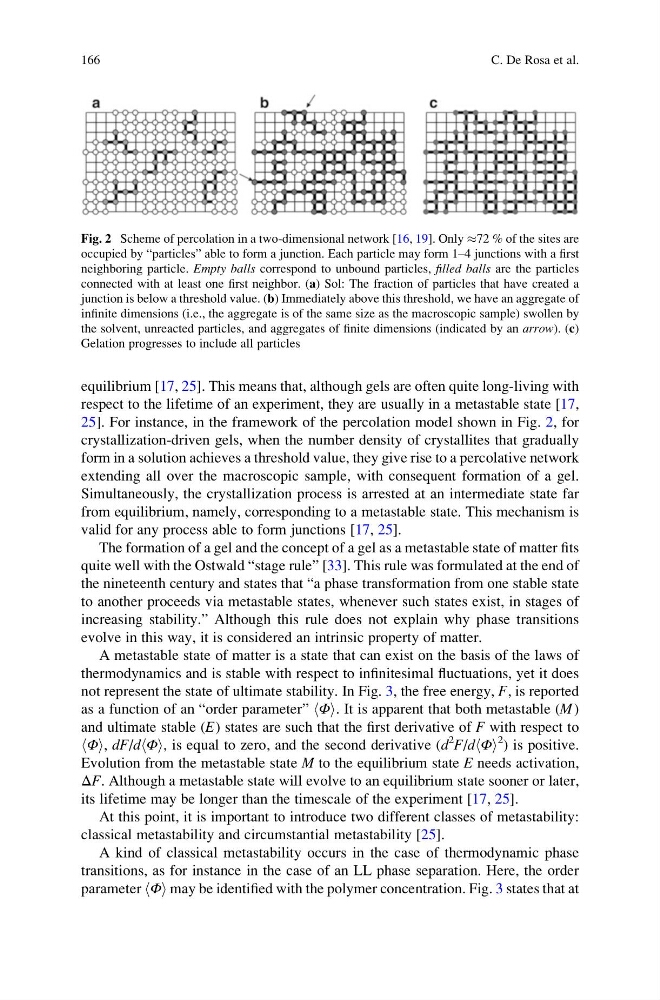
25]. For instance, in the framework of the percolation model shown in Fig. 2, for
crystallization-driven gels, when the number density of crystallites that gradually
form in a solution achieves a threshold value, they give rise to a percolative network
extending all over the macroscopic sample, with consequent formation of a gel.
Simultaneously, the crystallization process is arrested at an intermediate state far
from equilibrium, namely, corresponding to a metastable state. This mechanism is
valid for any process able to form junctions [17, 25].
The formation of a gel and the concept of a gel as a metastable state of matter fits
quite well with the Ostwald “stage rule” [33]. This rule was formulated at the end of
the nineteenth century and states that “a phase transformation from one stable state
to another proceeds via metastable states, whenever such states exist, in stages of
increasing stability.” Although this rule does not explain why phase transitions
evolve in this way, it is considered an intrinsic property of matter.
A metastable state of matter is a state that can exist on the basis of the laws of
thermodynamics and is stable with respect to infinitesimal fluctuations, yet it does
not represent the state of ultimate stability. In Fig. 3, the free energy, F, is reported
as a function of an “order parameter” hΦi. It is apparent that both metastable (M )
and ultimate stable (E) states are such that the first derivative of F with respect to
hΦi, dF/dhΦi, is equal to zero, and the second derivative (d
2 F/dhΦi
2 ) is positive.
Evolution from the metastable state M to the equilibrium state E needs activation,
ΔF. Although a metastable state will evolve to an equilibrium state sooner or later,
its lifetime may be longer than the timescale of the experiment [17, 25].
At this point, it is important to introduce two different classes of metastability:
classical metastability and circumstantial metastability [25].
A kind of classical metastability occurs in the case of thermodynamic phase
transitions, as for instance in the case of an LL phase separation. Here, the order
parameter hΦi may be identified with the polymer concentration. Fig. 3 states that at
Fig. 2 Scheme of percolation in a two-dimensional network [16, 19]. Only %72 % of the sites are
occupied by “particles” able to form a junction. Each particle may form 1–4 junctions with a first
neighboring particle. Empty balls correspond to unbound particles, filled balls are the particles
connected with at least one first neighbor. (a) Sol: The fraction of particles that have created a
junction is below a threshold value. (b) Immediately above this threshold, we have an aggregate of
infinite dimensions (i.e., the aggregate is of the same size as the macroscopic sample) swollen by
the solvent, unreacted particles, and aggregates of finite dimensions (indicated by an arrow). (c)
Gelation progresses to include all particles
166
C. De Rosa et al.
respect to the lifetime of an experiment, they are usually in a metastable state [17,
25]. For instance, in the framework of the percolation model shown in Fig. 2, for
crystallization-driven gels, when the number density of crystallites that gradually
form in a solution achieves a threshold value, they give rise to a percolative network
extending all over the macroscopic sample, with consequent formation of a gel.
Simultaneously, the crystallization process is arrested at an intermediate state far
from equilibrium, namely, corresponding to a metastable state. This mechanism is
valid for any process able to form junctions [17, 25].
The formation of a gel and the concept of a gel as a metastable state of matter fits
quite well with the Ostwald “stage rule” [33]. This rule was formulated at the end of
the nineteenth century and states that “a phase transformation from one stable state
to another proceeds via metastable states, whenever such states exist, in stages of
increasing stability.” Although this rule does not explain why phase transitions
evolve in this way, it is considered an intrinsic property of matter.
A metastable state of matter is a state that can exist on the basis of the laws of
thermodynamics and is stable with respect to infinitesimal fluctuations, yet it does
not represent the state of ultimate stability. In Fig. 3, the free energy, F, is reported
as a function of an “order parameter” hΦi. It is apparent that both metastable (M )
and ultimate stable (E) states are such that the first derivative of F with respect to
hΦi, dF/dhΦi, is equal to zero, and the second derivative (d
2 F/dhΦi
2 ) is positive.
Evolution from the metastable state M to the equilibrium state E needs activation,
ΔF. Although a metastable state will evolve to an equilibrium state sooner or later,
its lifetime may be longer than the timescale of the experiment [17, 25].
At this point, it is important to introduce two different classes of metastability:
classical metastability and circumstantial metastability [25].
A kind of classical metastability occurs in the case of thermodynamic phase
transitions, as for instance in the case of an LL phase separation. Here, the order
parameter hΦi may be identified with the polymer concentration. Fig. 3 states that at
Fig. 2 Scheme of percolation in a two-dimensional network [16, 19]. Only %72 % of the sites are
occupied by “particles” able to form a junction. Each particle may form 1–4 junctions with a first
neighboring particle. Empty balls correspond to unbound particles, filled balls are the particles
connected with at least one first neighbor. (a) Sol: The fraction of particles that have created a
junction is below a threshold value. (b) Immediately above this threshold, we have an aggregate of
infinite dimensions (i.e., the aggregate is of the same size as the macroscopic sample) swollen by
the solvent, unreacted particles, and aggregates of finite dimensions (indicated by an arrow). (c)
Gelation progresses to include all particles
166
C. De Rosa et al.