

by small fringed micelle-like crystals or chain-folded lamellae, while the connectivity is ensured by portions of chains connecting the crystallites throughout the
macroscopic samples, swollen by the solvent.
Finally, gels may be also generated through a liquid–liquid (LL) phase separation, or a combination of LL phase separation and crystallization, as we shall see in
Sect. 2.2 [17, 25].
Regardless of the kind of process, gelation involves complex mechanisms and
the gradual formation of junctions [16, 19]. As long as these junctions form
aggregates of small dimensions, the system is still a sol (Fig. 2a). Gel is formed
when the concentration of junctions reaches a threshold value, so that at least a
single aggregate having infinite size is created, that is, aggregates having the same
size as the macroscopic sample (Fig. 2b). Above this threshold value some sol
(aggregates of finite size, indicated with an arrow in Fig. 2b) may still survive, and
these aggregates end up connected to the gel only in the later stages of the process.
This is in essence the (site) percolation model [16, 19].
2.2 Metastability and Sol–Gel Transitions
In order to better understand the mechanism of formation of a 3D network, and then
a gel, via a gradual crosslinking (both physical and chemical) process according to
the percolative scheme shown in Fig. 2, we need to emphasize that, regardless of the
processes involved in the creation of junctions, these processes compete with
gelation [16, 17, 25]. As a result of this competition, the process is arrested at an
intermediate level instead of proceeding to completion, so that the system does not
attain the ultimate thermodynamically stable state, but reaches a state far from
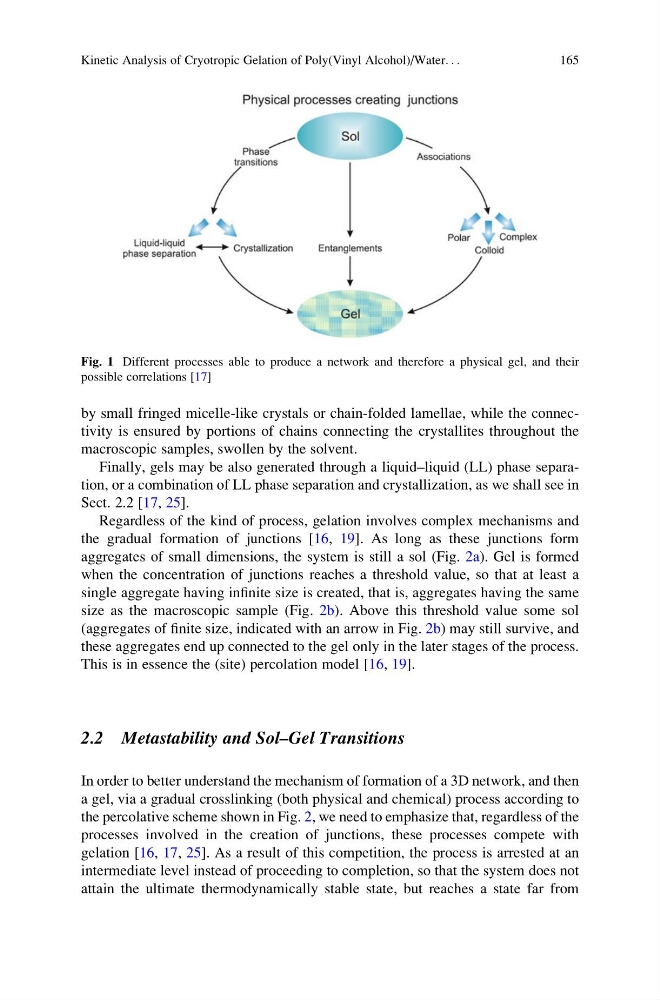
Fig. 1 Different processes able to produce a network and therefore a physical gel, and their
possible correlations [17]
Kinetic Analysis of Cryotropic Gelation of Poly(Vinyl Alcohol)/Water. . .
165
macroscopic samples, swollen by the solvent.
Finally, gels may be also generated through a liquid–liquid (LL) phase separation, or a combination of LL phase separation and crystallization, as we shall see in
Sect. 2.2 [17, 25].
Regardless of the kind of process, gelation involves complex mechanisms and
the gradual formation of junctions [16, 19]. As long as these junctions form
aggregates of small dimensions, the system is still a sol (Fig. 2a). Gel is formed
when the concentration of junctions reaches a threshold value, so that at least a
single aggregate having infinite size is created, that is, aggregates having the same
size as the macroscopic sample (Fig. 2b). Above this threshold value some sol
(aggregates of finite size, indicated with an arrow in Fig. 2b) may still survive, and
these aggregates end up connected to the gel only in the later stages of the process.
This is in essence the (site) percolation model [16, 19].
2.2 Metastability and Sol–Gel Transitions
In order to better understand the mechanism of formation of a 3D network, and then
a gel, via a gradual crosslinking (both physical and chemical) process according to
the percolative scheme shown in Fig. 2, we need to emphasize that, regardless of the
processes involved in the creation of junctions, these processes compete with
gelation [16, 17, 25]. As a result of this competition, the process is arrested at an
intermediate level instead of proceeding to completion, so that the system does not
attain the ultimate thermodynamically stable state, but reaches a state far from
Fig. 1 Different processes able to produce a network and therefore a physical gel, and their
possible correlations [17]
Kinetic Analysis of Cryotropic Gelation of Poly(Vinyl Alcohol)/Water. . .
165