

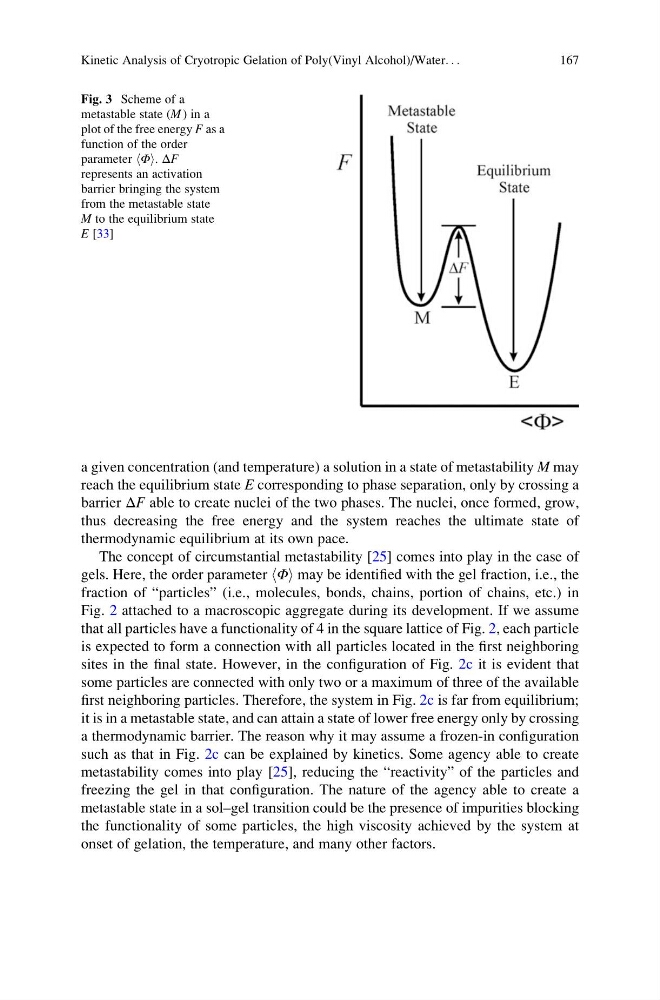
a given concentration (and temperature) a solution in a state of metastability M may
reach the equilibrium state E corresponding to phase separation, only by crossing a
barrier ΔF able to create nuclei of the two phases. The nuclei, once formed, grow,
thus decreasing the free energy and the system reaches the ultimate state of
thermodynamic equilibrium at its own pace.
The concept of circumstantial metastability [25] comes into play in the case of
gels. Here, the order parameter hΦi may be identified with the gel fraction, i.e., the
fraction of “particles” (i.e., molecules, bonds, chains, portion of chains, etc.) in
Fig. 2 attached to a macroscopic aggregate during its development. If we assume
that all particles have a functionality of 4 in the square lattice of Fig. 2, each particle
is expected to form a connection with all particles located in the first neighboring
sites in the final state. However, in the configuration of Fig. 2c it is evident that
some particles are connected with only two or a maximum of three of the available
first neighboring particles. Therefore, the system in Fig. 2c is far from equilibrium;
it is in a metastable state, and can attain a state of lower free energy only by crossing
a thermodynamic barrier. The reason why it may assume a frozen-in configuration
such as that in Fig. 2c can be explained by kinetics. Some agency able to create
metastability comes into play [25], reducing the “reactivity” of the particles and
freezing the gel in that configuration. The nature of the agency able to create a
metastable state in a sol–gel transition could be the presence of impurities blocking
the functionality of some particles, the high viscosity achieved by the system at
onset of gelation, the temperature, and many other factors.
Fig. 3 Scheme of a
metastable state (M ) in a
plot of the free energy F as a
function of the order
parameter hΦi. ΔF
represents an activation
barrier bringing the system
from the metastable state
M to the equilibrium state
E [33]
Kinetic Analysis of Cryotropic Gelation of Poly(Vinyl Alcohol)/Water. . .
167
reach the equilibrium state E corresponding to phase separation, only by crossing a
barrier ΔF able to create nuclei of the two phases. The nuclei, once formed, grow,
thus decreasing the free energy and the system reaches the ultimate state of
thermodynamic equilibrium at its own pace.
The concept of circumstantial metastability [25] comes into play in the case of
gels. Here, the order parameter hΦi may be identified with the gel fraction, i.e., the
fraction of “particles” (i.e., molecules, bonds, chains, portion of chains, etc.) in
Fig. 2 attached to a macroscopic aggregate during its development. If we assume
that all particles have a functionality of 4 in the square lattice of Fig. 2, each particle
is expected to form a connection with all particles located in the first neighboring
sites in the final state. However, in the configuration of Fig. 2c it is evident that
some particles are connected with only two or a maximum of three of the available
first neighboring particles. Therefore, the system in Fig. 2c is far from equilibrium;
it is in a metastable state, and can attain a state of lower free energy only by crossing
a thermodynamic barrier. The reason why it may assume a frozen-in configuration
such as that in Fig. 2c can be explained by kinetics. Some agency able to create
metastability comes into play [25], reducing the “reactivity” of the particles and
freezing the gel in that configuration. The nature of the agency able to create a
metastable state in a sol–gel transition could be the presence of impurities blocking
the functionality of some particles, the high viscosity achieved by the system at
onset of gelation, the temperature, and many other factors.
Fig. 3 Scheme of a
metastable state (M ) in a
plot of the free energy F as a
function of the order
parameter hΦi. ΔF
represents an activation
barrier bringing the system
from the metastable state
M to the equilibrium state
E [33]
Kinetic Analysis of Cryotropic Gelation of Poly(Vinyl Alcohol)/Water. . .
167