

and outside the gel rises, which creates additional osmotic pressure that expands the
gel. The opposite behavior occurs at low pH, which induces deswelling of the gel
sample. However, the extent of volume change in the pH oscillating reaction is
much smaller than that observed in swelling–deswelling experiments, as shown in
Fig. 20. This is due to the high salt concentration in oscillating reaction systems,
which partially screens the charge interactions within the cryogel.
The results thus show that PAAc cryogels produce periodic swelling–deswelling
oscillations in the bromate oscillation system. As the response rate of cryogels does
not depend on their size, much larger cryogel samples can also be used in selfoscillating systems. This suggests that, like the back-and-forth motion of a piston of
a heat engine, a pH-responsive cryogel could be used as a working substance to
convert random molecular energy into macroscopic mechanical energy of lower
entropy.
Time / min
0 30 60 90 120 150 180
pH
4
5
6
7
Time / min
0 30 60 90 120 150 180
pH
3
4
5
6
7
b
c
d
a
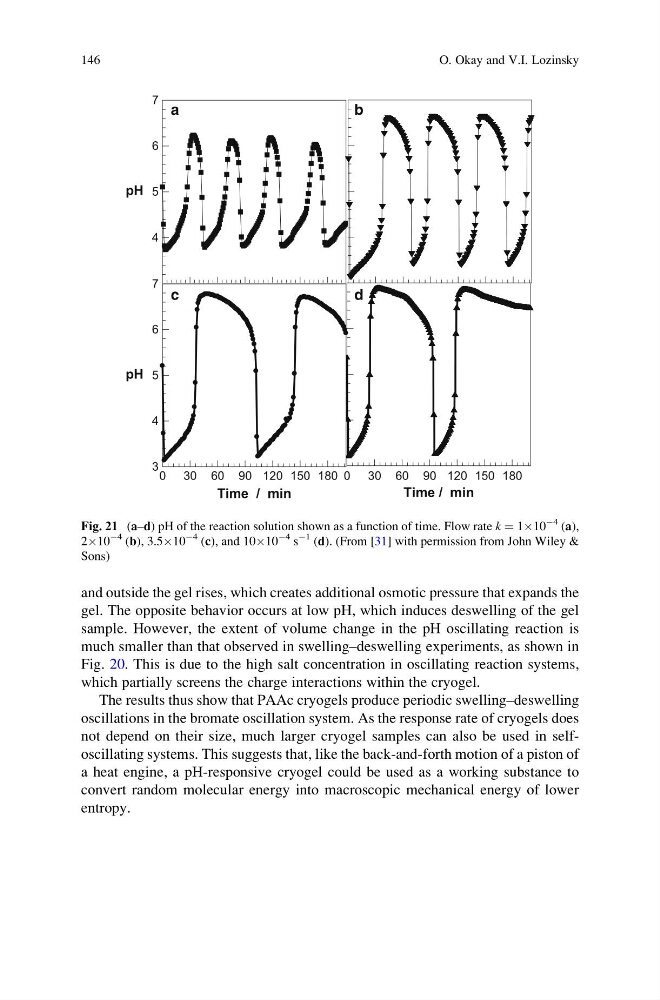
Fig. 21 (a–d) pH of the reaction solution shown as a function of time. Flow rate k ¼ 1Â10
À4 (a),
2Â10
À4 (b), 3.5Â10
À4 (c), and 10Â10
À4 s
À1 (d). (From [31] with permission from John Wiley &
Sons)
146
O. Okay and V.I. Lozinsky
gel. The opposite behavior occurs at low pH, which induces deswelling of the gel
sample. However, the extent of volume change in the pH oscillating reaction is
much smaller than that observed in swelling–deswelling experiments, as shown in
Fig. 20. This is due to the high salt concentration in oscillating reaction systems,
which partially screens the charge interactions within the cryogel.
The results thus show that PAAc cryogels produce periodic swelling–deswelling
oscillations in the bromate oscillation system. As the response rate of cryogels does
not depend on their size, much larger cryogel samples can also be used in selfoscillating systems. This suggests that, like the back-and-forth motion of a piston of
a heat engine, a pH-responsive cryogel could be used as a working substance to
convert random molecular energy into macroscopic mechanical energy of lower
entropy.
Time / min
0 30 60 90 120 150 180
pH
4
5
6
7
Time / min
0 30 60 90 120 150 180
pH
3
4
5
6
7
b
c
d
a
Fig. 21 (a–d) pH of the reaction solution shown as a function of time. Flow rate k ¼ 1Â10
À4 (a),
2Â10
À4 (b), 3.5Â10
À4 (c), and 10Â10
À4 s
À1 (d). (From [31] with permission from John Wiley &
Sons)
146
O. Okay and V.I. Lozinsky