

5.4 Rubber Cryogels as Reusable Oil Sorbents
Accidents involving oil tankers can result in the release of large volumes of crude
oil, and this risk significantly increases along narrow seaways with heavy maritime
traffic. Removal of crude oil and petroleum products that are spilled at sea has been
a serious problem in recent decades [158]. Among existing techniques for the
removal of oil, the use of sorbents is generally considered to be one of the most
efficient techniques [159, 160]. The properties of an ideal sorbent material for oil
spill cleanup include hydrophobicity, high uptake capacity and high rate of uptake,
buoyancy, reusability or biodegradability, and recoverability of oil. Although
several materials have been proposed as sorbents for oil removal, polymeric
materials based on nonwoven polypropylene are the most commonly used commercial sorbents in oil spill cleanup [161–165]. However, commercial oil sorbents
are not reusable, meaning that they form a solid waste after the cleanup procedures.
The reusability of the sorbents and the recoverability of the crude oil are
important aspects of oil spill cleanup procedures. Because cryogels are squeezable
gels and the liquid in the cryogels can simply be recovered via manual hand
compression, hydrophobic cryogels are good candidates as oil sorbents for oil
spill removal. The most suitable polymeric precursor for the preparation of cryogels
as sorbent for crude oil can be estimated using the solubility parameters. According
to the Hildebrand theory [166], the solvating (swelling) power of a polymer–solvent
medium can be estimated from (δ 1 Àδ 2 )
2 , where δ 1 and δ 2 are the solubility
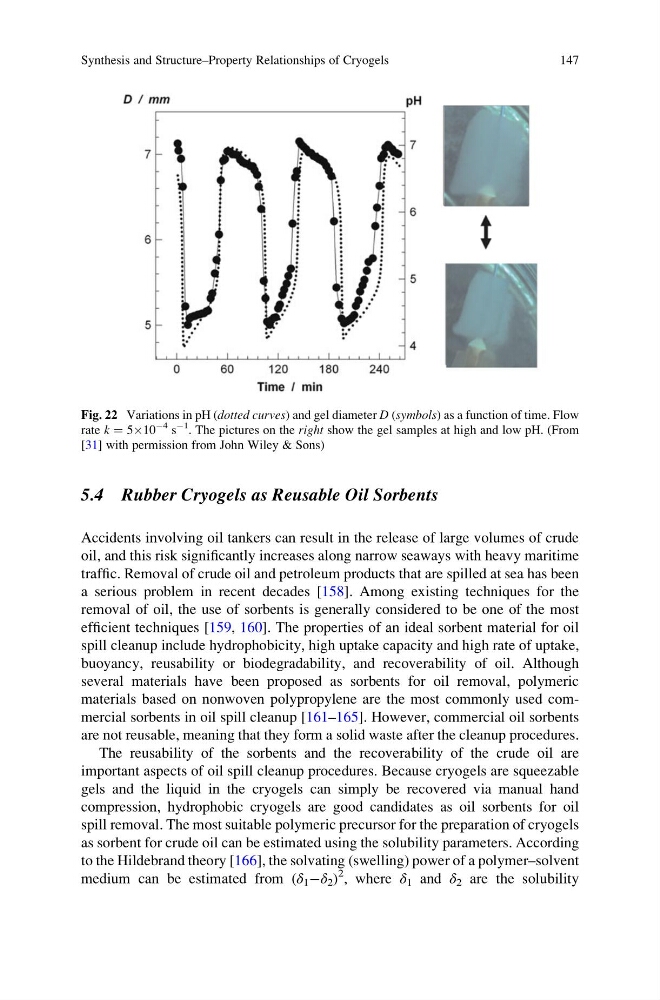
Fig. 22 Variations in pH (dotted curves) and gel diameter D (symbols) as a function of time. Flow
rate k ¼ 5Â10
À4 s
À1
. The pictures on the right show the gel samples at high and low pH. (From
[31] with permission from John Wiley & Sons)
Synthesis and Structure–Property Relationships of Cryogels
147
Accidents involving oil tankers can result in the release of large volumes of crude
oil, and this risk significantly increases along narrow seaways with heavy maritime
traffic. Removal of crude oil and petroleum products that are spilled at sea has been
a serious problem in recent decades [158]. Among existing techniques for the
removal of oil, the use of sorbents is generally considered to be one of the most
efficient techniques [159, 160]. The properties of an ideal sorbent material for oil
spill cleanup include hydrophobicity, high uptake capacity and high rate of uptake,
buoyancy, reusability or biodegradability, and recoverability of oil. Although
several materials have been proposed as sorbents for oil removal, polymeric
materials based on nonwoven polypropylene are the most commonly used commercial sorbents in oil spill cleanup [161–165]. However, commercial oil sorbents
are not reusable, meaning that they form a solid waste after the cleanup procedures.
The reusability of the sorbents and the recoverability of the crude oil are
important aspects of oil spill cleanup procedures. Because cryogels are squeezable
gels and the liquid in the cryogels can simply be recovered via manual hand
compression, hydrophobic cryogels are good candidates as oil sorbents for oil
spill removal. The most suitable polymeric precursor for the preparation of cryogels
as sorbent for crude oil can be estimated using the solubility parameters. According
to the Hildebrand theory [166], the solvating (swelling) power of a polymer–solvent
medium can be estimated from (δ 1 Àδ 2 )
2 , where δ 1 and δ 2 are the solubility
Fig. 22 Variations in pH (dotted curves) and gel diameter D (symbols) as a function of time. Flow
rate k ¼ 5Â10
À4 s
À1
. The pictures on the right show the gel samples at high and low pH. (From
[31] with permission from John Wiley & Sons)
Synthesis and Structure–Property Relationships of Cryogels
147