

pH ¼ pK a þ log
α
1 À α
ð12Þ
Using pK a ¼ 4.25, as reported for PAAc gels [157], one may calculate the
dissociation degree α as 0.15 and 0.99 for pH values of 3.5 and 6.5, respectively.
Thus, if PAAc gel is immersed into this solution, the concentration of the mobile
ions (Na
+ ) inside the gel will change sevenfold during these pH oscillations.
Figure 21 also shows that the larger the flow rate k, the larger the extent of
oscillation. Furthermore, increasing flow rate also increases the time period at
high and low pH values. For example, at k ¼ 1Â10
À4 and 1Â10
À3 s
À1 , the pH of
the solution remains above pH 6 for 25 and 75 min in each cycle, respectively. The
results in Fig. 21 also demonstrate that the oscillation proceeds monotonically with
fixed values of the maximum and minimum pH.
Figure 22 demonstrates the behavior of PAAc cryogels in this pH oscillating
system. Here, the pH and the gel diameter D are plotted as a function of time at a
flow rate k ¼ 5Â10
À4 s
À1 . Gel samples of 5 mm in diameter and about 1 cm in
length (approximately 1 cm
3 ) were used in the experiments. Images of the gel
samples were taken every minute using an image analyzing system, while the pH of
the solution was also monitored by PC. The images in Fig. 22 were taken from the
gel sample in swollen and collapsed states. It is seen that, depending on the pH
oscillations, the diameter of the gel sample periodically varies between 7 and 5 mm,
indicating a threefold change in the gel volume.
At high pH, the concentration of the mobile ions inside the PAAc cryogel
increases (12) so that the difference between the mobile ion concentration inside
Deswelling time / min
0
1
2
3
4
5
D / mm
4
6
8
Swelling time / min
0
1
2
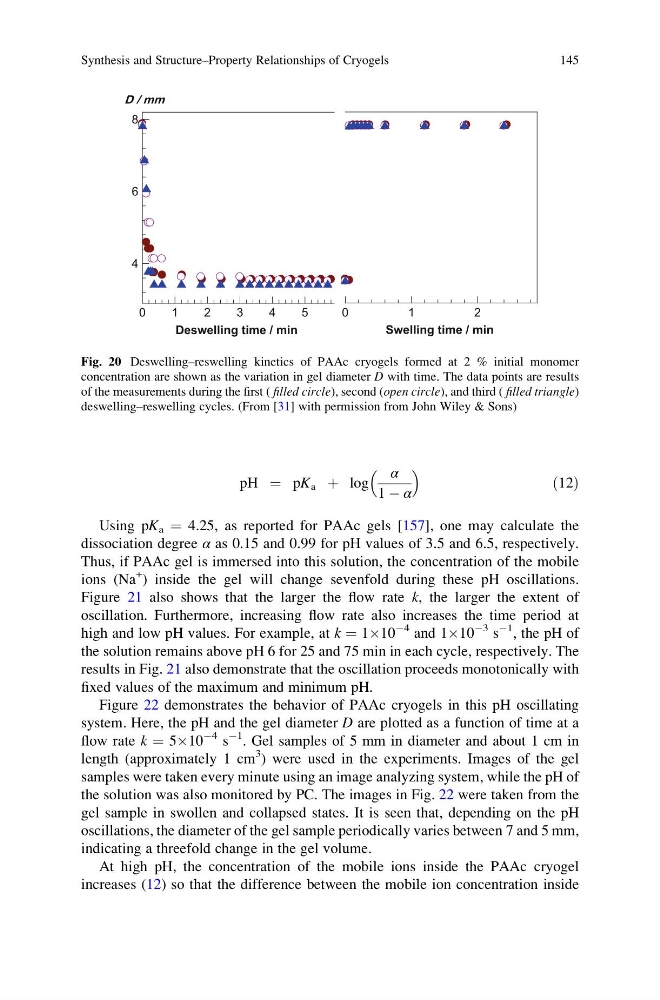
Fig. 20 Deswelling–reswelling kinetics of PAAc cryogels formed at 2 % initial monomer
concentration are shown as the variation in gel diameter D with time. The data points are results
of the measurements during the first ( filled circle), second (open circle), and third ( filled triangle)
deswelling–reswelling cycles. (From [31] with permission from John Wiley & Sons)
Synthesis and Structure–Property Relationships of Cryogels
145
α
1 À α
ð12Þ
Using pK a ¼ 4.25, as reported for PAAc gels [157], one may calculate the
dissociation degree α as 0.15 and 0.99 for pH values of 3.5 and 6.5, respectively.
Thus, if PAAc gel is immersed into this solution, the concentration of the mobile
ions (Na
+ ) inside the gel will change sevenfold during these pH oscillations.
Figure 21 also shows that the larger the flow rate k, the larger the extent of
oscillation. Furthermore, increasing flow rate also increases the time period at
high and low pH values. For example, at k ¼ 1Â10
À4 and 1Â10
À3 s
À1 , the pH of
the solution remains above pH 6 for 25 and 75 min in each cycle, respectively. The
results in Fig. 21 also demonstrate that the oscillation proceeds monotonically with
fixed values of the maximum and minimum pH.
Figure 22 demonstrates the behavior of PAAc cryogels in this pH oscillating
system. Here, the pH and the gel diameter D are plotted as a function of time at a
flow rate k ¼ 5Â10
À4 s
À1 . Gel samples of 5 mm in diameter and about 1 cm in
length (approximately 1 cm
3 ) were used in the experiments. Images of the gel
samples were taken every minute using an image analyzing system, while the pH of
the solution was also monitored by PC. The images in Fig. 22 were taken from the
gel sample in swollen and collapsed states. It is seen that, depending on the pH
oscillations, the diameter of the gel sample periodically varies between 7 and 5 mm,
indicating a threefold change in the gel volume.
At high pH, the concentration of the mobile ions inside the PAAc cryogel
increases (12) so that the difference between the mobile ion concentration inside
Deswelling time / min
0
1
2
3
4
5
D / mm
4
6
8
Swelling time / min
0
1
2
Fig. 20 Deswelling–reswelling kinetics of PAAc cryogels formed at 2 % initial monomer
concentration are shown as the variation in gel diameter D with time. The data points are results
of the measurements during the first ( filled circle), second (open circle), and third ( filled triangle)
deswelling–reswelling cycles. (From [31] with permission from John Wiley & Sons)
Synthesis and Structure–Property Relationships of Cryogels
145