

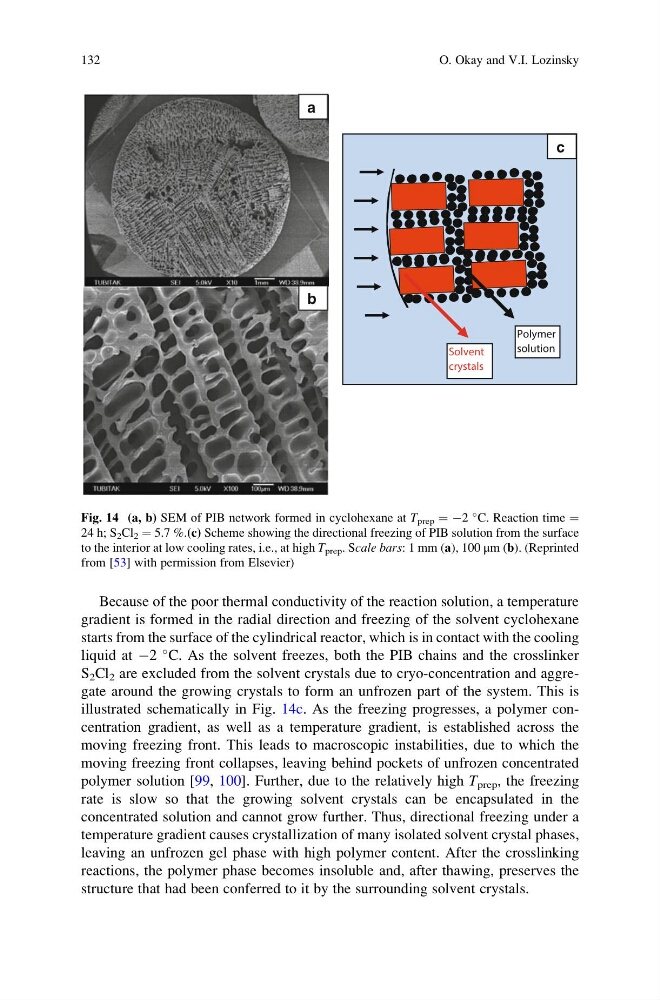
Because of the poor thermal conductivity of the reaction solution, a temperature
gradient is formed in the radial direction and freezing of the solvent cyclohexane
starts from the surface of the cylindrical reactor, which is in contact with the cooling
liquid at À2
C. As the solvent freezes, both the PIB chains and the crosslinker
S 2 Cl 2 are excluded from the solvent crystals due to cryo-concentration and aggregate around the growing crystals to form an unfrozen part of the system. This is
illustrated schematically in Fig. 14c. As the freezing progresses, a polymer concentration gradient, as well as a temperature gradient, is established across the
moving freezing front. This leads to macroscopic instabilities, due to which the
moving freezing front collapses, leaving behind pockets of unfrozen concentrated
polymer solution [99, 100]. Further, due to the relatively high T prep , the freezing
rate is slow so that the growing solvent crystals can be encapsulated in the
concentrated solution and cannot grow further. Thus, directional freezing under a
temperature gradient causes crystallization of many isolated solvent crystal phases,
leaving an unfrozen gel phase with high polymer content. After the crosslinking
reactions, the polymer phase becomes insoluble and, after thawing, preserves the
structure that had been conferred to it by the surrounding solvent crystals.
Solvent
crystals
Polymer
solution
a
b
c
Fig. 14 (a, b) SEM of PIB network formed in cyclohexane at T prep ¼ À2
C. Reaction time ¼
24 h; S 2 Cl 2 ¼ 5.7 %.(c) Scheme showing the directional freezing of PIB solution from the surface
to the interior at low cooling rates, i.e., at high T prep . Scale bars: 1 mm (a), 100 μm (b). (Reprinted
from [53] with permission from Elsevier)
132
O. Okay and V.I. Lozinsky
gradient is formed in the radial direction and freezing of the solvent cyclohexane
starts from the surface of the cylindrical reactor, which is in contact with the cooling
liquid at À2
C. As the solvent freezes, both the PIB chains and the crosslinker
S 2 Cl 2 are excluded from the solvent crystals due to cryo-concentration and aggregate around the growing crystals to form an unfrozen part of the system. This is
illustrated schematically in Fig. 14c. As the freezing progresses, a polymer concentration gradient, as well as a temperature gradient, is established across the
moving freezing front. This leads to macroscopic instabilities, due to which the
moving freezing front collapses, leaving behind pockets of unfrozen concentrated
polymer solution [99, 100]. Further, due to the relatively high T prep , the freezing
rate is slow so that the growing solvent crystals can be encapsulated in the
concentrated solution and cannot grow further. Thus, directional freezing under a
temperature gradient causes crystallization of many isolated solvent crystal phases,
leaving an unfrozen gel phase with high polymer content. After the crosslinking
reactions, the polymer phase becomes insoluble and, after thawing, preserves the
structure that had been conferred to it by the surrounding solvent crystals.
Solvent
crystals
Polymer
solution
a
b
c
Fig. 14 (a, b) SEM of PIB network formed in cyclohexane at T prep ¼ À2
C. Reaction time ¼
24 h; S 2 Cl 2 ¼ 5.7 %.(c) Scheme showing the directional freezing of PIB solution from the surface
to the interior at low cooling rates, i.e., at high T prep . Scale bars: 1 mm (a), 100 μm (b). (Reprinted
from [53] with permission from Elsevier)
132
O. Okay and V.I. Lozinsky