

of the cryogels due to the very fast polymerization that occurs before the freezing of
the reaction solution. A similar effect of the initiator was also observed in the
preparation of PAAm cryogels [25].
The preparation of aligned porous materials with micrometer-sized pores is of
particular importance for applications such as tissue engineering, microfluidics, and
organic electronics [99, 100]. It was shown that cryogels with an aligned pore
structure could be prepared at low freezing rates (i.e., at temperatures close to the
transition temperature to the cryogelation regime) or at low polymerization rates
(i.e., at a low monomer concentration) [53, 101]. Another requirement is that the
solvent used in the reactions should be a solvating diluent for the polymer so that no
phase separation takes place during cooling of the gelation solution. For example,
during the solution crosslinking of 5 % PIB in cyclohexane, cryogels start to form at
or above À2
C [53]. Moreover, the cyclohexane–PIB system did not show
significant temperature effect and, thus, any liquid–liquid phase separation could
be prevented during the cryogelation reactions of PIB. SEM images of dried
cryogels formed at temperatures T prep close to this upper temperature limit showed
an oriented porous structure of the materials [53]. The micrographs in Fig. 14a,b
show the alignment of the pores in the gel network formed at T prep ¼ À2
C. The
structure consists of brick-shaped pores of about 100 μm in length and 50 μm in
width, separated by pore walls of 10–20 μm in thickness. The aligned porous
structure of the sample indicates directional freezing of the solvent crystals in the
direction from the surface to the interior, i.e., in the direction of the temperature
gradient. Note that experiments carried out by decreasing the reactor diameter from
16.4 to 3.7 mm partially destroyed the regularity of the pore structure, probably due
to the increasing rate of freezing of the reaction solution. Decreasing the temperature or increasing the cooling rate also destroyed the regularity of the porous
structure of the network. The pores of 10–100 μm in size formed at À2
C became
increasingly irregular as T prep decreased [53].
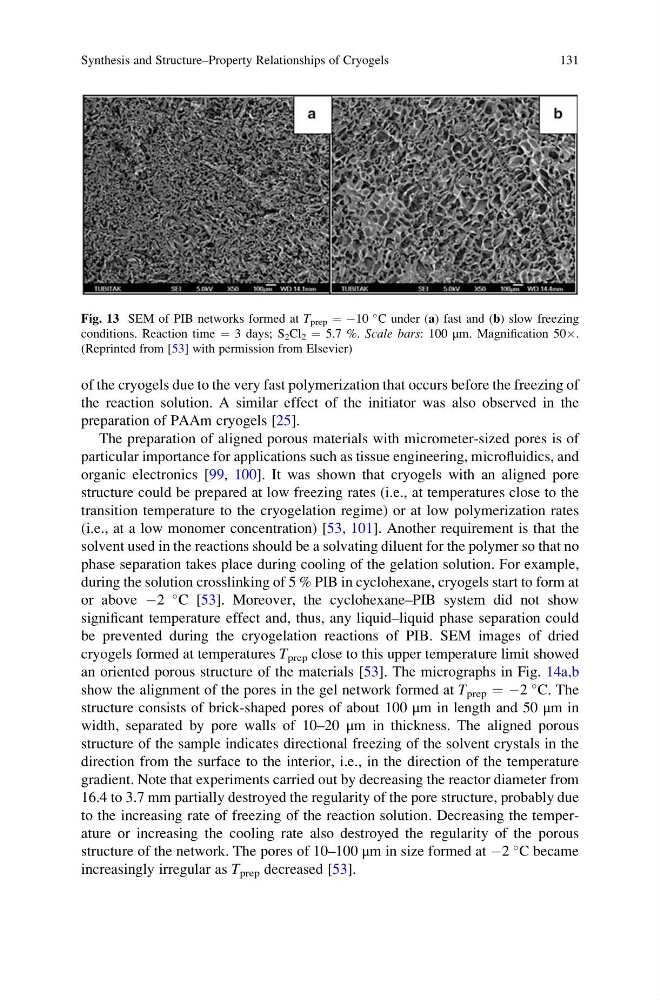
Fig. 13 SEM of PIB networks formed at T prep ¼ À10
C under (a) fast and (b) slow freezing
conditions. Reaction time ¼ 3 days; S 2 Cl 2 ¼ 5.7 %. Scale bars: 100 μm. Magnification 50Â.
(Reprinted from [53] with permission from Elsevier)
Synthesis and Structure–Property Relationships of Cryogels
131
the reaction solution. A similar effect of the initiator was also observed in the
preparation of PAAm cryogels [25].
The preparation of aligned porous materials with micrometer-sized pores is of
particular importance for applications such as tissue engineering, microfluidics, and
organic electronics [99, 100]. It was shown that cryogels with an aligned pore
structure could be prepared at low freezing rates (i.e., at temperatures close to the
transition temperature to the cryogelation regime) or at low polymerization rates
(i.e., at a low monomer concentration) [53, 101]. Another requirement is that the
solvent used in the reactions should be a solvating diluent for the polymer so that no
phase separation takes place during cooling of the gelation solution. For example,
during the solution crosslinking of 5 % PIB in cyclohexane, cryogels start to form at
or above À2
C [53]. Moreover, the cyclohexane–PIB system did not show
significant temperature effect and, thus, any liquid–liquid phase separation could
be prevented during the cryogelation reactions of PIB. SEM images of dried
cryogels formed at temperatures T prep close to this upper temperature limit showed
an oriented porous structure of the materials [53]. The micrographs in Fig. 14a,b
show the alignment of the pores in the gel network formed at T prep ¼ À2
C. The
structure consists of brick-shaped pores of about 100 μm in length and 50 μm in
width, separated by pore walls of 10–20 μm in thickness. The aligned porous
structure of the sample indicates directional freezing of the solvent crystals in the
direction from the surface to the interior, i.e., in the direction of the temperature
gradient. Note that experiments carried out by decreasing the reactor diameter from
16.4 to 3.7 mm partially destroyed the regularity of the pore structure, probably due
to the increasing rate of freezing of the reaction solution. Decreasing the temperature or increasing the cooling rate also destroyed the regularity of the porous
structure of the network. The pores of 10–100 μm in size formed at À2
C became
increasingly irregular as T prep decreased [53].
Fig. 13 SEM of PIB networks formed at T prep ¼ À10
C under (a) fast and (b) slow freezing
conditions. Reaction time ¼ 3 days; S 2 Cl 2 ¼ 5.7 %. Scale bars: 100 μm. Magnification 50Â.
(Reprinted from [53] with permission from Elsevier)
Synthesis and Structure–Property Relationships of Cryogels
131