

The formation of polyhedral pores in hydrophilic cryogels may be explained as
follows [97, 98]: Water molecules in crosslinked hydrophilic polymers are known
to exist in three states: (1) free water in the middle of the mesh of the network,
(2) bound water adjacent to the network chains, and (3) film water adsorbed on the
bound water layer. Freezing of free water and the growth of ice crystals thus formed
may lead to deformation of the polymer network by stretching the hydrated network
chains around the ice crystals. Although the polymer elasticity allows easy deformation of the network chains, the high viscosity of the system may slow down
growth of the crystals. As a consequence, one may expect formation of ice crystals
in the mesh of polymer network separated by swollen polymer chains. Moreover,
the total surface energy of ice crystals is minimized by the crystals coming together,
forming four ice crystals in contact, with angles of 120
o where the forces of
interfacial tension balance.
Experiments were also designed to study the effects of freezing rate on the
morphology of the cryogels. For this purpose, one part of the reaction solution was
slowly frozen in a freezer in contact with air, while the other part was fast frozen in
a cryostat in contact with a liquid. The initial cooling rate decreased from 54 to
4
C/min as the cooling liquid was replaced with cooling air at À18
C [53].
Figure 13 shows SEM images of the PIB gel network prepared in cyclohexane at
T prep ¼ À10
C under fast and slow freezing conditions [53]. It is seen that the size
of the pores increases as the freezing rate decreases. Increasing the freezing rate of
the reaction solution necessarily reduces the time available for solvent crystals to
grow, which would inhibit the formation of large crystals. Thus, small solvent
crystals form under fast freezing conditions, which leads to small pores after
thawing. Further, increasing the freezing rate shortens the duration of the initial
non-isothermal period of the reactions so that the crosslinking mainly occurs in the
unfrozen microzones of the apparently frozen reaction system. This may also
decrease the size of the pores.
A similar effect of the freezing rate of the gelation solution can be observed by
changing the initiator concentration. During the preparation of PSA cryogels in
aqueous solutions and using a APS/TEMED redox initiator system, increasing the
APS concentration from 1.75 to 3.5 mm decreased the average pore size of the
cryogels [95]. This is due to the faster rate of polymerization, which leads to smaller
ice crystals. However, further increase in APS concentration decreases the porosity
-5
o C
-10
o C
-22
o C
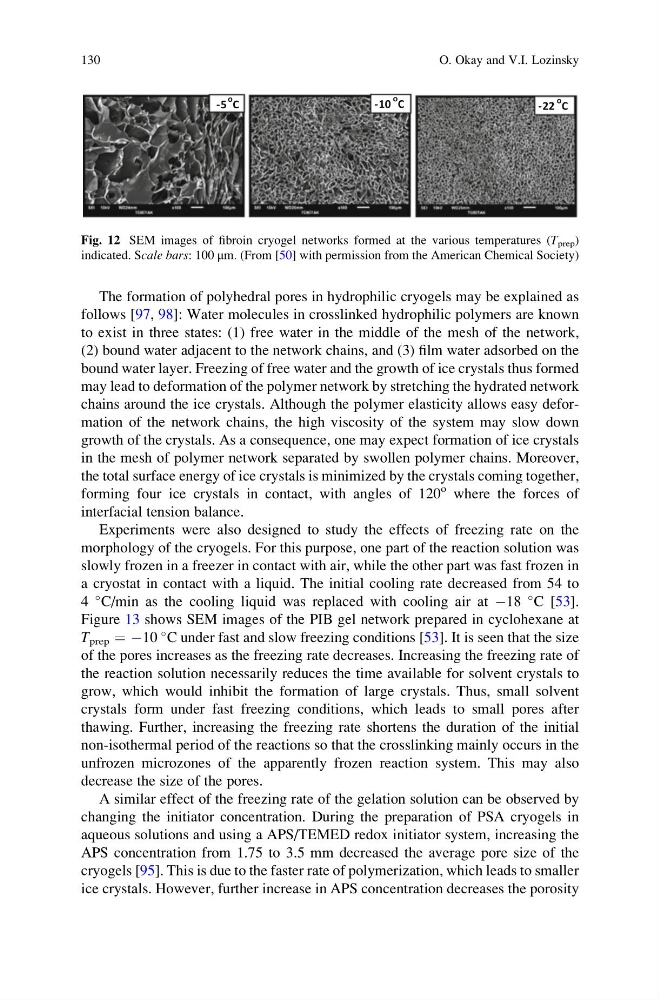
Fig. 12 SEM images of fibroin cryogel networks formed at the various temperatures (T prep )
indicated. Scale bars: 100 μm. (From [50] with permission from the American Chemical Society)
130
O. Okay and V.I. Lozinsky
follows [97, 98]: Water molecules in crosslinked hydrophilic polymers are known
to exist in three states: (1) free water in the middle of the mesh of the network,
(2) bound water adjacent to the network chains, and (3) film water adsorbed on the
bound water layer. Freezing of free water and the growth of ice crystals thus formed
may lead to deformation of the polymer network by stretching the hydrated network
chains around the ice crystals. Although the polymer elasticity allows easy deformation of the network chains, the high viscosity of the system may slow down
growth of the crystals. As a consequence, one may expect formation of ice crystals
in the mesh of polymer network separated by swollen polymer chains. Moreover,
the total surface energy of ice crystals is minimized by the crystals coming together,
forming four ice crystals in contact, with angles of 120
o where the forces of
interfacial tension balance.
Experiments were also designed to study the effects of freezing rate on the
morphology of the cryogels. For this purpose, one part of the reaction solution was
slowly frozen in a freezer in contact with air, while the other part was fast frozen in
a cryostat in contact with a liquid. The initial cooling rate decreased from 54 to
4
C/min as the cooling liquid was replaced with cooling air at À18
C [53].
Figure 13 shows SEM images of the PIB gel network prepared in cyclohexane at
T prep ¼ À10
C under fast and slow freezing conditions [53]. It is seen that the size
of the pores increases as the freezing rate decreases. Increasing the freezing rate of
the reaction solution necessarily reduces the time available for solvent crystals to
grow, which would inhibit the formation of large crystals. Thus, small solvent
crystals form under fast freezing conditions, which leads to small pores after
thawing. Further, increasing the freezing rate shortens the duration of the initial
non-isothermal period of the reactions so that the crosslinking mainly occurs in the
unfrozen microzones of the apparently frozen reaction system. This may also
decrease the size of the pores.
A similar effect of the freezing rate of the gelation solution can be observed by
changing the initiator concentration. During the preparation of PSA cryogels in
aqueous solutions and using a APS/TEMED redox initiator system, increasing the
APS concentration from 1.75 to 3.5 mm decreased the average pore size of the
cryogels [95]. This is due to the faster rate of polymerization, which leads to smaller
ice crystals. However, further increase in APS concentration decreases the porosity
-5
o C
-10
o C
-22
o C
Fig. 12 SEM images of fibroin cryogel networks formed at the various temperatures (T prep )
indicated. Scale bars: 100 μm. (From [50] with permission from the American Chemical Society)
130
O. Okay and V.I. Lozinsky